Updated: October 2026. Facts in this article were checked against FIFA and several major news outlets. FIFA Live Updates is an independent website and is not affiliated with FIFA.
🔑 Key Takeaways
- 🏆 Spain won the FIFA World Cup 2026, defeating Argentina 1–0 after extra time.
- ⚽ Ferran Torres scored the winning goal in the 106th minute of the final.
- 📅 The World Cup final took place on 19 July 2026 at New York New Jersey Stadium.
- 🥇 Kylian Mbappé won the Golden Boot after scoring 10 goals.
- 🌟 Rodri received the Golden Ball Award as the tournament’s best player.
- 🧤 Unai Simón won the Golden Glove Award after recording seven clean sheets.
- 🥉 England finished third after defeating France 6–4 in the bronze medal match.
- 🌎 The tournament featured 48 teams, 104 matches and three host countries: Canada, Mexico and the United States.
🏆 Who Won the FIFA World Cup 2026?
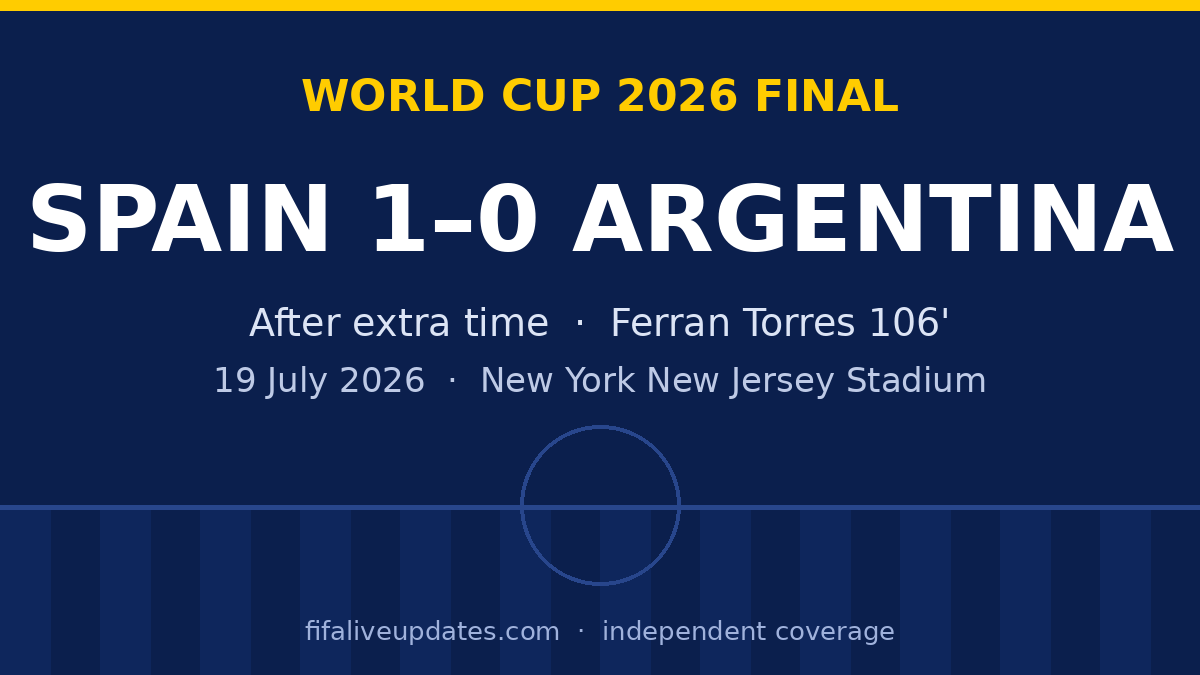
Spain won the FIFA World Cup 2026 after defeating Argentina 1–0 in a dramatic final that went into extra time. The match was played on 19 July 2026 at New York New Jersey Stadium in the United States.
The victory gave Spain its second men’s FIFA World Cup title, following the country’s first triumph in 2010. It was a major achievement for the Spanish national team, which combined attacking quality, strong midfield control and an outstanding defensive performance throughout the competition.
Argentina entered the final as the defending world champions after winning the 2022 World Cup in Qatar. The team hoped to secure another title, but Spain proved difficult to break down and created more opportunities during the match.
The final remained goalless throughout normal time. Spain continued to put pressure on Argentina in extra time, and substitute Ferran Torres eventually scored the decisive goal.
Final result: Spain 1–0 Argentina after extra time.
This victory placed Spain among the nations that have won the men’s World Cup more than once. It also completed a memorable tournament for a team that conceded only one goal across its eight matches.
Read more about the final on the official FIFA website.
⚽ Spain vs Argentina: World Cup 2026 Final Result
The final brought together two of international football’s strongest national teams. Spain relied on possession, movement and coordinated attacks, while Argentina looked to defend carefully and create opportunities through its experienced players.
Here is a summary of the final match.
| Match detail | Result |
|---|---|
| Tournament | FIFA World Cup 2026 |
| Match | Spain vs Argentina |
| Date | 19 July 2026 |
| Venue | New York New Jersey Stadium |
| Full-time score | 0–0 |
| Final score after extra time | Spain 1–0 Argentina |
| Winning goal | Ferran Torres, 106th minute |
| World Cup winner | Spain |
🔥 How Did Spain Win the Final?
Spain started the final with confidence and tried to control the game through possession. Lamine Yamal was involved in Spain’s early attacking play, while goalkeeper Emiliano Martínez made important saves to keep Argentina in the match.
Despite Spain’s pressure, Argentina defended with determination. Spain continued to search for an opening but could not score during the first 90 minutes.
The match became even more difficult for Argentina when Enzo Fernández received a second yellow card late in normal time, leaving his team with ten players.
During extra time, Spain continued to attack. In the 106th minute, Nico Williams helped create the decisive opportunity by directing Pedro Porro’s cross into the path of Ferran Torres. Torres finished the chance and put Spain ahead.
Argentina tried to respond, but Spain held on to secure the trophy.
🌟 Why Was the Winning Goal Important?
Ferran Torres’s goal was the defining moment of the final. Scoring in extra time meant Spain had to remain patient for more than 100 minutes before finally breaking Argentina’s defence.
The goal also demonstrated the importance of squad depth. A substitute made the difference when the match was still undecided, showing how players coming off the bench can influence the biggest games in football.
For Spain, the result was not only about scoring one goal. It was the reward for a tournament built around teamwork, disciplined defending and consistent performances.
🥇 FIFA World Cup 2026 Top Scorers
The race for the Golden Boot was one of the tournament’s major individual storylines. Several international stars scored important goals, but France forward Kylian Mbappé finished at the top of the scoring chart.
Mbappé scored 10 goals in eight matches, earning the Golden Boot for the second consecutive men’s World Cup. Lionel Messi finished second with eight goals, while England’s Jude Bellingham scored seven.
⚽ Top Goal Scorers Table
| Rank | Player | Country | Goals |
|---|---|---|---|
| 1 | Kylian Mbappé | France | 10 |
| 2 | Lionel Messi | Argentina | 8 |
| 3 | Jude Bellingham | England | 7 |
| 4 | Erling Haaland | Norway | 7 |
| 5 | Ousmane Dembélé | France | 6 |
| 6 | Harry Kane | England | 6 |
| 7 | Mikel Oyarzabal | Spain | 5 |
The table lists the leading scorers at the end of the tournament.
🥇 Kylian Mbappé: Golden Boot Winner
Kylian Mbappé was the leading scorer of the 2026 World Cup, finishing with ten goals. His performances helped France reach the semi-finals before the team lost to Spain.
Mbappé continued scoring in the bronze medal match against England, where he added two goals despite France’s 6–4 defeat. His final tally secured the Golden Boot and made him one of the most talked-about players of the tournament.
Winning the Golden Boot is a significant achievement because it recognises the player who scores the most goals during the competition. It also highlights a player’s ability to deliver across several matches rather than in one standout performance.
🇦🇷 Lionel Messi’s Impressive Tournament
Lionel Messi finished the competition with eight goals for Argentina. His contribution helped the defending champions reach the final, where they eventually lost to Spain.
Messi’s performance remained a major talking point because of his experience, creativity and influence on Argentina’s attacking play. Although Argentina did not retain the trophy, Messi finished as the tournament’s second-highest scorer.
🏴 Jude Bellingham and Other Leading Scorers
England’s Jude Bellingham scored seven goals, sharing that total with Norway’s Erling Haaland. Both players demonstrated how midfielders and forwards can make a major impact in a tournament.
France’s Ousmane Dembélé and England’s Harry Kane each finished with six goals. Spain’s Mikel Oyarzabal also appeared among the leading scorers, ending the tournament with five goals.
For the complete scoring table, visit FIFA’s official Golden Boot report.
🌟 FIFA World Cup 2026 Individual Award Winners
The World Cup recognises outstanding performances through several individual awards. These honours celebrate players who excel in areas such as overall performance, goalkeeping, scoring and youth development.
Spain’s title-winning campaign was reflected in several awards, while Mbappé’s goals earned him one of the competition’s biggest individual prizes.
🏅 Complete Award Winners
| Award | Winner | Country |
|---|---|---|
| Golden Ball | Rodri | Spain |
| Silver Ball | Lionel Messi | Argentina |
| Bronze Ball | Kylian Mbappé | France |
| Golden Boot | Kylian Mbappé | France |
| Silver Boot | Lionel Messi | Argentina |
| Bronze Boot | Jude Bellingham | England |
| Golden Glove | Unai Simón | Spain |
| Best Young Player | Pau Cubarsí | Spain |
| Fair Play Trophy | Netherlands | Netherlands |
🌟 Rodri Wins the Golden Ball
Rodri received the Golden Ball Award, which recognises the best player of the tournament. His performances in midfield were central to Spain’s success across eight matches.
A midfielder’s contribution is not measured only by goals and assists. Players in this position help control possession, support defensive transitions, distribute the ball and create opportunities for teammates.
Rodri’s influence helped Spain maintain control during important moments. His award recognised the consistency and quality he brought to the team throughout the competition.
🧤 Unai Simón Wins the Golden Glove
Spain goalkeeper Unai Simón won the Golden Glove Award after recording seven clean sheets in eight matches.
A clean sheet means a team does not concede a goal during a match. Achieving seven clean sheets at a World Cup reflects excellent goalkeeping, organised defending and effective teamwork.
Spain conceded just one goal during the entire tournament. Simón’s performances were an important part of that achievement, including in the final against Argentina.
🌱 Pau Cubarsí Wins Best Young Player
Pau Cubarsí received the FIFA Best Young Player Award. The Spanish defender played an important role in a defence that allowed very few goals throughout the competition.
Young players face significant pressure when representing their countries on the international stage. Performing consistently at a World Cup can help establish their reputations and provide valuable experience for future tournaments.
Cubarsí’s award highlighted his contribution to Spain’s successful campaign.
🤝 Netherlands Receive the Fair Play Trophy
The Netherlands won the FIFA Fair Play Trophy. This award recognises sportsmanship and fair conduct during the competition.
Football is highly competitive, but respect for opponents, match officials and the rules remains an important part of the game. The Fair Play Trophy highlights that football achievements are not limited to results and individual statistics.
🥉 Final Standings: Which Teams Finished on the Podium?
Spain finished first, Argentina second and England third. France placed fourth after losing the bronze medal match.
These results reflect the teams’ final positions in the tournament and the performances that carried them through the knockout stages.
| Position | Team | Result or achievement |
|---|---|---|
| 1st | Spain | World champions |
| 2nd | Argentina | Lost the final 1–0 after extra time |
| 3rd | England | Defeated France 6–4 |
| 4th | France | Lost the bronze medal match |
🥈 Argentina Finish as Runners-Up
Argentina reached the final after an impressive campaign, but the team could not overcome Spain. The final was a difficult conclusion for the defending champions, who had hoped to win the World Cup for a second consecutive time.
Although Argentina lost the final, reaching the last match of a World Cup remains a significant achievement. The team demonstrated its ability to compete against the strongest opponents and advanced through several challenging knockout fixtures.
🥉 England Beat France in a 6–4 Thriller
England secured third place by defeating France 6–4 in the bronze medal match. The high-scoring contest was one of the most entertaining matches of the tournament’s final stage.
Bukayo Saka scored a hat-trick for England, while France’s Mbappé scored twice. The result gave England its best World Cup finish since winning the tournament in 1966.
France finished fourth after reaching the semi-finals. Despite missing out on the final, the French team produced strong attacking performances, and Mbappé’s ten goals earned him the Golden Boot.
🌎 The Three Host Countries of the FIFA World Cup 2026
The 2026 World Cup was hosted by Canada, Mexico and the United States. It was a historic edition because the competition expanded to 48 teams and featured 104 matches.
Hosting duties across three countries allowed the tournament to use stadiums and football facilities in different regions of North America. The competition included 16 host cities and brought together national teams from around the world.
The expanded format gave more nations the opportunity to participate. It also created a longer tournament with more matches for supporters to follow.
🇨🇦 Canada
Canada was one of the three host nations. Hosting World Cup matches provided an opportunity to showcase Canadian football facilities and welcome international supporters.
The tournament also gave local fans a chance to experience the atmosphere of a major global football competition in their own country.
🇲🇽 Mexico
Mexico continued its long relationship with the men’s World Cup by serving as a host nation in 2026. Its football culture and experienced stadium infrastructure made it an important part of the event.
Hosting matches also connected the tournament with a country where football has a passionate following.
🇺🇸 United States
The United States hosted matches across multiple cities, including the final at New York New Jersey Stadium. The country’s large stadiums and transport networks supported the scale of the expanded tournament.
The final brought the competition to a close with Spain’s extra-time victory over Argentina.
📊 FIFA World Cup 2026: Important Tournament Statistics
The 2026 World Cup produced major milestones in the history of international football. Its expanded format, number of matches and individual performances made it a landmark edition.
Here are some of the key tournament figures:
| Statistic | Tournament figure |
|---|---|
| Participating teams | 48 |
| Total matches | 104 |
| Goals scored | 308 |
| Average goals per match | 2.96 |
| Spain’s matches | 8 |
| Spain’s goals scored | 14 |
| Goals conceded by Spain | 1 |
| Unai Simón’s clean sheets | 7 |
| Mbappé’s goals | 10 |
Spain’s defensive record was particularly impressive. The team conceded only one goal in eight matches, while goalkeeper Unai Simón recorded seven clean sheets.
The tournament’s 308 goals produced an average of 2.96 goals per match. These figures demonstrate the amount of attacking action across the competition while highlighting the defensive consistency that helped Spain win the trophy.
For football fans, tournament statistics provide another way to compare teams and players beyond the final score. Goals, clean sheets and match results help explain why certain teams progressed further than others.
❓ Frequently Asked Questions About the FIFA World Cup 2026
1. Who won the FIFA World Cup 2026?
Spain won the FIFA World Cup 2026, defeating Argentina 1–0 after extra time in the final on 19 July 2026.
2. What was the final score of Spain vs Argentina?
Spain defeated Argentina 1–0 after extra time. Ferran Torres scored the winning goal in the 106th minute.
3. Who scored the winning goal in the World Cup final?
Spain forward Ferran Torres scored the decisive goal in extra time to give Spain the trophy.
4. Who won the Golden Boot at the 2026 World Cup?
France forward Kylian Mbappé won the Golden Boot after scoring ten goals during the tournament.
5. Who won the Golden Ball Award?
Spain midfielder Rodri won the Golden Ball Award as the best player of the tournament.
6. Who won the Golden Glove Award?
Spain goalkeeper Unai Simón won the Golden Glove after recording seven clean sheets in eight matches.
7. Which team finished third in the 2026 World Cup?
England finished third after defeating France 6–4 in the bronze medal match.
8. How many teams played in the 2026 World Cup?
The tournament featured 48 national teams and 104 matches.
9. Which countries hosted the 2026 World Cup?
The host countries were Canada, Mexico and the United States.
10. How many goals did Lionel Messi score?
Lionel Messi scored eight goals, finishing second behind Mbappé in the tournament’s scoring standings.
✅ Final Thoughts
The FIFA World Cup 2026 delivered a memorable conclusion as Spain defeated Argentina 1–0 after extra time to become world champions for the second time. Ferran Torres scored the decisive goal, while Rodri, Unai Simón and Pau Cubarsí also received individual recognition for their performances.
Kylian Mbappé finished as the tournament’s leading scorer with ten goals, and England claimed third place after a thrilling 6–4 victory over France. Across 104 matches, the tournament brought together 48 teams and produced 308 goals.
Spain’s achievement was built on a combination of attacking quality, midfield control and exceptional defending. Conceding just one goal throughout the competition made the champions’ campaign particularly impressive.
For more football results, player statistics and tournament updates, visit FifaLiveUpdates.com.
Official sources: FIFA World Cup 2026 Final Report · Final Tournament Standings · Official Award Winners · Golden Boot and Top Scorers