Updated: November 2026. FIFA Live Updates is an independent fan website and is not affiliated with FIFA.
Extra time in soccer is an additional 30 minutes, played as two halves of up to 15 minutes each, when a knockout match is level at the end of normal time and the competition needs a winner. Both halves are played in full, so a goal does not end the game. If the scores are still level after extra time, the match usually goes to a penalty shootout.
This guide explains how extra time works under the IFAB Laws of the Game 2026/27, how it differs from added (stoppage) time, what the extra substitute rule says, and why the old golden goal and silver goal rules no longer apply.
Extra Time at a Glance
| Question | Answer |
|---|---|
| When is it played? | Only when a match is level and competition rules require a winner |
| How long is it? | Two equal periods, each no longer than 15 minutes (Law 10) |
| Break before extra time | Set by competition rules, not by a fixed number in the Laws |
| Break between the two halves | A short drinks break of up to one minute (Law 7) |
| Is there added time? | Yes. The referee can add time for stoppages in each half |
| Extra substitute? | Only if the competition rules allow it (Law 3) |
| Still level afterwards? | Usually a penalty shootout |
When Is Extra Time Played?
Knockout matches, not league games
Extra time is only used when a match has to produce a winner. League matches and most group-stage games can end in a draw, so they finish after 90 minutes plus added time. Knockout ties, such as the round of 32 onwards at the 2026 World Cup, cannot end level, so they may go to extra time.
Competition rules decide
Law 10 does not force every competition to use extra time. It lists the methods a competition may use to find a winner after a drawn match or a level two-legged tie: the away goals rule, two equal periods of extra time of no more than 15 minutes each, and kicks from the penalty mark. A competition can use one of these or a combination. The away goals rule is an option, not a universal rule, and many major competitions do not use it. Each tournament states its own method in its regulations.
How Long Is Extra Time in Soccer?
Two 15-minute halves
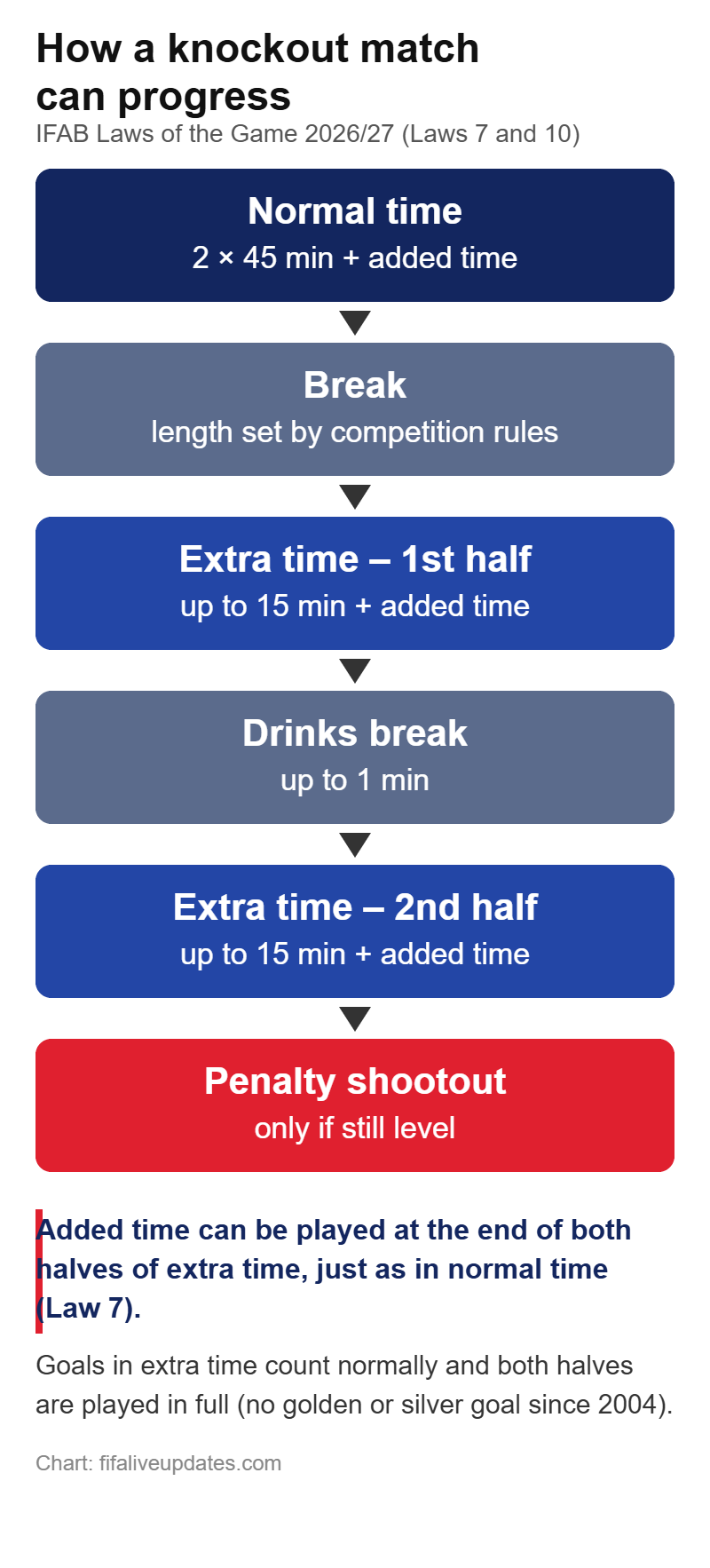
Under Law 10, extra time is two equal periods of no more than 15 minutes each, so 30 minutes in total. In professional football both periods are normally the full 15 minutes. The teams change ends for the second period, just as they do in normal time.
The break before extra time
The Laws of the Game do not set a fixed length for the break between the end of normal time and the start of extra time. That interval is decided by the competition rules.
The break between the two halves of extra time
Law 7 allows a short drinks break, which should not exceed one minute, at the half-time interval of extra time. This is much shorter than the normal half-time interval, which may not exceed 15 minutes.
Is there added time in extra time?
Yes. Law 7 says the referee makes an allowance “in each half” for playing time lost through substitutions, injuries, time-wasting, disciplinary sanctions, VAR checks, goal celebrations and other delays. In practice this applies to both halves of extra time as well, which is why goals are sometimes scored in added time at the end of an extra-time period. Greece’s winner against the Czech Republic at EURO 2004 came “in added time at the end of the first half of extra time”, according to UEFA. As in normal time, the fourth official shows the minimum added time, and the referee can increase it but not reduce it.
How long can a match last?
There is no single answer. A knockout match can include 90 minutes of normal time, added time in both halves, a break before extra time, 30 minutes of extra time with its own added time, and then a penalty shootout.
Extra Time vs Added (Stoppage) Time
These two terms are often confused, especially in the United States, where extra time is often called “overtime”. They are completely different.
| Added (stoppage) time | Extra time | |
|---|---|---|
| What it is | Time added to make up for stoppages | An extra 30-minute period after normal time |
| When it is used | At the end of every half, in every match | Only in matches that need a winner |
| How long | Decided by the referee; varies each half | Two periods of up to 15 minutes each |
| Who decides | The referee (minimum shown by the fourth official) | The competition rules |
| Law | Law 7 | Law 10 |
Added time can be long in the modern game, because VAR checks and goal celebrations also count as lost time. Our guide to the offside rule and VAR explains how video reviews work.
Extra Time Rules You Should Know
The extra substitute depends on the competition
Law 3 lets each competition decide whether a team may use one additional substitute when a match goes to extra time, even if it has already used its full number. Where this is allowed, teams also get one extra substitution opportunity. Teams can also use any substitutes or opportunities they have not used in normal time, and changes made in the break before extra time or at half-time of extra time do not count as one of their opportunities. Because these details are set by each competition, the exact numbers can differ between tournaments.
Goals count normally, and there is no sudden death
A goal in extra time counts exactly like a goal in normal time and is added to the score. The full 30 minutes are played even if a team takes the lead, so the trailing side always has time to reply. This has been the rule since 2004, when sudden-death methods were removed from the Laws.
What Happens if It Is Still Level After Extra Time?
If the score is still level after both halves of extra time, the winner is usually decided by kicks from the penalty mark, better known as a penalty shootout. Each team takes five kicks in turn, then continues one kick each until one side leads. The full rules, including who can take a kick and what happens if a goalkeeper is injured, are explained in our penalty shootout rules guide.
Golden Goal and Silver Goal: Rules That No Longer Apply
Note: neither of these rules is used today. They are part of football history, and current matches play the full 30 minutes of extra time.
Golden goal
Under the golden goal rule, the first team to score in extra time won the match immediately. Germany’s Oliver Bierhoff scored what UEFA describes as senior international football’s first golden goal, in the 95th minute of the EURO ’96 final, as Germany beat the Czech Republic 2–1. Four years later, France won the EURO 2000 final 2–1 against Italy with a golden goal from substitute David Trezeguet, according to UEFA.
Silver goal
The silver goal was a softer version. As UEFA explains, if one team was leading at the end of the first 15-minute period of extra time, it was declared the winner; if the score was level, a second 15-minute period was played, followed by penalties if needed. It was used at EURO 2004, where Traianos Dellas’s header in added time at the end of the first half of extra time sent Greece past the Czech Republic in the semi-final, according to UEFA.
When both rules ended
The International Football Association Board decided at its annual general meeting in London on 28 February 2004 to remove both methods, with full extra time and penalties taking their place, according to the Oceania Football Confederation. The new Laws came into force worldwide on 1 July 2004, which is why EURO 2004, already under way, kept the silver goal until the end of the tournament.
Extra Time at Recent World Cups
2022 final: Argentina 3–3 France
The 2022 final in Qatar is one of the most dramatic examples of extra time. Lionel Messi put Argentina 3–2 ahead in the 108th minute, and Kylian Mbappé equalised with a penalty in the 118th minute to complete his hat-trick, according to FIFA and Sky Sports. Argentina then won the shootout 4–2. Mbappé’s treble is one of only two in a World Cup final, as our list of World Cup hat-tricks shows.
2026 final: Spain 1–0 Argentina
The 2026 final at New York New Jersey Stadium was goalless after 90 minutes. Argentina’s Enzo Fernández was sent off for a second yellow card in stoppage time at the end of normal time, according to Sky Sports, and Ferran Torres scored the winner in the 106th minute, according to FIFA. Because extra time was played in full, Argentina still had the rest of the second period to reply, but Spain held on. Read the full story in our 2026 World Cup final report and the 2026 World Cup winner review.
Frequently Asked Questions
How long is extra time in soccer?
Extra time is 30 minutes, played as two halves of no more than 15 minutes each, plus any added time the referee allows for stoppages.
Is extra time sudden death?
No. Since 2004 both halves of extra time are played in full. The golden goal and silver goal rules, which could end a match early, are no longer used.
Is there stoppage time in extra time?
Yes. The referee can add time at the end of each half of extra time to make up for time lost to substitutions, injuries, VAR checks and other delays.
Do teams get an extra substitute in extra time?
Only if the competition rules allow it. Law 3 lets competitions permit one additional substitute and one extra substitution opportunity in extra time.
What is the difference between extra time and overtime?
They mean the same thing. “Extra time” is the official term in the Laws of the Game, while “overtime” is commonly used in the United States.
Sources
- IFAB – Law 7: The Duration of the Match
- IFAB Laws of the Game 2026/27 – Law 7 (published by The FA)
- IFAB Laws of the Game 2026/27 – Law 10: Determining the Outcome of a Match (The FA)
- IFAB Laws of the Game 2026/27 – Law 3: The Players (The FA)
- Oceania Football Confederation – IFAB ends golden goal and silver goal (2 July 2004)
- UEFA – Bierhoff the hero of Germany’s EURO ’96 final win
- UEFA – Trezeguet’s golden goal sinks Italy (EURO 2000 final report)
- UEFA – EURO 2004 format (silver goal explained)
- UEFA – Dellas delights Greece and stuns Czech Republic in EURO 2004 semi-final
- FIFA – Argentina v France, 2022 World Cup final (Greatest Games)
- Sky Sports – Argentina 3-3 France (2022 World Cup final) report
- FIFA – Spain 1-0 Argentina, 2026 World Cup final report
- Sky Sports – Spain 1-0 Argentina (aet), 2026 World Cup final