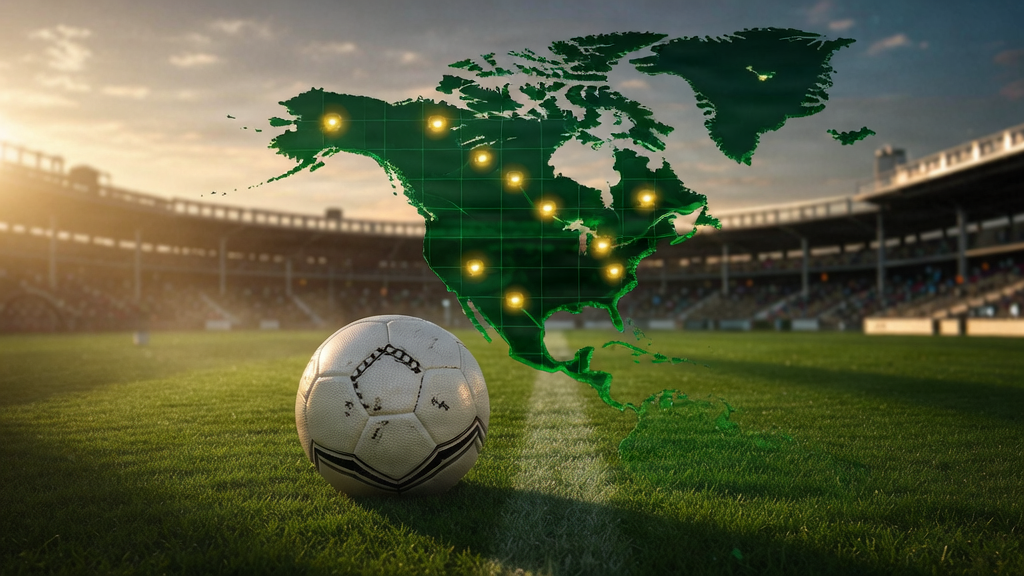
The FIFA World Cup 2026 brought a major change to international football with an expanded 48-team format and three host countries: Canada, Mexico and the United States. The tournament took place from June 11 to July 19, 2026, featuring 104 matches across 16 host cities.
For football fans, understanding the FIFA World Cup 2026 format helps explain how teams qualified for the knockout rounds and competed for the championship. In this guide, we cover the tournament format, group-stage rules, host countries and key facts about the competition.
If you follow international football, explore our latest FIFA World Cup 2026 updates for more tournament-related information.
What Made the FIFA World Cup 2026 Different?
The most significant change was the expansion from 32 teams to 48 teams. This gave more national teams the opportunity to compete in the world’s biggest men’s international football tournament.
The competition also introduced an additional knockout round. Instead of moving directly from the group stage to the Round of 16, qualifying teams entered the Round of 32.
Here are the key FIFA World Cup 2026 facts:
| Tournament Feature | Details |
|---|---|
| Host countries | Canada, Mexico and the United States |
| Participating teams | 48 |
| Number of groups | 12 |
| Teams per group | 4 |
| Total matches | 104 |
| Host cities | 16 |
| Opening date | June 11, 2026 |
| Final date | July 19, 2026 |
These changes made the tournament longer and increased the number of matches compared with previous 32-team editions.
For official tournament information, visit the FIFA World Cup 2026 official website.
How Did the FIFA World Cup 2026 Format Work?
The Group Stage
The 48 participating teams were divided into 12 groups, with four teams in each group. Every team played three group-stage matches.
The points system remained familiar to football fans:
- Win: 3 points
- Draw: 1 point
- Loss: 0 points
Teams were ranked according to the official competition rules. Their group positions determined which teams advanced to the knockout stage.
Fans looking for additional football coverage can visit FIFAliveUpdates.com for related tournament articles and updates.
Which Teams Advanced to the Round of 32?
The top two teams from each group advanced automatically. The eight best third-placed teams also qualified for the knockout stage.
This brought the total number of teams progressing from the group stage to 32.
The expanded format gave teams another opportunity to reach the knockout rounds, although every group-stage result remained important.
The Knockout Stage
The knockout stage consisted of the Round of 32, Round of 16, quarter-finals, semi-finals, the third-place match and the final.
Teams needed to win their knockout matches to continue in the competition. A defeat meant elimination.
The finalists played eight matches to reach the championship, one more than finalists in the previous 32-team format.
For confirmed match information, schedules and results, consult FIFA’s official tournament coverage.
2026 World Cup Key Dates and Match Count
The 104 matches were spread across 39 days. The table below shows how the schedule was divided between the stages and how many matches each round contained.
| Stage | Dates (2026) | Matches |
|---|---|---|
| Group stage | June 11 – June 27 | 72 |
| Round of 32 | June 28 – July 3 | 16 |
| Round of 16 | July 4 – July 7 | 8 |
| Quarter-finals | July 9 – July 11 | 4 |
| Semi-finals | July 14 – July 15 | 2 |
| Third-place match | July 18 | 1 |
| Final | July 19 | 1 |
The group stage alone contained 72 matches, more than the entire 64-match schedule of a 32-team World Cup. For more on the showpiece match itself, see our guide to the 2026 World Cup final date and venue.
How Were Group-Stage Ties Broken?
With 12 groups of four, teams finishing level on points was inevitable. For 2026, FIFA changed the order of the tiebreakers so that head-to-head results came first. At Qatar 2022, overall goal difference had been the first criterion after points.
According to the Associated Press summary of the competition rules, teams level on points in a group were separated in this order:
- Points won in the matches between the teams concerned (head-to-head)
- Goal difference in the matches between the teams concerned
- Goals scored in the matches between the teams concerned
- Overall goal difference in all group matches
- Overall goals scored in all group matches
- Fewest yellow and red cards received (including team officials)
- FIFA/Coca-Cola Men’s World Ranking
Ranking the Third-Placed Teams
Because third-placed teams came from different groups, head-to-head results could not be used to compare them. The eight best third-placed sides were ranked on points, then goal difference, then goals scored, then disciplinary record and, finally, the FIFA ranking.
The head-to-head rule had a visible effect. Some teams secured their places, or were eliminated, before the final round of group matches, while the third-place route kept many other groups alive until the last day.
Which Countries Hosted the FIFA World Cup 2026?
Canada, Mexico and the United States jointly hosted the men’s FIFA World Cup for the first time.
Canada
Canada hosted matches in Toronto and Vancouver. The tournament brought World Cup football to Canadian fans and added two Canadian cities to the competition’s host-city list.
Mexico
Mexico hosted matches in Mexico City, Guadalajara and Monterrey. Mexico City hosted the opening match on June 11, 2026.
United States
The United States hosted matches across 11 host cities. These included Los Angeles, Dallas, Miami, Seattle, Atlanta and the New York/New Jersey area.
The final was scheduled for July 19, 2026, at New York New Jersey Stadium, commonly associated with MetLife Stadium.
Together, the three countries hosted a tournament spread across North America.
The 16 Host Cities and Stadiums
The United States staged 78 of the 104 matches, with Canada and Mexico hosting the remainder. Most U.S. venues are large NFL stadiums, while Canada and Mexico used a mix of football grounds and multi-purpose arenas. During the tournament, FIFA generally referred to venues by city names, such as “Dallas Stadium” or “New York New Jersey Stadium”, rather than by their usual commercial names.
| Host city | Country | Stadium (usual name) |
|---|---|---|
| Toronto | Canada | BMO Field |
| Vancouver | Canada | BC Place |
| Mexico City | Mexico | Estadio Azteca |
| Guadalajara | Mexico | Estadio Akron |
| Monterrey | Mexico | Estadio BBVA |
| Atlanta | United States | Mercedes-Benz Stadium |
| Boston | United States | Gillette Stadium (Foxborough) |
| Dallas | United States | AT&T Stadium (Arlington) |
| Houston | United States | NRG Stadium |
| Kansas City | United States | Arrowhead Stadium |
| Los Angeles | United States | SoFi Stadium (Inglewood) |
| Miami | United States | Hard Rock Stadium (Miami Gardens) |
| New York New Jersey | United States | MetLife Stadium (East Rutherford) |
| Philadelphia | United States | Lincoln Financial Field |
| San Francisco Bay Area | United States | Levi’s Stadium (Santa Clara) |
| Seattle | United States | Lumen Field |
Estadio Azteca, which hosted the opening match, also made history. Having staged the finals of 1970 and 1986, it became the first stadium to host matches at three different men’s World Cups. Toronto and Vancouver, meanwhile, brought men’s World Cup matches to Canada for the first time.
Several U.S. stadiums are some distance from their city centres, which made match-day travel a major topic for visiting supporters. Our article on FIFA PASS, visa appointments and World Cup parking prices looks at the costs fans faced.
Why Did FIFA Expand the World Cup to 48 Teams?
The expansion created additional places for national teams from different football confederations. More countries could compete for a place in the final tournament, potentially introducing fans to new teams and international matchups.
The new format increased the number of matches from 64 to 104. It also added another knockout round, giving qualifying teams an additional challenge on their path to the final.
However, a larger competition requires careful planning for travel, scheduling, player recovery and stadium operations. Hosting matches across three countries also creates logistical challenges for teams and organizers.
Read the official FIFA World Cup 2026 tournament information for details about the competition structure and host arrangements.
How Did Teams Qualify for the 2026 World Cup?
The 48 places were shared among FIFA’s six confederations. Canada, Mexico and the United States qualified automatically as hosts, using three of CONCACAF’s places. The final two spots were decided by an intercontinental play-off tournament involving six teams from outside Europe.
Europe (UEFA) received the largest share with 16 places, and Oceania (OFC) was guaranteed a direct place for the first time. Our guide to how World Cup qualification works breaks the numbers down by confederation, and our CONCACAF and CAF qualification guide covers two of the regional campaigns in detail.
First-Time Qualifiers
The larger field opened the door to new nations. Four teams made their World Cup debut in 2026: Cape Verde, Curaçao, Jordan and Uzbekistan. Cape Verde were drawn against Spain and held the eventual champions to a goalless draw in their opening match.
How Did the 2026 World Cup Play Out?
After the group stage and the new Round of 32, the tournament built towards a final between two of the strongest teams of recent years: Spain, the European champions, and Argentina, the holders.
Quarter-Finals and Semi-Finals
| Round | Result |
|---|---|
| Quarter-final | France 2–0 Morocco |
| Quarter-final | Spain 2–1 Belgium |
| Quarter-final | England 2–1 Norway |
| Quarter-final | Argentina 3–1 Switzerland (after extra time) |
| Semi-final (July 14, Dallas) | Spain 2–0 France |
| Semi-final (July 15, Atlanta) | Argentina 2–1 England |
| Third-place match (July 18, Miami) | England 6–4 France |
| Final (July 19, New York New Jersey) | Spain 1–0 Argentina (after extra time) |
Both semi-finals were decided in normal time. In Arlington, Spain beat France 2–0 with goals from Mikel Oyarzabal, from the penalty spot, and Pedro Porro. A day later in Atlanta, Argentina came from behind to beat England 2–1 and reach a second successive World Cup final.
England and France then produced one of the most remarkable matches of the tournament in the third-place match at Hard Rock Stadium. England won 6–4, with Bukayo Saka scoring a hat-trick. The ten goals made it the highest-scoring third-place match in World Cup history and the highest-scoring World Cup match of any kind since Hungary beat El Salvador 10–1 in 1982.
The Final
The final at MetLife Stadium was goalless after 90 minutes. Argentina had Enzo Fernández sent off in stoppage time at the end of normal time, and Spain eventually broke through in the 106th minute when Ferran Torres scored. The win gave Spain their second World Cup, following 2010, and added to their Euro 2024 title. Sky Sports reported that Spain conceded only one goal in their eight matches and were never behind at any point in the tournament.
For a full account of the final, the awards and the road to the trophy, read our FIFA World Cup 2026 winner report.
Tournament Awards
- Champions: Spain
- Runners-up: Argentina
- Third place: England
- Best player: Rodri (Spain)
- Golden Boot: Kylian Mbappé (France), 10 goals
- Golden Glove: Unai Simón (Spain)
- Best young player: Pau Cubarsí (Spain)
What Records Were Set at the 2026 World Cup?
The bigger format inevitably produced bigger totals, but several figures stood out even after allowing for the extra matches. According to FIFA’s post-tournament figures:
- Attendance: 6,810,966 spectators attended the 104 matches, an all-time record and more than the 2018 and 2022 tournaments combined. The average crowd was 65,490.
- Goals: 308 goals were scored, compared with the previous record of 172 in 2022.
- Goals per match: the average of 2.96 was the highest since the 1970 tournament in Mexico.
- Fan Festivals: more than 9 million people attended FIFA Fan Festivals across the host cities.
Individual records fell too. Kylian Mbappé’s 10 goals took his career World Cup tally to 22, moving him past Lionel Messi (21) to become the competition’s all-time leading scorer. See our list of World Cup all-time top scorers and the full FIFA World Cup winners list for the wider history.
Did the 48-Team Format Work?
Before the tournament, the main concerns about expansion were the quality of the group stage, the risk of meaningless final-round matches and the extra load on players. The 2026 edition gave both supporters and critics something to point to.
- More nations, new stories: four debutants reached the finals, and teams from every confederation had more places than under the 32-team format.
- Live groups: the third-place route meant that many teams still had something to play for on the final matchday, even after a poor start.
- Goals and crowds: the record goal ratio and attendance figures suggested that the larger format did not reduce the entertainment value or demand for tickets.
- Longer road to the trophy: finalists had to play eight matches rather than seven, which increased the physical demands on squads during a North American summer.
Whether the format is judged a success in the long run is likely to depend on how it performs in different conditions, starting with the multi-country 2030 tournament.
What Comes After the 2026 World Cup?
The 48-team format is set to continue. The 2030 World Cup will mark the tournament’s centenary and will be spread across several countries, as explained in our 2030 World Cup hosts, dates and format guide. Saudi Arabia will then host in 2034; read our 2034 World Cup Saudi Arabia guide for details. Before that, the women’s game takes centre stage at the 2027 Women’s World Cup in Brazil.
How Can Fans Find FIFA World Cup Results and Statistics?
Football fans should use reliable sources when checking scores, standings, match reports and tournament statistics.
The official FIFA website is the primary source for confirmed tournament information. Established sports news publications can provide additional reporting, tactical analysis and player coverage.
When reading or publishing match updates, check the date, participating teams, final score and competition stage. Avoid treating rumours or unverified social media posts as confirmed news.
For more football content, visit FIFAliveUpdates.com and explore its available articles. You can also use FIFA’s official website to cross-check important facts.
Frequently Asked Questions
How many teams participated in the FIFA World Cup 2026?
The tournament featured 48 national teams, compared with 32 teams in previous editions using the earlier format.
Which countries hosted the FIFA World Cup 2026?
Canada, Mexico and the United States jointly hosted the tournament across 16 cities.
How many matches were included in the tournament?
The expanded format included 104 matches.
How many groups were there in the FIFA World Cup 2026?
The 48 teams were divided into 12 groups, with four teams in each group.
How did teams qualify for the Round of 32?
The top two teams from each group and the eight best third-placed teams advanced to the knockout stage.
When did the FIFA World Cup 2026 take place?
The tournament ran from June 11 to July 19, 2026.
Who won the FIFA World Cup 2026?
Spain won the tournament, beating Argentina 1–0 after extra time in the final at MetLife Stadium on July 19, 2026. Ferran Torres scored the winning goal in the 106th minute.
Who won the Golden Boot at the 2026 World Cup?
Kylian Mbappé of France won the Golden Boot with 10 goals, two more than Lionel Messi.
Conclusion
The FIFA World Cup 2026 introduced a 48-team format, 12 groups and 104 matches across Canada, Mexico and the United States. These changes created a new tournament structure and an additional knockout round on the road to the final.
Understanding the format helps football fans follow the competition and understand how teams progress through each stage.
For accurate results, official announcements and confirmed tournament information, consult FIFA’s official website. You can also explore FIFAliveUpdates.com for more football-related content.
Official external reference: FIFA World Cup 2026
Related guide: How World Cup qualification works breaks down the 48 places by confederation and explains the play-off for the final two spots.