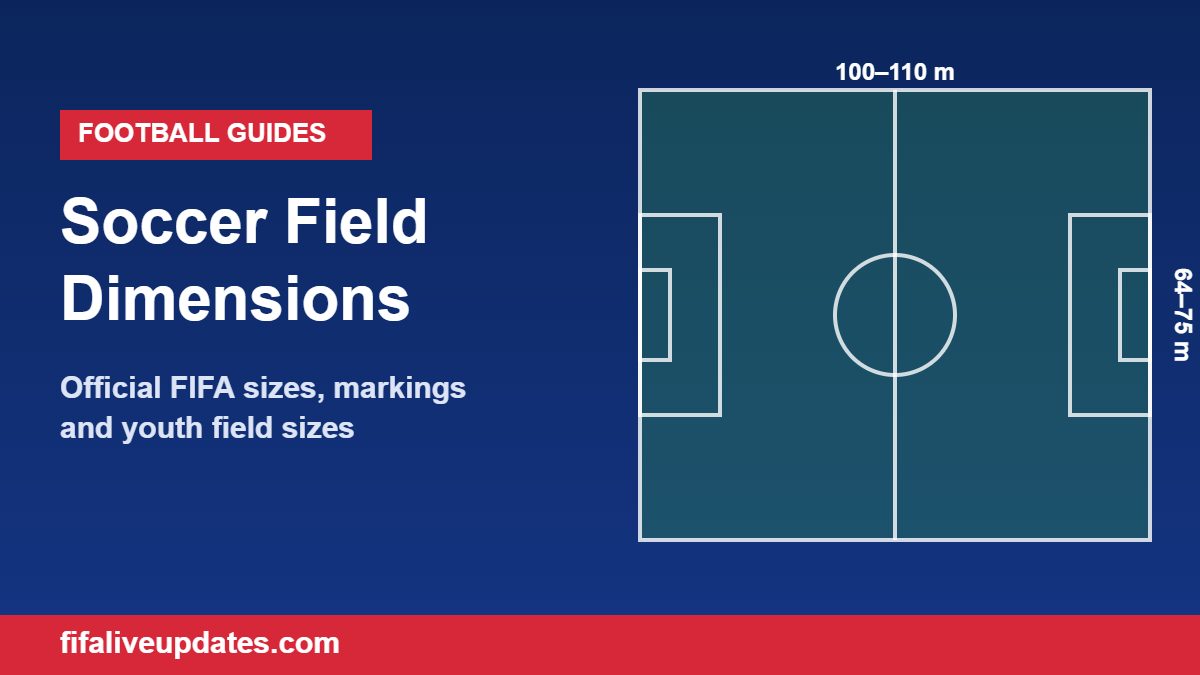
A full-size soccer field is 100–110 meters (110–120 yards) long and 64–75 meters (70–80 yards) wide for international matches. For other adult matches, the rules allow a wider range: 90–120 meters (100–130 yards) long and 45–90 meters (50–100 yards) wide. The field must always be rectangular, with the touchlines longer than the goal lines.
This guide explains every official soccer field dimension in both meters and yards, from the penalty area and center circle to the size of the goal. It also covers youth field sizes, the pitch size used at top professional stadiums, and what makes a field legal. All official measurements come from Law 1 of the IFAB Laws of the Game, the rules used by FIFA and every national association.
Soccer Field Dimensions at a Glance
| Measurement | Meters | Yards / feet |
|---|---|---|
| Field length (international) | 100–110 m | 110–120 yd |
| Field width (international) | 64–75 m | 70–80 yd |
| Field length (other matches) | 90–120 m | 100–130 yd |
| Field width (other matches) | 45–90 m | 50–100 yd |
| Penalty area | 16.5 m × 40.3 m | 18 yd × 44 yd |
| Goal area | 5.5 m × 18.32 m | 6 yd × 20 yd |
| Penalty mark | 11 m from goal line | 12 yd |
| Center circle radius | 9.15 m | 10 yd |
| Corner arc radius | 1 m | 1 yd |
| Goal size | 7.32 m × 2.44 m | 8 yd × 8 ft |
| Maximum line width | 12 cm | 5 in |
Note that the metric and imperial figures in the Laws are official equivalents, not exact conversions. For example, 9.15 meters is listed alongside 10 yards. Either system can be used.
How Long and Wide Is a Soccer Field?
Unlike basketball courts or American football fields, soccer fields do not have one fixed size. The Laws set a minimum and maximum for both length and width, which gives clubs and stadiums some flexibility.
International Matches
For international matches between national teams, the field must be 100–110 m long and 64–75 m wide (110–120 yards by 70–80 yards). This tighter range keeps conditions fair at the highest level of the game.
Other Adult Matches
For league and amateur adult matches, the rules are more flexible: 90–120 m long and 45–90 m wide (100–130 yards by 50–100 yards). Competitions can set their own sizes within this range.
The Most Common Size in Professional Soccer
Many top professional stadiums use a pitch of about 105 m × 68 m (roughly 115 × 74 yards). FIFA recommends this size for major tournaments, and many leading leagues and stadium guidelines use it as their standard. It sits comfortably inside the international range.
In square terms, a 105 × 68 m pitch covers about 7,140 square meters, or roughly 1.76 acres. That is a useful comparison if you are trying to picture how big a professional field really is.
Soccer Field Markings Explained
Every line on a soccer field has a purpose. Here is what each marking means and how big it must be. All lines must be the same width and no more than 12 cm (5 inches) wide. The lines belong to the areas they mark, so a ball on the line is still in play.
Touchlines and Goal Lines
The two long boundary lines are called touchlines (or sidelines). The two short lines at each end are the goal lines (or end lines). The ball is out of play only when the whole ball crosses one of these lines.
Halfway Line and Center Mark
The halfway line divides the field into two equal halves. The center mark sits in the middle of this line, and every kick-off is taken from it.
Center Circle
The center circle has a radius of 9.15 m (10 yards) around the center mark. At kick-off, opponents must stay outside the circle until the ball is in play.
Goal Area (Six-Yard Box)
The goal area is the small box directly in front of each goal. Two lines start 5.5 m (6 yards) from the inside of each goalpost and extend 5.5 m into the field, joined by a line parallel to the goal line. Goal kicks can be taken from anywhere inside this area.
Penalty Area (18-Yard Box)
The penalty area is the larger box. Two lines start 16.5 m (18 yards) from the inside of each goalpost and extend 16.5 m into the field. The goalkeeper can handle the ball only inside their own penalty area, and a foul by a defender inside it usually leads to a penalty kick.
Penalty Mark and Penalty Arc
The penalty mark is 11 m (12 yards) from the midpoint between the goalposts. The penalty arc, often called “the D”, is drawn outside the penalty area with a radius of 9.15 m (10 yards) from the penalty mark. It keeps players at the right distance during a penalty kick. You can learn more in our guide to penalty shootout rules.
Corner Arcs and Flagposts
A corner arc with a radius of 1 m (1 yard) is drawn in each corner. Corner kicks are taken from inside this arc. A flagpost at least 1.5 m (5 feet) high, with a flag, must stand at each corner. Flagposts at the halfway line are optional and must be at least 1 m outside the touchline.
Optional Distance Marks
Competitions may add small marks off the field, 9.15 m (10 yards) from the corner arc, at right angles to the goal lines and touchlines. They help referees make sure defenders stay back during corner kicks.
Soccer Goal Dimensions
Goal size is the one measurement that never changes in the full-size game. The distance between the inside of the posts is 7.32 m (8 yards), and the lower edge of the crossbar is 2.44 m (8 feet) above the ground.
The posts and crossbar must be white, the same width and depth, and no more than 12 cm (5 inches) wide. Goals must be safely anchored to the ground, and portable goals may only be used if they meet this requirement. A goal is scored only when the whole ball crosses the goal line between the posts and under the crossbar.
Youth Soccer Field Sizes
Young players use smaller fields and goals so they get more touches of the ball. In the United States, the US Soccer Player Development Initiatives set recommended field and goal sizes by age group:
| Format | Age group | Field size (yards) | Max goal size (feet) |
|---|---|---|---|
| 4v4 (no goalkeepers) | U6–U8 | 25–35 × 15–25 | 4 × 6 |
| 7v7 | U9–U10 | 55–65 × 35–45 | 6.5 × 18.5 |
| 9v9 | U11–U12 | 70–80 × 45–55 | 7 × 21 |
| 11v11 | U13 and older | Full-size field | 8 × 24 |
These are recommended ranges, and local leagues can set their own exact sizes. Other countries follow different youth programs, so always check with your league or national association. For youth match lengths, see our guide on how long a soccer game lasts.
Soccer Field vs American Football Field
Fans in the United States often compare a soccer field with an NFL field. An American football field is 120 yards long including both end zones, and 53⅓ yards wide.
| Feature | Soccer (international) | American football (NFL) |
|---|---|---|
| Length | 110–120 yd | 120 yd (including end zones) |
| Width | 70–80 yd | 53⅓ yd |
| Fixed size? | No, a range is allowed | Yes |
The lengths are similar, but a soccer field is much wider. That is why some stadiums struggle to fit a full-size soccer pitch, and why temporary grass is sometimes laid over wider areas for major tournaments. Several 2026 World Cup venues were NFL stadiums, as covered in our 2026 World Cup venues guide.
Natural Grass, Artificial Turf and Hybrid Pitches
The Laws allow matches on natural grass, artificial turf or a hybrid of both, as long as the surface is the same across the field. For artificial surfaces in competition matches, the color must be green, and the surface must meet FIFA quality standards or an approved international standard, unless special permission is given.
Most top leagues and the World Cup use natural or hybrid grass. Hybrid pitches mix natural grass with a small amount of synthetic fiber, which makes the surface stronger and longer lasting.
The Technical Area and Surroundings
Each team has a technical area next to the field where the coaches and substitutes sit. Its size can vary by stadium, but it usually extends 1 m on either side of the bench and forward to within 1 m of the touchline. Only one coach may give instructions at a time, and they must stay inside the area.
Major competitions also require space around the field for assistant referees, ball kids, advertising boards and safety. That is why professional stadiums are much larger than the pitch itself.
Why Do Soccer Field Sizes Vary?
The flexible size range dates back to the early days of soccer, when matches were played on whatever open land was available. The Laws kept a range rather than one fixed size so that more grounds could host official matches.
Field size can also affect how a team plays. A wider pitch can help teams that rely on wingers and long passes, while a narrower pitch can make it harder for attacking teams to find space. Some clubs choose their pitch size, within the rules, to suit their style.
Can You Change the Size of a Soccer Field?
A club can adjust its pitch within the limits set by the Laws and its competition. Many leagues set extra rules, such as requiring the same size for the whole season or requiring a minimum size for televised matches. Changes in the middle of a season are usually not allowed without permission.
Soccer Field Dimensions in Feet
Many people in the United States think about sports fields in feet. Here are the main official measurements converted from the yard figures in the Laws of the Game:
| Measurement | Yards | Feet |
|---|---|---|
| Field length (international) | 110–120 yd | 330–360 ft |
| Field width (international) | 70–80 yd | 210–240 ft |
| Penalty area depth | 18 yd | 54 ft |
| Penalty area width | 44 yd | 132 ft |
| Goal area depth | 6 yd | 18 ft |
| Penalty mark distance | 12 yd | 36 ft |
| Center circle radius | 10 yd | 30 ft |
| Goal width | 8 yd | 24 ft |
| Goal height | — | 8 ft |
So a full-size international goal is 24 feet wide and 8 feet high, and the penalty spot sits 36 feet from the goal line.
Is a Women’s Soccer Field the Same Size?
Yes. The Laws of the Game do not set different field sizes for men and women. Women’s professional matches, including the Women’s World Cup, use the same field dimensions, the same markings and the same full-size goals as the men’s game. Read more about the next tournament in our 2027 Women’s World Cup guide.
Futsal Court Dimensions
Futsal is FIFA’s official five-a-side indoor game, and it uses a much smaller court. Under the Futsal Laws of the Game, the court is 25–42 m long and 16–25 m wide. For international futsal matches, the range is tighter: 38–42 m long and 20–25 m wide.
Futsal goals are also smaller, at 3 m wide and 2 m high. The smaller court and goals lead to a faster game with more touches of the ball, which is why many young players develop their skills through futsal.
How to Mark Out a Soccer Field: Step by Step
If you are setting up a field for a school, club or community game, here is a simple method. Always check your league’s required size first.
- Choose your size. Pick a length and width inside the legal range for your age group or competition.
- Mark one goal line. Run a string line between two pegs to set the first goal line.
- Create a right angle. Use the 3-4-5 method: measure 3 m along the goal line and 4 m along the planned touchline. When the diagonal between those two points is exactly 5 m, the corner is square.
- Mark the touchlines and second goal line. Measure the full length and width, then check that both diagonals of the rectangle are equal. If they match, the field is square.
- Mark the halfway line and center circle. Find the middle of each touchline, join them, and use a 9.15 m (10 yd) cord from the center mark to draw the circle.
- Mark the penalty and goal areas. Measure from the inside of each goalpost position: 5.5 m (6 yd) for the goal area and 16.5 m (18 yd) for the penalty area.
- Add the penalty marks, arcs and corner arcs. Then place the goals and corner flags.
Use line paint made for sports fields, and keep every line no more than 12 cm (5 inches) wide.
Common Mistakes When Measuring a Soccer Field
Even experienced groundskeepers sometimes get field markings wrong. These are the most common errors and how to avoid them:
- Measuring from the outside of the posts. The goal area and penalty area are measured from the inside of each goalpost, not the outside.
- Measuring to the wrong edge of a line. The field size is measured to the outer edges of the boundary lines, because the lines are part of the area they enclose.
- Forgetting to check the corners. If the two diagonals of the field are not equal, the field is not a true rectangle, and the penalty areas will not line up.
- Making lines too thick. Lines wider than 12 cm (5 inches) break the Laws and can confuse players and officials.
- Using the wrong youth size. Youth leagues often have their own field and goal sizes, so check your league rules before marking.
Getting these details right makes the field fair for both teams and avoids disputes about whether a ball was in or out of play. For more beginner-friendly rule guides, see our explainer on the offside rule and VAR.
Frequently Asked Questions
How big is a soccer field in yards?
For international matches, a soccer field is 110–120 yards long and 70–80 yards wide. Other adult matches can use 100–130 yards by 50–100 yards.
How big is a soccer field in meters?
For international matches, the field is 100–110 m long and 64–75 m wide. Many professional stadiums use 105 m × 68 m.
How big is a soccer field in acres?
A standard 105 × 68 m professional pitch covers about 1.76 acres. Smaller legal fields can be under 1.5 acres.
How big is a soccer goal?
A full-size goal is 7.32 m (8 yards) wide and 2.44 m (8 feet) high, measured from the inside of the posts and the lower edge of the crossbar.
How far is the penalty spot from the goal?
The penalty mark is 11 m (12 yards) from the midpoint between the goalposts.
How big is the penalty box?
The penalty area extends 16.5 m (18 yards) from each goalpost and 16.5 m into the field, which makes it 40.3 m (44 yards) wide.
Are all soccer fields the same size?
No. The Laws allow a range of sizes. Only the goal size and the markings inside the field, such as the penalty area and center circle, are fixed.
What size field do 7v7 youth teams use?
US Soccer recommends 55–65 yards long and 35–45 yards wide for 7v7 games at U9–U10.
How big is a soccer field in feet?
An international soccer field is 330–360 feet long and 210–240 feet wide.
Is a women’s soccer field smaller?
No. Women’s professional soccer uses the same field size and full-size goals as the men’s game.
How big is a futsal court?
A futsal court is 25–42 m long and 16–25 m wide, or 38–42 m by 20–25 m for international matches. The goals are 3 m wide and 2 m high.