A professional soccer game lasts 90 minutes, split into two 45-minute halves, with a half-time break of up to 15 minutes. The referee also adds stoppage time at the end of each half to make up for time lost during play. In practice, a standard match takes just under two hours from kick-off to the final whistle.
That is the short answer. The full picture has a few more layers: added time, extra time in knockout games, penalty shootouts and shorter matches for youth players. This guide explains each one in plain English, using the official rules written by the International Football Association Board (IFAB), the body that sets the Laws of the Game used by FIFA and every national association.
How Long Is a Soccer Game? The Quick Answer
| Part of the match | Official length |
|---|---|
| First half | 45 minutes |
| Half-time break | Up to 15 minutes |
| Second half | 45 minutes |
| Stoppage (added) time | Decided by the referee in each half |
| Extra time (knockout games only) | Two periods of 15 minutes |
| Penalty shootout (if still level) | No fixed time |
So a regular league game is 90 minutes of playing time plus added time. Once you include half-time and stoppages, most professional matches finish roughly 105 to 115 minutes after kick-off.
The Two 45-Minute Halves
Under Law 7 of the IFAB Laws of the Game, a match lasts for two equal halves of 45 minutes. The clock in soccer runs continuously. Unlike American football or basketball, it does not stop when the ball goes out of play or when a foul is given.
The rules do allow shorter halves, but only if the referee and both teams agree before the game starts and the competition rules permit it. This is common in youth soccer, some amateur leagues and matches played in bad light, but never in top-level professional competitions.
How Long Is Half-Time in Soccer?
Players are entitled to a half-time break, and the Laws say it must not exceed 15 minutes. Competition rules set the exact length, and it can only be changed with the referee’s permission.
In most professional leagues and at the World Cup, half-time is 15 minutes. Teams use it to rest, rehydrate and change tactics. A short drinks break of up to one minute is also allowed at the break between the two periods of extra time.
What Is Stoppage Time (Added Time)?
Because the clock never stops, time is lost during a match for things like injuries and substitutions. Stoppage time, also called added time or injury time, is the extra time the referee adds at the end of each half to make up for it.
What Counts Toward Added Time
IFAB Law 7 lists the main reasons the referee adds time:
- Substitutions
- Assessing and removing injured players
- Time-wasting
- Disciplinary sanctions (yellow and red cards)
- Medical stoppages allowed by competition rules, such as drinks or cooling breaks
- VAR checks and reviews
- Goal celebrations
- Any other significant delay, such as fans on the pitch or a floodlight failure
How Referees Calculate Added Time
The referee keeps track of time lost throughout each half and decides how much to add. Near the end of the half, the fourth official holds up an electronic board showing the minimum amount of added time, for example “+5”.
That number is a minimum, not a fixed limit. If there are more delays during added time, such as another injury or a long VAR check, the referee can play longer. The referee cannot reduce the amount shown on the board.
There is one more rule worth knowing. If a penalty kick is awarded right at the end of a half, the half is extended so the penalty can be taken. Time is not cut short to stop a penalty.
Why Added Time Has Grown in Recent Years
At recent World Cups, referees have been instructed to calculate lost time more precisely, especially for goal celebrations, substitutions and VAR checks. As a result, seeing six to ten minutes of added time at the end of a half is now more common than it was in the past.
Can a Soccer Game Last Longer Than 90 Minutes?
Yes. Every professional match goes beyond 90 minutes because of stoppage time. A few situations can make a game run much longer:
- Extra time: used in knockout games when the competition requires a winner.
- Penalty shootouts: used if the score is still level after extra time.
- Long stoppages: serious injuries, weather delays or crowd problems.
Extra Time in Knockout Matches
League matches can end in a draw. Knockout games, such as World Cup round-of-16 ties or cup finals, need a winner. If the competition rules require it and the score is level after 90 minutes, the match goes to extra time.
Under Law 10, extra time is two equal periods of no more than 15 minutes each, so up to 30 extra minutes, plus any added time. The full score counts, and there is no “golden goal”: both periods are played in full even if a team scores.
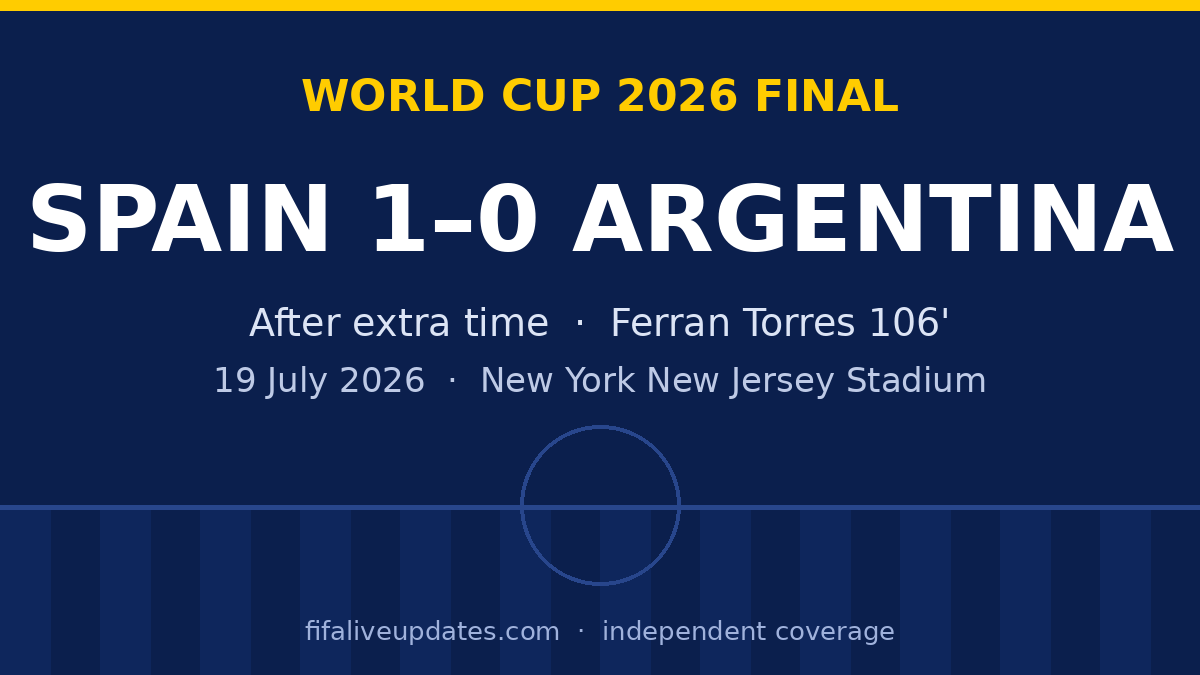
A recent example: the 2026 World Cup final went to extra time before Spain beat Argentina 1–0. For a deeper look at the rules, including the extra substitute teams get, read our full guide to extra time in soccer.
Penalty Shootouts: When They Happen
If a knockout match is still level after extra time, it is usually decided by a penalty shootout, officially called “kicks from the penalty mark”. Each team takes five kicks, alternating. If it is still level after five each, it goes to sudden death.
Some competitions skip extra time and go straight to penalties after 90 minutes. Goals scored in the shootout are not added to the match score. Our guide to penalty shootout rules explains the full procedure.
Total Match Length: A Simple Breakdown
Here is how long different types of professional games typically take in real time. The added-time figures are typical examples, not fixed rules.
| Match type | Playing time | Approximate real time |
|---|---|---|
| Regular game (90 min + added time) | About 95–105 minutes | About 1 hour 50 minutes to 2 hours |
| Knockout game with extra time | About 125–135 minutes | About 2 hours 25 minutes to 2 hours 40 minutes |
| Extra time plus penalty shootout | About 125–135 minutes + shootout | About 2 hours 40 minutes to 3 hours |
If you are planning to watch a game on TV, allow about two hours for a normal match, and up to three hours for a knockout match that could go to penalties.
How Long Are Youth, High School and College Soccer Games?
Youth and amateur games are often shorter. The Laws of the Game allow shorter halves when the competition rules say so, so the exact length depends on the league or organization.
- Youth soccer: younger age groups play much shorter matches, sometimes split into quarters. The length usually increases with age. Check your club or league rules for exact times.
- High school (USA): games are commonly two 40-minute halves, set by state high school associations.
- College (USA): games are normally two 45-minute halves, the same as the professional game.
- Youth international tournaments: FIFA youth competitions such as the U-17 World Cup use the standard 90 minutes.
Because rules vary between countries and leagues, always check the specific competition rules for youth or school matches.
What Happens If a Match Is Abandoned?
Sometimes a game cannot be finished, for example because of heavy rain, lightning, a waterlogged pitch or crowd trouble. The referee can suspend or abandon the match.
According to IFAB Law 7, an abandoned match is replayed unless the competition rules or organizers decide otherwise. Some competitions resume the game from the minute it stopped, while others award the result or order a full replay. The decision belongs to the competition, not the referee.
Why Does the Soccer Clock Never Stop?
Soccer keeps a running clock to keep the game flowing. Instead of stopping the clock for every throw-in or foul, the referee adds the lost time at the end. This is why a “90-minute” match almost always lasts longer, and why the final minutes of added time can be so dramatic.
Rules like VAR reviews and offside checks also add time, which is one reason modern matches run longer than they did a decade ago.
Who Keeps Time in a Soccer Match?
In soccer, the referee is the official timekeeper. The stadium clock and the TV graphic are only there to help fans. If they show a different time from the referee’s watch, the referee’s timing is what counts.
This is very different from sports such as basketball or American football, where a separate official stops and starts a game clock. In soccer, the referee simply notes how much time was lost and adds it back at the end of each half.
The fourth official, who stands between the two team benches, helps by managing substitutions and showing the added-time board. In top competitions, the referee team also communicates through headsets, so everyone knows exactly when a half should end.
Can the Referee End a Half Early?
No. Once the minimum added time is shown, it must be played. The referee can blow the whistle only after that time has passed, unless a penalty kick must be completed first. Fans sometimes think a referee ended a game “too early”, but in most cases the referee is following the actual time lost, not the stadium clock.
Can a Goal Be Scored After Time Runs Out?
A goal only counts if the ball fully crosses the goal line before the referee signals the end of the half. If the whistle blows while the ball is in the air, the goal does not count. The one exception is a penalty kick awarded at the end of a half: time is extended until the kick is completed.
Drinks Breaks and Cooling Breaks
In hot weather, competitions can allow short breaks during each half so players can drink water. According to IFAB Law 7, drinks breaks should not exceed one minute, while cooling breaks can last between 90 seconds and three minutes.
These breaks usually happen around the middle of each half. The time they take is added back at the end of the half, so they make the match longer in real time but do not reduce the 90 minutes of playing time.
How Time-Wasting Affects Match Length
Time-wasting means deliberately slowing the game down, usually by a team that is winning. Common examples include taking a long time over a goal kick, a throw-in or a substitution, or a player staying down after minor contact.
The Laws deal with this in two ways. First, referees can show a yellow card for delaying the restart of play. Second, the time lost is added back on, so wasting time often does not help as much as players hope.
Recent rule changes have also targeted goalkeepers. Under the current Laws, a goalkeeper who holds the ball in their hands for more than eight seconds can be penalized with a corner kick to the opposing team. This rule was introduced to stop keepers from running down the clock.
Two-Legged Ties and Aggregate Scores
Some competitions, such as the knockout rounds of European club tournaments, are played over two matches, called “legs”. Each leg is a normal 90-minute game. The scores from both games are added together to find the winner, which is called the aggregate score.
Extra time and penalties are only used at the end of the second leg, and only if the aggregate score is level. UEFA removed the away goals rule from its club competitions in 2021, so goals scored away from home no longer count double in those tournaments.
How Long Are Other Types of Soccer?
Not every version of the game uses 90 minutes. Small-sided and indoor formats have their own rules:
| Format | Typical match length | Notes |
|---|---|---|
| Professional 11-a-side (men and women) | 90 minutes (2 × 45) | Same length for the men’s and women’s World Cup |
| Futsal (FIFA indoor game) | 40 minutes (2 × 20) | The clock stops when the ball is out of play |
| Beach soccer | 36 minutes (3 × 12) | Played in three periods |
| 5-a-side and 7-a-side leagues | Varies | Set by the league or venue |
This is why a futsal match can take as long as a regular game in real time, even though the official playing time is much shorter. The stopped clock adds a lot of real time.
How Soccer Compares With Other Sports
If you are used to American sports, soccer’s timing can feel unusual. Here is a simple comparison of official game time:
| Sport | Official game time | Clock stops? |
|---|---|---|
| Soccer | 90 minutes | No (time added at end of each half) |
| American football (NFL) | 60 minutes | Yes, often |
| Basketball (NBA) | 48 minutes | Yes |
| Ice hockey (NHL) | 60 minutes | Yes |
| Rugby union | 80 minutes | Only in some situations |
Even though soccer has the longest official game time on this list, a soccer match usually finishes sooner in real time than an NFL game, because the clock keeps running and there are no timeouts or commercial breaks during play.
Planning to Watch a Game? How Much Time to Allow
Here is a practical guide for fans watching on TV or going to a stadium:
- TV, regular league game: about two hours from kick-off to final whistle.
- TV, knockout game: allow up to three hours in case of extra time and penalties.
- Going to the stadium: add time for travel, security checks and leaving the ground. Many fans arrive 45 to 60 minutes before kick-off for big matches.
- Pre-match and post-match TV shows: broadcasters often add an hour or more of coverage before and after big games.
Frequently Asked Questions
How long is a soccer game with half-time?
A standard game is 90 minutes of play plus a half-time break of up to 15 minutes. Adding stoppage time, most matches finish about 105 to 115 minutes after kick-off.
How long is each half in soccer?
Each half lasts 45 minutes in professional soccer, plus any stoppage time the referee adds.
How long is extra time in soccer?
Extra time is two periods of up to 15 minutes each, for a maximum of 30 minutes plus added time.
Is a soccer game 90 minutes or 2 hours?
The official playing time is 90 minutes. With half-time and stoppage time, the whole event usually lasts close to two hours.
Who decides how much added time is played?
The referee decides. The fourth official shows the minimum added time on a board, but the referee can play longer if there are more delays.
Can a soccer game end in a tie?
Yes. League and group-stage games can end in a draw. Only knockout matches that need a winner use extra time and penalties.
Why is a soccer game 90 minutes long?
The 90-minute length became the standard in the early history of the modern game and has been part of the official Laws of the Game for well over a century. It gives a balance between a fair contest and player fatigue.
How long is a Premier League or MLS game?
Both are standard 90-minute games with a 15-minute half-time and added time, so they usually last just under two hours.
How long is a World Cup game?
Group-stage World Cup games last 90 minutes plus added time. Knockout games can add 30 minutes of extra time and a penalty shootout if needed.
What is injury time in soccer?
Injury time is another name for stoppage time or added time. It covers more than injuries, including substitutions, VAR checks and time-wasting.