The 2025 FIFA Club World Cup was the first edition of the competition with 32 teams. Hosted in the United States in the summer of 2025, it also served as a dress rehearsal for the 2026 World Cup, using several of the same stadiums. Chelsea won the title with a commanding 3–0 victory over Paris Saint-Germain in the final.
2025 Club World Cup at a Glance
Before getting into the detail, here are the key facts from the first 32-team Club World Cup.
| Detail | Information |
|---|---|
| Dates | 14 June – 13 July 2025 |
| Host country | United States |
| Teams | 32 clubs from six confederations |
| Venues | 12 stadiums in 11 host cities |
| Opening match | Inter Miami v Al Ahly, Hard Rock Stadium, Miami |
| Final | Chelsea 3–0 Paris Saint-Germain, MetLife Stadium |
| Champions | Chelsea |
| Runners-up | Paris Saint-Germain |
| Prize fund | About $1 billion |
Lionel Messi’s Inter Miami were given the opening fixture as the host-nation club, and the tournament built towards a final between two European giants who had both won major continental trophies only weeks earlier.
The Final: Chelsea 3–0 Paris Saint-Germain
The final was played on Sunday 13 July 2025 at MetLife Stadium in East Rutherford, New Jersey, the same venue that hosted the 2026 World Cup final under the name New York New Jersey Stadium.
PSG arrived as European champions and favourites, but Chelsea took control in the first half. Cole Palmer scored twice and then set up João Pedro for the third goal, all before half-time. Chelsea held their lead in the second half to complete a 3–0 win.
How the Final Unfolded
The final drew a crowd of 81,118 and was refereed by Alireza Faghani. Most observers expected PSG to dominate possession, as they had done during their run to the Champions League title, which they had sealed with a 5–0 win over Inter in the final that spring.
Instead, Chelsea pressed high and attacked quickly. Palmer opened the scoring in the 22nd minute and added a second in the 30th. Thirteen minutes later he turned provider, releasing João Pedro to make it 3–0 in the 43rd minute.
PSG pushed for a way back after the break, but Chelsea stayed compact and goalkeeper Robert Sánchez, later named best goalkeeper of the tournament, kept a clean sheet. The three-goal half-time lead was never seriously threatened, and Chelsea lifted the new trophy in New Jersey.
Why Chelsea Won
- Palmer’s big-game quality: he was involved in all three goals and was the clear choice for the Golden Ball.
- A fast start: Chelsea scored three times before half-time, forcing PSG to chase the game.
- Squad depth: Enzo Maresca rotated heavily during the tournament, and players such as Pedro Neto, Christopher Nkunku and Kiernan Dewsbury-Hall all scored important goals along the way.
- Momentum: Chelsea arrived in the United States having just won the UEFA Conference League, beating Real Betis 4–1 in the final in Wrocław on 28 May 2025.
Tournament Awards
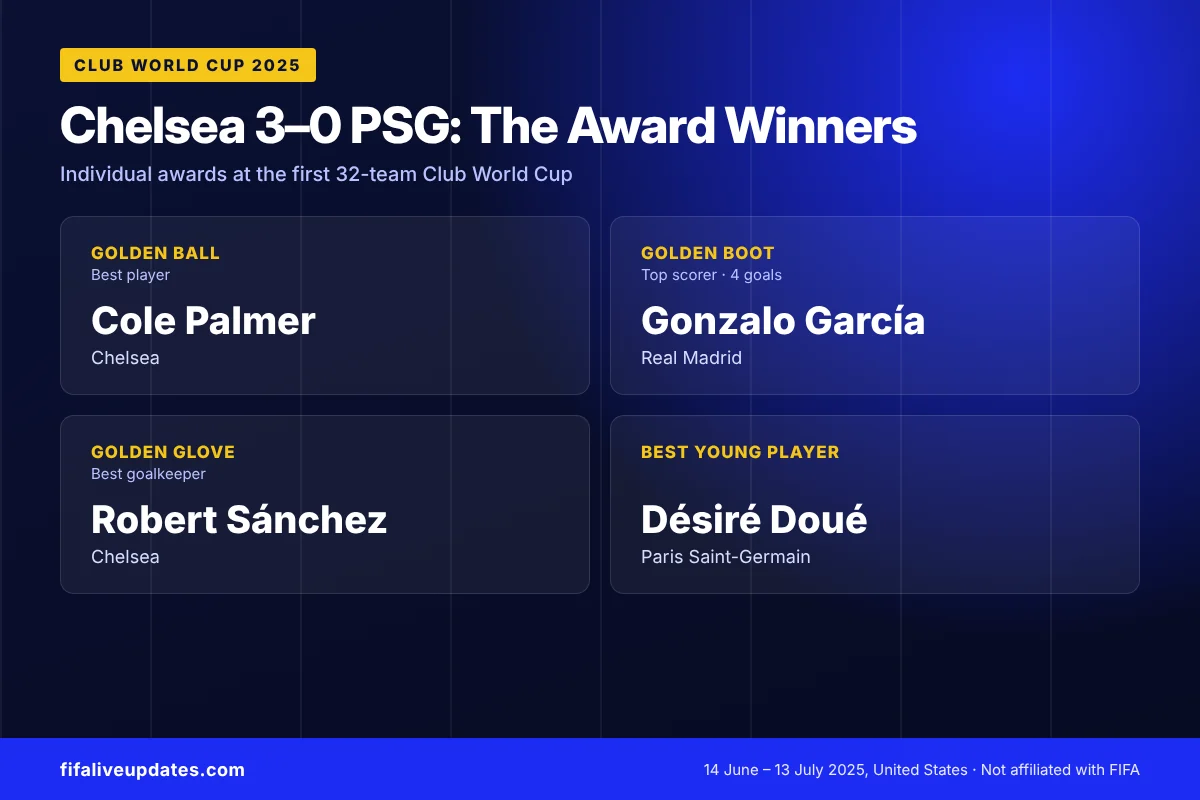
| Award | Winner | Club |
|---|---|---|
| Golden Ball (best player) | Cole Palmer | Chelsea |
| Golden Boot (top scorer) | Gonzalo García (4 goals) | Real Madrid |
| Golden Glove (best goalkeeper) | Robert Sánchez | Chelsea |
| Best Young Player | Désiré Doué | Paris Saint-Germain |
Gonzalo García finished level on four goals with Ángel Di María of Benfica, Serhou Guirassy of Borussia Dortmund and Marcos Leonardo of Al Hilal, and took the Golden Boot on the assists tiebreaker.
Players Who Stood Out
Beyond the official awards, a handful of players used the tournament to make a lasting impression.
Cole Palmer (Chelsea)
Palmer saved his best for the knockout rounds. He opened the scoring against Palmeiras in the quarter-final and then produced two goals and an assist in the final, the kind of performance that wins trophies on its own.
João Pedro (Chelsea)
Signed during the tournament, João Pedro made an immediate impact. He scored twice on his first start in the semi-final against his boyhood club Fluminense and then added the third goal in the final.
Gonzalo García (Real Madrid)
The young striker was handed opportunities in Xabi Alonso’s first weeks in charge of Real Madrid and took them, finishing with four goals and the Golden Boot.
Marcos Leonardo (Al Hilal)
The Brazilian forward also scored four times, including two in the famous 4–3 win over Manchester City, making him one of the faces of the non-European challenge.
Désiré Doué and Estêvão
PSG’s Doué was named best young player after another season of rapid progress, while Palmeiras teenager Estêvão showed Chelsea fans what they could look forward to by scoring against his future club in the quarter-final.
Chelsea’s Path to the Title
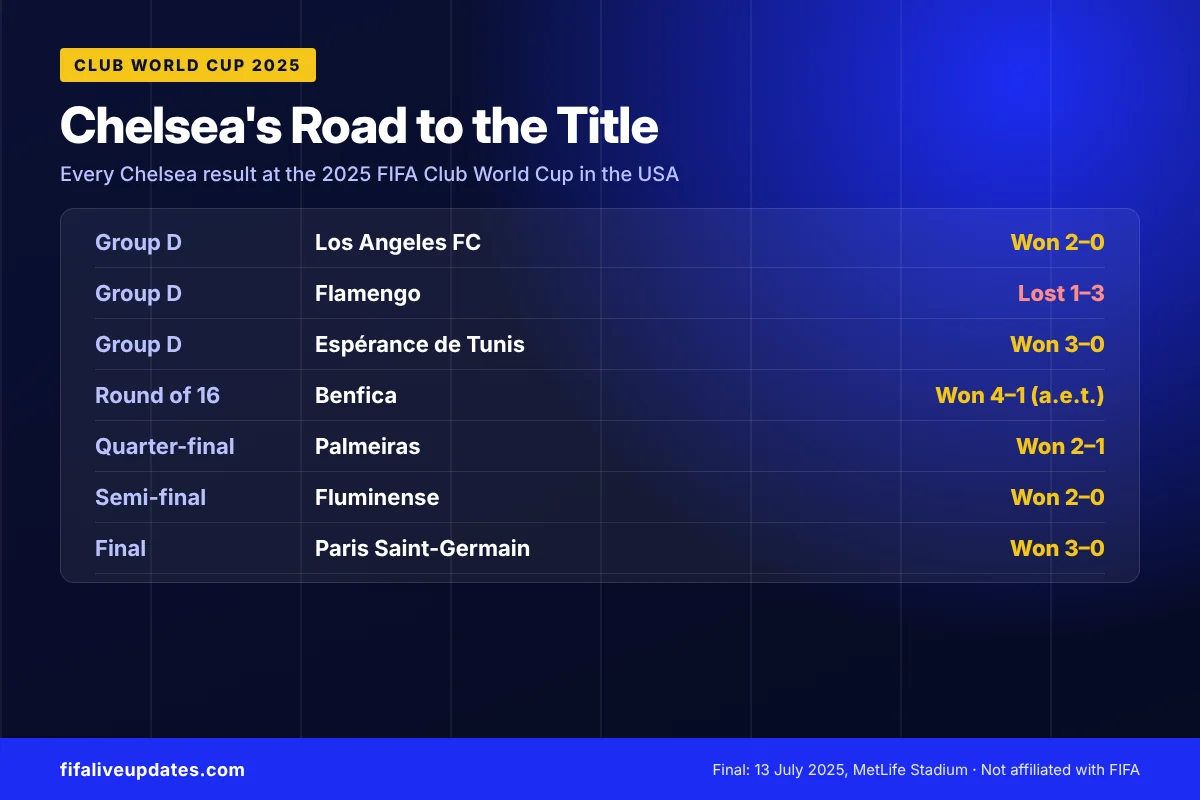
Chelsea progressed through the group stage and then won four knockout matches in a row. Palmer was decisive throughout, scoring in the 2–1 quarter-final win over Brazilian side Palmeiras before his match-winning display in the final.
| Stage | Date | Opponent | Result |
|---|---|---|---|
| Group D | 16 June 2025 | Los Angeles FC | Won 2–0 |
| Group D | 20 June 2025 | Flamengo | Lost 1–3 |
| Group D | 24 June 2025 | Espérance de Tunis | Won 3–0 |
| Round of 16 | 28 June 2025 | Benfica | Won 4–1 (after extra time) |
| Quarter-final | 4 July 2025 | Palmeiras | Won 2–1 |
| Semi-final | 8 July 2025 | Fluminense | Won 2–0 |
| Final | 13 July 2025 | Paris Saint-Germain | Won 3–0 |
Group Stage: A Wobble Against Flamengo
Chelsea opened Group D with a 2–0 win over Los Angeles FC at Mercedes-Benz Stadium in Atlanta, with Pedro Neto and Enzo Fernández scoring. The second match was a reality check. Neto gave Chelsea the lead against Flamengo at Lincoln Financial Field in Philadelphia, but the Brazilian side hit back through Bruno Henrique, Danilo and Wallace Yan to win 3–1, while Nicolas Jackson was sent off.
That defeat meant Chelsea needed a result in their final group game, and they delivered with a 3–0 win over Espérance de Tunis. Tosin Adarabioyo and Liam Delap scored in first-half stoppage time and Tyrique George added a late third. Chelsea finished second in the group on six points, one behind Flamengo.
Round of 16: Surviving a Storm Against Benfica
The last-16 tie against Benfica at Bank of America Stadium in Charlotte became one of the longest matches of the tournament. Reece James put Chelsea ahead with a 64th-minute free kick, but with the match close to the end, a lightning storm forced the players off the pitch for almost two hours.
When play resumed, Ángel Di María equalised from the penalty spot deep into stoppage time after a handball by Malo Gusto, taking the game to extra time. Benfica were down to ten men after Gianluca Prestianni was sent off for a second yellow card, and Chelsea took advantage with goals from Christopher Nkunku, Pedro Neto and Kiernan Dewsbury-Hall to win 4–1.
Quarter-final: Palmer Shines Against Palmeiras
Chelsea met Palmeiras at Lincoln Financial Field on 4 July. Palmer opened the scoring in the 16th minute, before Estêvão, the Palmeiras teenager who had already agreed to join Chelsea, equalised early in the second half. The winner came in the 83rd minute when Malo Gusto’s shot from a short corner deflected in, with the goal officially recorded as an own goal by Palmeiras goalkeeper Weverton.
Semi-final: João Pedro Sinks His Old Club
In the semi-final at MetLife Stadium, Chelsea faced Fluminense, the club where João Pedro started his career. The striker had only just signed for Chelsea, and on his first start for the club he scored both goals in a 2–0 win to send them into the final.
PSG’s Road to the Final
Paris Saint-Germain arrived in the United States as European champions and largely played like it. They topped Group B with six points, beating Atlético Madrid 4–0 and Seattle Sounders 2–0, although they also suffered a surprise defeat to Brazil’s Botafogo.
In the knockout rounds, Luis Enrique’s side looked unstoppable. They beat Inter Miami 4–0 in the round of 16, edged past Bayern Munich 2–0 in the quarter-finals despite having Willian Pacho sent off, and then thrashed Real Madrid 4–0 in the semi-final at MetLife Stadium. Fabián Ruiz scored twice in that game, with Ousmane Dembélé and Gonçalo Ramos also on target. That run made the 3–0 defeat in the final even more striking.
The Biggest Surprises of the Tournament
The expanded format was designed to give clubs from every continent a chance to test themselves against Europe’s elite, and several of them took it.
- Al Hilal 4–3 Manchester City: the Saudi club knocked out Pep Guardiola’s side in an extraordinary round-of-16 match in Orlando that went to extra time. Marcos Leonardo scored twice, with Malcom and Kalidou Koulibaly also on target.
- Fluminense 2–0 Inter: only weeks after reaching the Champions League final, Inter were beaten in Charlotte by goals from Germán Cano and substitute Hércules. Fluminense went on to beat Al Hilal in the quarter-finals.
- Brazil’s strong showing: all four Brazilian clubs – Palmeiras, Botafogo, Flamengo and Fluminense – reached the round of 16, with Botafogo beating PSG and Flamengo beating Chelsea in the group stage.
- New stars: Real Madrid’s Gonzalo García emerged as a genuine first-team option, finishing as the Golden Boot winner.
From Seven Teams to 32: How the Club World Cup Has Changed
The FIFA Club World Cup was first held in 2000, when Corinthians won the inaugural tournament with the final played at the Maracanã in Rio de Janeiro. For most of its history it was a short competition held almost every year, usually featuring the six continental champions plus a club from the host nation.
That smaller format was dominated by Europe. European clubs won every edition from 2013 to 2023, and Real Madrid hold the record with five titles. Cristiano Ronaldo is the competition’s all-time leading scorer with seven goals across spells with Manchester United and Real Madrid.
The 2025 relaunch changed the competition completely. Instead of a week-long event squeezed into the middle of the European season, it became a month-long summer tournament with a group stage and knockout rounds, modelled closely on the World Cup itself.
How the New Format Worked
- 32 clubs qualified from all six continental confederations based on results over the previous four seasons.
- Teams were drawn into eight groups of four, with the top two from each group reaching the Round of 16.
- The knockout stage continued with quarter-finals, semi-finals and a single final, with no third-place match.
- The tournament ran from mid-June to 13 July 2025 in host cities across the United States.
Host Cities and Stadiums
Matches were spread across 12 stadiums in 11 cities, with Orlando the only city to use two venues. The list mixed giant NFL arenas with smaller MLS grounds:
- MetLife Stadium – East Rutherford, New Jersey (final and both semi-finals)
- Mercedes-Benz Stadium – Atlanta
- Bank of America Stadium – Charlotte
- TQL Stadium – Cincinnati
- Rose Bowl Stadium – Los Angeles (Pasadena)
- Hard Rock Stadium – Miami
- GEODIS Park – Nashville
- Camping World Stadium – Orlando
- Inter&Co Stadium – Orlando
- Lincoln Financial Field – Philadelphia
- Lumen Field – Seattle
- Audi Field – Washington, D.C.
Five of these grounds – MetLife Stadium, Mercedes-Benz Stadium, Lincoln Financial Field, Hard Rock Stadium and Lumen Field – are also 2026 World Cup venues, which is why the tournament was so closely watched as a test event.
Prize Money: The Richest Club Tournament Ever
FIFA put up a prize fund of around $1 billion, by far the largest in the history of club football. Every club received a participation fee, with extra payments for each win, draw and round reached.
According to reported figures, Chelsea earned about $114.6 million in total, including $40 million for winning the final, while runners-up PSG collected around $106.9 million. For clubs from outside Europe, even reaching the knockout rounds represented a major financial boost.
Why the 2025 Club World Cup Mattered
- It was the first time the Club World Cup was held in a World Cup-style format with 32 teams.
- It gave the United States a major test of its stadiums, security and transport ahead of the 2026 World Cup.
- Chelsea became the first champions of the expanded competition, adding to their earlier Club World Cup title in 2021.
- Clubs from outside Europe, especially from Brazil and Saudi Arabia, produced several strong results against European opponents.
What the Tournament Taught Us About the 2026 World Cup
Because it was played a year before the 2026 World Cup in many of the same stadiums, the Club World Cup was a useful preview of what players and fans could expect.
- Weather: summer heat and thunderstorms were a regular talking point. The almost two-hour lightning delay during Chelsea v Benfica showed how strictly US stadiums apply weather-safety rules.
- Crowds: attendances varied widely, from more than 80,000 at the final to much smaller crowds at some group matches, which fed into debate about ticket pricing and kick-off times.
- Travel: teams and supporters had to cover long distances between cities, a challenge that grows even bigger with 48 national teams in 2026.
- Officiating: VAR was used throughout. If you want a refresher on how reviews work, read our guide to the offside rule and VAR.
For the date and venue of the national-team showpiece that followed a year later, see our guide to the 2026 World Cup final.
The Debate Over Player Workload
The tournament also reignited arguments about the football calendar. It started only a few weeks after the end of the European season, so finalists such as Chelsea and PSG played competitive matches into mid-July before beginning preparations for the following campaign. Players’ unions and some coaches raised concerns about fatigue and the lack of a proper summer break, while supporters of the new format argued that it gave clubs from every continent a rare chance to play Europe’s best on a global stage. That debate is likely to shape how future editions are scheduled.
Chelsea’s Club World Cup History
The 2025 title was not Chelsea’s first experience of this competition. They reached the final of the old seven-team format in 2012 but lost to Corinthians in Japan. They made amends in the 2021 edition, played in Abu Dhabi in February 2022, when Kai Havertz scored an extra-time penalty to beat Palmeiras 2–1.
Winning the first expanded tournament in 2025 gave Chelsea a second world club title and capped a summer in which they had also lifted the Conference League. For a young squad, it was a statement that the club was back competing for the biggest prizes.
When Is the Next Club World Cup?
FIFA intends to stage the expanded Club World Cup every four years, so the next edition is planned for 2029. Several countries have shown interest in hosting, and FIFA has discussed changes to the number of places available, so check official announcements for the latest decisions. In the years between, FIFA also runs the annual Intercontinental Cup for continental champions.
Frequently Asked Questions
Who won the 2025 Club World Cup?
Chelsea, who beat Paris Saint-Germain 3–0 in the final on 13 July 2025.
Who won the Golden Ball?
Chelsea’s Cole Palmer, who scored twice and provided an assist in the final.
Where was the final played?
At MetLife Stadium in East Rutherford, New Jersey, United States.
How much prize money did Chelsea earn?
Reported figures put Chelsea’s total earnings at around $114.6 million, including $40 million for winning the final.
Who did Chelsea beat in the semi-final?
Fluminense of Brazil, 2–0 at MetLife Stadium on 8 July 2025, with João Pedro scoring both goals against his former club.
How many teams played in the 2025 Club World Cup?
32 clubs from all six confederations, split into eight groups of four.
What was the biggest shock of the tournament?
Al Hilal’s 4–3 extra-time win over Manchester City in the round of 16 is widely seen as the biggest upset, alongside Fluminense’s 2–0 win over Inter.
When is the next Club World Cup?
The next edition is planned for 2029. Check FIFA’s official announcements for the confirmed host and format.
Keep reading: see how the national-team game crowned its newest champion in our FIFA World Cup 2026 winner guide, or browse the full list of World Cup winners.