
Updated: October 2026. This is an independent recap. FIFA Live Updates is not affiliated with FIFA.
The 2026 FIFA World Cup was the first edition with 48 teams. Canada, Mexico and the United States qualified automatically as hosts, and the remaining 45 places were decided through qualifying in each confederation, followed by an intercontinental play-off tournament in Mexico in March 2026. This article explains how the CONCACAF and CAF (Africa) routes worked, who qualified, and how those teams performed at the finals.
How many places did each confederation get?
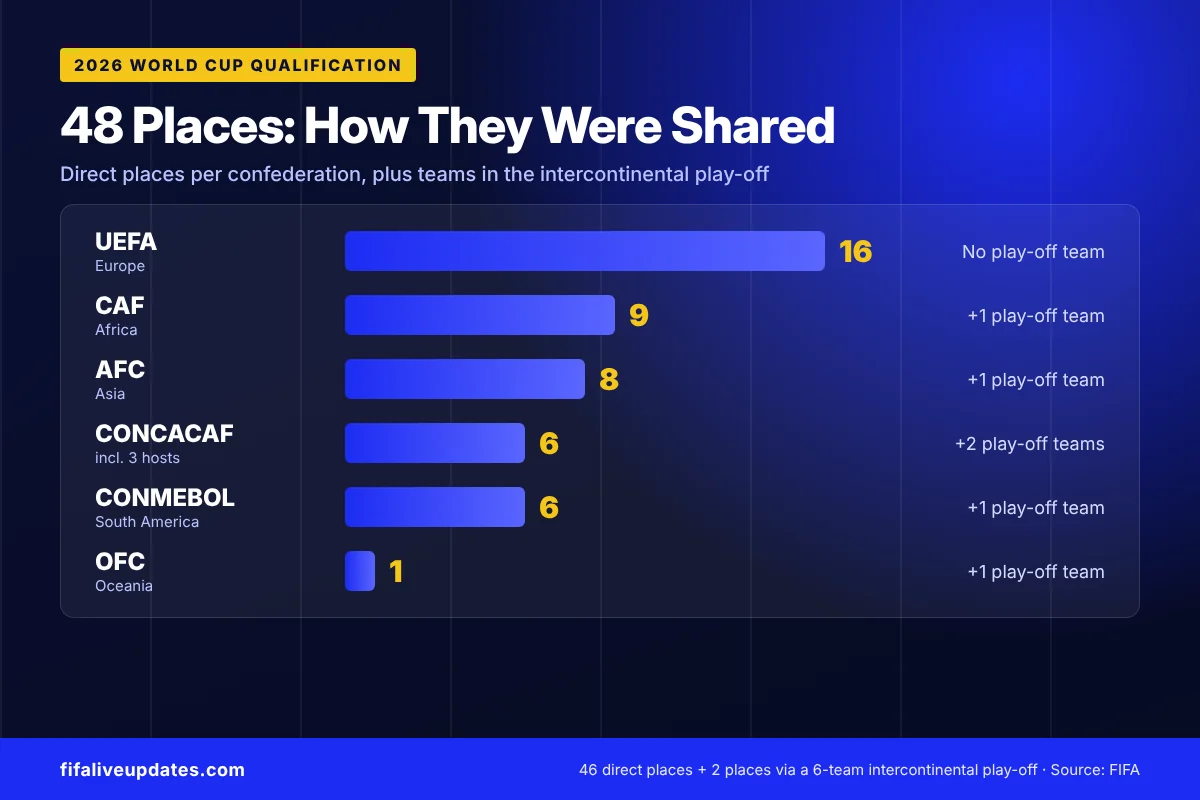
| Confederation | Direct places | Intercontinental play-off places |
|---|---|---|
| AFC (Asia) | 8 | 1 |
| CAF (Africa) | 9 | 1 |
| CONCACAF (North/Central America & Caribbean) | 3 + 3 hosts | 2 |
| CONMEBOL (South America) | 6 | 1 |
| OFC (Oceania) | 1 | 1 |
| UEFA (Europe) | 16 | 0 |
The six-team intercontinental play-off produced the final two qualifiers.
Why 2026 qualifying was different
Expanding the World Cup from 32 to 48 teams changed the maths for every confederation, and Africa and North America were among the biggest winners. At Qatar 2022, CAF had five places and CONCACAF had three direct places plus one inter-confederation play-off spot. For 2026, Africa had nine direct places and a play-off route, while CONCACAF effectively had six places (three for the hosts and three through qualifying) plus two play-off spots.
That extra room opened the door for smaller football nations. With more places available, sides that had rarely come close in the past, such as Cape Verde and Curaçao, were able to realistically target a first appearance. The host nations’ automatic places also removed three of CONCACAF’s strongest teams from the qualifying race, which made the competition for the remaining spots far more open than usual.
If you want a broader explanation of seeding, play-offs and how places are allocated between confederations, read our guide to how World Cup qualification works.
CONCACAF qualifying: the third round
Because the three hosts were already qualified, the other CONCACAF nations competed for three direct places. The decisive third round had three groups of four, played home and away, finishing on 18 November 2025. The three group winners qualified directly and the two best runners-up went to the intercontinental play-off.
- Group A: Panama won the group; Suriname finished second.
- Group B: Curaçao won the group to qualify for their first World Cup; Jamaica finished second.
- Group C: Haiti won the group, returning to the World Cup for the first time since 1974.
Jamaica and Suriname were the two best runners-up and moved on to the intercontinental play-off.
The first and second rounds
CONCACAF qualifying began in March 2024. The four lowest-ranked entrants played two-legged ties in the first round, with Anguilla and the British Virgin Islands both progressing on penalties. Thirty teams then entered the second round, split into six groups of five and played as single round-robins across two windows in June 2024 and June 2025. The six group winners and six runners-up advanced to the third round.
Third round final standings
The third round ran from September to November 2025. These were the final tables:
| Group | Team | Points | Outcome |
|---|---|---|---|
| A | Panama | 12 | Qualified |
| A | Suriname | 9 | Play-off |
| A | Guatemala | 8 | Eliminated |
| A | El Salvador | 3 | Eliminated |
| B | Curaçao | 12 | Qualified |
| B | Jamaica | 11 | Play-off |
| B | Trinidad and Tobago | 7 | Eliminated |
| B | Bermuda | 1 | Eliminated |
| C | Haiti | 11 | Qualified |
| C | Honduras | 9 | Eliminated |
| C | Costa Rica | 7 | Eliminated |
| C | Nicaragua | 4 | Eliminated |
The final night: 18 November 2025
All three groups went to the last matchday. Panama beat El Salvador 3–0 at home to win Group A. In Kingston, Curaçao held Jamaica to a 0–0 draw, enough to finish top of Group B unbeaten. Haiti beat Nicaragua 2–0 in Willemstad, Curaçao, to clinch Group C, with goals from Louicius Deedson and Ruben Providence.
Panama returned to the World Cup for the second time after their debut in 2018. Honduras finished level on nine points with Suriname, but Suriname took the second play-off place, so Honduras missed out altogether. Costa Rica, who had played at every World Cup from 2014 to 2022, finished third in Group C and were eliminated.
Curaçao: the smallest nation to qualify
Curaçao, a Caribbean island with a population of around 156,000, became the smallest nation by population ever to qualify for a World Cup. The previous record belonged to Iceland, who reached the 2018 tournament with a population of just over 350,000. The team was coached by the veteran Dutch manager Dick Advocaat, a former Netherlands, Belgium, Russia and South Korea coach, although he missed the decisive draw in Jamaica after returning home for family reasons.
Haiti: qualifying without a home
Haiti’s achievement came against a difficult backdrop. Because of the security situation in the country, they played their “home” qualifiers in Willemstad, Curaçao. Topping Group C ended a wait of more than half a century since their only previous appearance, at the 1974 World Cup in West Germany.
CAF qualifying: nine groups of six
Africa had nine direct places for 2026. Qualifying used nine groups of six teams, played home and away, with each group winner qualifying. The four best runners-up played a CAF play-off for a place in the intercontinental play-off.
The nine African group winners were Morocco, Tunisia, Egypt, Algeria, Ghana, Cape Verde, Senegal, South Africa and Ivory Coast. Cape Verde qualified for the first time. DR Congo won the CAF play-off, beating Nigeria on penalties in the final.
CAF group winners and runners-up
Qualifying in Africa ran from November 2023 to November 2025. Fifty-three teams entered, although Eritrea withdrew after the draw, leaving Group E with five teams. To keep the runners-up comparison fair, results against sixth-placed teams were not counted when ranking the second-placed sides.
| Group | Winner | Runner-up |
|---|---|---|
| A | Egypt | Burkina Faso |
| B | Senegal | DR Congo |
| C | South Africa | Nigeria |
| D | Cape Verde | Cameroon |
| E | Morocco | Niger |
| F | Ivory Coast | Gabon |
| G | Algeria | Uganda |
| H | Tunisia | Namibia |
| I | Ghana | Madagascar |
The CAF play-off in Morocco
The four best runners-up, Cameroon, DR Congo, Gabon and Nigeria, met in a mini-tournament in Morocco in November 2025. In the semi-finals on 13 November, Nigeria beat Gabon 4–1 after extra time and DR Congo beat Cameroon 1–0.
The final in Rabat on 16 November finished 1–1 after extra time. Frank Onyeka gave Nigeria an early lead and Meschack Elia equalised for DR Congo, who then won the shoot-out 4–3, with captain Chancel Mbemba scoring the decisive penalty. That sent DR Congo to the intercontinental play-off, where they went on to beat Jamaica.
Key stories from African qualifying
- Cape Verde’s breakthrough: the island nation won Group D ahead of Cameroon to reach their first World Cup.
- Giants left behind: Nigeria and Cameroon, two of Africa’s most successful World Cup nations, both finished second in their groups and then lost in the play-off, so neither reached the finals.
- Top scorer: Algeria’s Mohamed Amoura finished as the leading scorer in CAF qualifying with 10 goals.
- Off-field disruption: FIFA suspended the Congo federation for several months in 2025 over government interference, and some results elsewhere were changed after teams fielded ineligible players.
- Familiar faces: Egypt, Algeria, Ghana, Tunisia, Morocco, Senegal, South Africa and Ivory Coast all returned to the World Cup.
Overall, CAF qualifying produced 259 matches and 648 goals, an average of 2.5 goals per game.
The intercontinental play-off (March 2026)
The intercontinental play-off was a new six-team, single-match knockout format held entirely in Mexico, in Guadalajara and Monterrey. The two highest-ranked teams in the FIFA rankings, DR Congo and Iraq, went straight into the two finals. In the semi-finals on 26 March 2026, Jamaica edged New Caledonia in Guadalajara and Bolivia beat Suriname in Monterrey, setting up the two deciders five days later.
The play-off finals were played in Mexico on 31 March 2026:
- DR Congo 1–0 Jamaica (after extra time) at Estadio Akron, Guadalajara. Axel Tuanzebe scored the winner in the 100th minute, sending DR Congo to their first World Cup since 1974.
- Iraq 2–1 Bolivia at Estadio BBVA, Monterrey. Iraq qualified for the first time since 1986.
In Europe’s play-off finals on the same day, Bosnia and Herzegovina beat Italy on penalties after a 1–1 draw, Sweden beat Poland 3–2, Turkey won 1–0 away to Kosovo, and Czechia beat Denmark on penalties after a 2–2 draw.
How did the CONCACAF and CAF teams do at the finals?
| Team | Group (finish) | Tournament result |
|---|---|---|
| Mexico (host) | A (1st, 9 pts) | Beat Ecuador 2–0 in the Round of 32; lost 3–2 to England in the Round of 16 |
| Canada (host) | B (2nd) | Beat South Africa 1–0 in the Round of 32; lost 3–0 to Morocco in the Round of 16 |
| USA (host) | D (1st) | Beat Bosnia and Herzegovina 2–0 in the Round of 32; lost 4–1 to Belgium in the Round of 16 |
| Panama | L (4th) | Eliminated in the group stage |
| Curaçao | E (4th) | Eliminated in the group stage |
| Haiti | C (4th) | Eliminated in the group stage |
| Morocco | C (2nd) | Beat the Netherlands on penalties and Canada 3–0; lost 2–0 to France in the quarter-finals |
| Egypt | G (2nd) | Beat Australia on penalties; lost 3–2 to Argentina in the Round of 16 |
| Cape Verde | H (2nd, three draws) | Lost 3–2 to Argentina after extra time in the Round of 32 |
| Ivory Coast | E (2nd) | Lost 2–1 to Norway in the Round of 32 |
| South Africa | A (2nd) | Lost 1–0 to Canada in the Round of 32 |
| Senegal | I (3rd) | Lost 3–2 to Belgium after extra time in the Round of 32 |
| Algeria | J (3rd) | Lost 2–0 to Switzerland in the Round of 32 |
| DR Congo | K (3rd) | Lost 2–1 to England in the Round of 32 |
| Ghana | L (3rd) | Lost 1–0 to Colombia in the Round of 32 |
| Tunisia | F (4th) | Eliminated in the group stage |
Morocco went furthest of the African teams, reaching the quarter-finals for the second World Cup in a row. Cape Verde, on their debut, finished second in a group that included Spain and Uruguay.
CONCACAF and CAF qualifying formats compared
The two confederations took very different approaches to filling their places.
- Length: CAF qualifying lasted two full years, from November 2023 to November 2025. CONCACAF’s ran from March 2024 to November 2025.
- Structure: CAF used a single large group stage of nine groups of six, so every team played up to ten matches. CONCACAF used three rounds, gradually reducing the field from the lowest-ranked entrants to twelve teams in the final round.
- Second chances: in Africa, only the four best runners-up kept their hopes alive through a play-off. In CONCACAF, the two best runners-up of the third round went straight to the intercontinental play-off.
- Goals: CONCACAF qualifying produced 309 goals in 99 matches, an average of just over three per game, compared with 2.5 per game in Africa.
The CAF format rewarded consistency over a long campaign, while the CONCACAF system concentrated the pressure into a short, intense final round of six matches.
All 16 CONCACAF and CAF teams at a glance
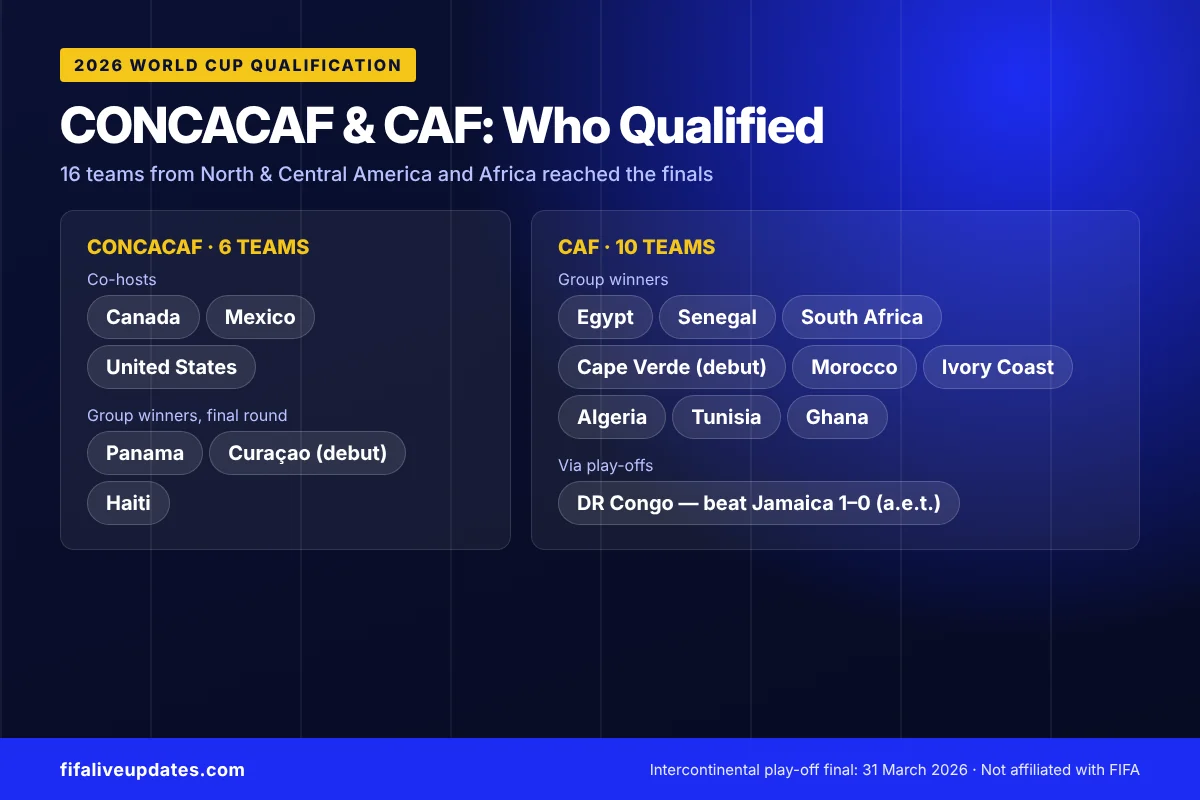
| Team | Confederation | How they qualified |
|---|---|---|
| Canada | CONCACAF | Co-host |
| Mexico | CONCACAF | Co-host |
| United States | CONCACAF | Co-host |
| Panama | CONCACAF | Won third-round Group A |
| Curaçao | CONCACAF | Won third-round Group B (debut) |
| Haiti | CONCACAF | Won third-round Group C |
| Egypt | CAF | Won Group A |
| Senegal | CAF | Won Group B |
| South Africa | CAF | Won Group C |
| Cape Verde | CAF | Won Group D (debut) |
| Morocco | CAF | Won Group E |
| Ivory Coast | CAF | Won Group F |
| Algeria | CAF | Won Group G |
| Tunisia | CAF | Won Group H |
| Ghana | CAF | Won Group I |
| DR Congo | CAF | CAF play-off, then intercontinental play-off |
What the 2026 results tell us
The expanded format gave more African and CONCACAF teams a place at the finals than ever before, and the results were mixed. All three teams that came through the CONCACAF third round, Panama, Curaçao and Haiti, finished bottom of their groups, a reminder of how big the gap remains between the region’s emerging sides and the world’s elite.
There were painful near misses too. Jamaica came within one match of the finals for the first time since 1998, only to lose to DR Congo in extra time in Guadalajara, while Suriname reached the intercontinental play-off before losing to Bolivia. Nigeria, beaten on penalties in Rabat, missed a second successive World Cup. Those results show how fine the margins were, even with 48 places available.
The hosts fared better. Mexico won all three group matches, and Canada and the United States both reached the knockout rounds. Playing at home, with large crowds and no long-haul travel, clearly helped.
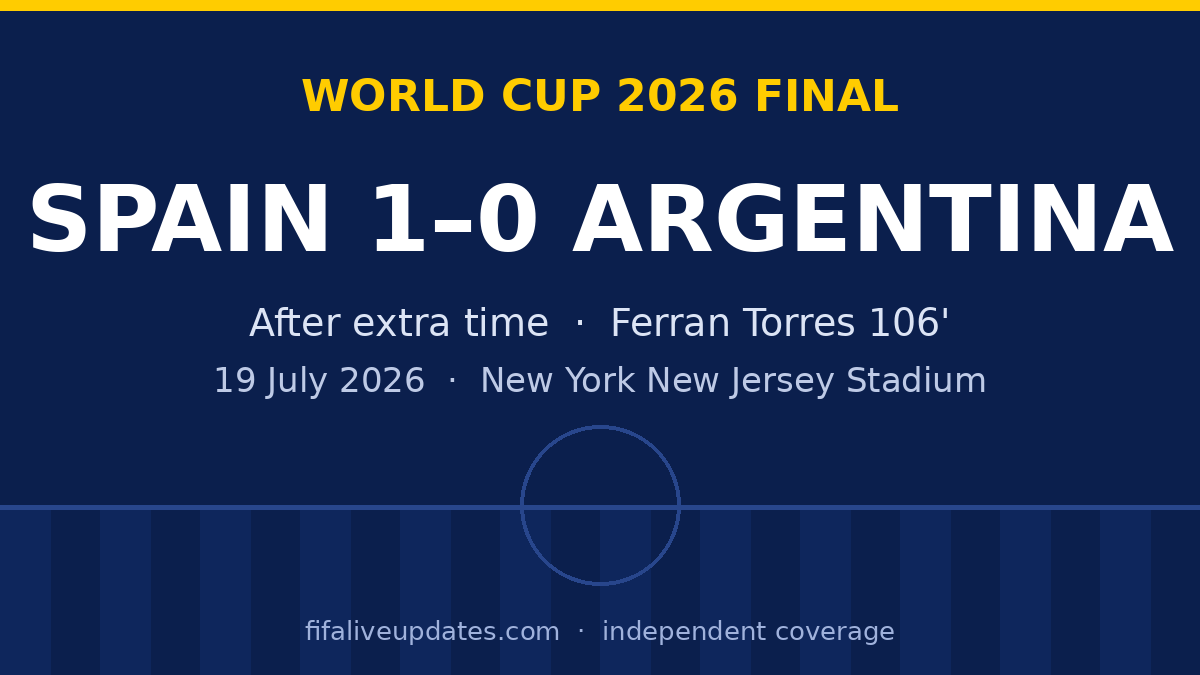
Africa’s performance was stronger overall. Nine of the ten CAF teams reached the Round of 32, with only Tunisia going out in the group stage, Morocco reached the quarter-finals for the second tournament running and Egypt reached the Round of 16. Cape Verde’s run, which included holding the eventual champions Spain to a goalless draw, was one of the stories of the group stage. Spain went on to win the tournament; read how they did it in our report on the 2026 World Cup final.
For a full overview of the tournament format, host cities and schedule, see our 2026 World Cup guide.
Looking ahead to 2030 qualifying
The next men’s World Cup, in 2030, will be staged mainly in Spain, Portugal and Morocco, with three centenary matches in Uruguay, Argentina and Paraguay. FIFA confirmed that all six countries would receive automatic places, so Morocco will not need to qualify through CAF. That leaves the rest of Africa competing for the continent’s remaining places, while CONCACAF nations will go into qualifying without the guaranteed host slots they enjoyed in 2026. More detail is in our 2030 World Cup hosts, dates and format guide.
Frequently asked questions
Which teams made their World Cup debut in 2026?
Cape Verde, Curaçao, Jordan and Uzbekistan.
Which CONCACAF teams qualified through the qualifiers?
Panama, Curaçao and Haiti, alongside the three hosts: Canada, Mexico and the United States.
Who won the intercontinental play-offs?
DR Congo (1–0 against Jamaica after extra time) and Iraq (2–1 against Bolivia).
How many African teams qualified for the 2026 World Cup?
Ten. The nine group winners qualified directly, and DR Congo qualified through the CAF play-off and then the intercontinental play-off.
Why did Haiti play their home qualifiers in Curaçao?
Because of the security situation in Haiti, their home matches were moved to Willemstad, Curaçao.
Which big nations failed to qualify from CAF and CONCACAF?
From Africa, Nigeria and Cameroon both missed out after losing in the CAF play-off. From CONCACAF, Costa Rica and Honduras were eliminated in the third round.
Who was the top scorer in African qualifying?
Algeria’s Mohamed Amoura, with 10 goals.
What is the smallest country to qualify for a World Cup?
Curaçao, with a population of around 156,000, beating the previous record held by Iceland.
Related articles
- All 48 teams at the 2026 World Cup
- Final group stage standings
- Full knockout results
- World Cup 2026 winner and awards
Sources
- 2026 FIFA World Cup qualification (overview)
- Al Jazeera: Iraq beat Bolivia 2–1 to qualify
- FourFourTwo: all 2026 World Cup scores
- FIFA World Cup 26 (official tournament site)
Related guide: for the full picture across all six confederations, read how World Cup qualification works, including the inter-confederation play-off.