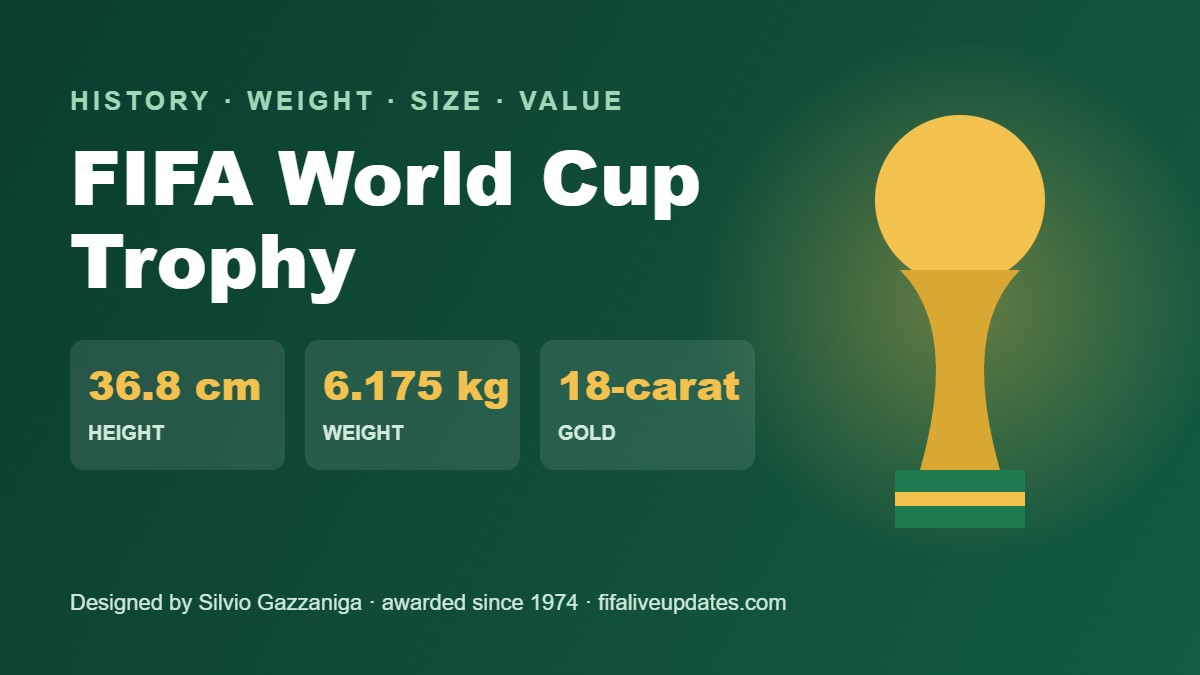
The FIFA World Cup Trophy is the most famous prize in football. The current trophy, designed by Italian sculptor Silvio Gazzaniga, has been awarded since 1974. It stands 36.8 cm tall, weighs 6.175 kg and is made of 18-carat gold with two bands of green malachite at its base. Spain were the latest team to lift it, after beating Argentina 1–0 in the 2026 final.
This guide covers everything you need to know about the World Cup trophy: its size, weight and materials, how it was designed, what it is worth, the replica that winners keep, the original Jules Rimet Trophy and the remarkable stories of how it was stolen twice.
World Cup trophy: key facts
| Fact | Details |
|---|---|
| Official name | FIFA World Cup Trophy |
| Designer | Silvio Gazzaniga (Italy) |
| Manufacturer | Bertoni, Milan |
| First awarded | 1974 (West Germany) |
| Height | 36.8 cm (about 14.5 inches) |
| Base diameter | 13 cm |
| Weight | 6.175 kg (about 13.6 lb) |
| Material | 18-carat gold, with two malachite bands in the base |
| Kept at | FIFA headquarters and the FIFA Museum, Zurich |
| Latest winner | Spain (2026) |
| Previous trophy | Jules Rimet Trophy (1930–1970) |
What is the World Cup trophy made of?
The World Cup trophy is made of 18-carat gold, which is 75% pure gold mixed with other metals to make it stronger. It was produced using the traditional “lost wax” casting method and is hollow inside, which is why it weighs just over 6 kg rather than much more. If it were solid gold all the way through, it would be far too heavy for players to lift above their heads.
The base contains two layers of malachite, a green semi-precious stone. The green bands are meant to represent the football pitch and give the trophy its distinctive two-colour look.
How big and heavy is the World Cup trophy?
| Measurement | Metric | Imperial |
|---|---|---|
| Height | 36.8 cm | 14.5 inches |
| Base diameter | 13 cm | 5.1 inches |
| Weight | 6.175 kg | 13.6 pounds |
In everyday terms, the trophy is a little taller than a 30 cm ruler and weighs about as much as six one-litre bottles of water. That is light enough for a captain to hold above his head with both hands, but heavy enough that most winners use both arms.
The design: two figures lifting the world
Gazzaniga’s design shows two human figures spiralling upwards from the base, with their arms reaching up to hold the Earth. The figures are meant to capture the moment of victory: the energy and joy of a player celebrating. FIFA’s brief in 1971 asked for a design that reflected exactly that moment.
FIFA received 53 design entries from seven countries. Gazzaniga, a sculptor from Milan, won the competition and also submitted a plaster model to show how his sketch would look in three dimensions. His design was chosen in 1971 and the new trophy was first presented at the 1974 World Cup in West Germany. Gazzaniga died in 2016 at the age of 95, but his design remains unchanged.
Names engraved on the base
The names of the winning countries, with the year of each victory, are engraved on a plate on the underside of the base, where they cannot be seen when the trophy is standing up. The plate has room for 17 winners, which means space should run out after the 2038 World Cup. FIFA has not yet said how it will deal with that, whether by changing the base, adding a new plate or replacing the trophy.
| Year | Winner engraved |
|---|---|
| 1974 | West Germany |
| 1978 | Argentina |
| 1982 | Italy |
| 1986 | Argentina |
| 1990 | West Germany |
| 1994 | Brazil |
| 1998 | France |
| 2002 | Brazil |
| 2006 | Italy |
| 2010 | Spain |
| 2014 | Germany |
| 2018 | France |
| 2022 | Argentina |
| 2026 | Spain |
That makes Spain’s 2026 title the 14th name on the current trophy. Argentina, Brazil, Germany (as West Germany and Germany), France, Italy and Spain are the only countries to have won it. For the complete list of champions including the Jules Rimet era, see our FIFA World Cup winners list.
Who keeps the World Cup trophy?
Unlike the original Jules Rimet Trophy, the current World Cup trophy can never be won outright. FIFA keeps the original, and it is only handed over for the presentation after the final and for official events such as trophy tours.
Instead, the winning country receives the FIFA World Cup Winner’s Trophy, a replica made of gold-plated bronze. The winners keep this replica permanently, while the real gold trophy returns to FIFA in Zurich shortly after the celebrations.
There is also a well-known rule about who may touch the original trophy. Under FIFA’s protocol, it can be handled only by a very small group of people, mainly former World Cup winners and heads of state. That is why the trophy is carried by former champions during official ceremonies and tours, and why ordinary fans can only see it behind glass or from a short distance.
How much is the World Cup trophy worth?
The World Cup trophy has no official price, because it is not for sale and is effectively priceless as a sporting symbol. Its value can be thought of in three ways:
- Production cost: the trophy cost about $50,000 to make in the early 1970s.
- Gold value: as an object made of several kilograms of 18-carat gold, its metal value alone is very high and rises and falls with the gold price.
- Symbolic value: as the most recognisable trophy in world sport, it is impossible to put a market price on it, which is why it is protected and insured as a unique object.
- Historical value: every name engraved on its base adds to its story, linking it with more than fifty years of World Cup finals.
Figures quoted online for the trophy’s value vary widely and are estimates rather than official valuations. For the money that teams actually earn from the tournament, see our guide to World Cup prize money.
The Jules Rimet Trophy (1930–1970)
Before 1974, World Cup winners received a different trophy. Originally called “Victory”, it was renamed the Jules Rimet Trophy in 1946 in honour of the FIFA president who created the World Cup.
| Fact | Jules Rimet Trophy |
|---|---|
| Designer | Abel Lafleur (France) |
| Design | Winged figure of Nike, the Greek goddess of victory |
| Material | Gold-plated sterling silver on a lapis lazuli base |
| Height | 35 cm |
| Weight | 3.8 kg |
| Used | 1930–1970 |
| Final fate | Kept permanently by Brazil in 1970, stolen in 1983, never recovered |
Under the original rules, any country that won the World Cup three times would keep the Jules Rimet Trophy for ever. Brazil achieved that in 1970 by winning in Mexico after earlier titles in 1958 and 1962. They took the trophy home permanently, and FIFA had to commission a new one, which is how Gazzaniga’s design came about.
Jules Rimet Trophy winners
| Year | Host | Winner |
|---|---|---|
| 1930 | Uruguay | Uruguay |
| 1934 | Italy | Italy |
| 1938 | France | Italy |
| 1950 | Brazil | Uruguay |
| 1954 | Switzerland | West Germany |
| 1958 | Sweden | Brazil |
| 1962 | Chile | Brazil |
| 1966 | England | England |
| 1970 | Mexico | Brazil |
The trophy that was stolen twice
1966: found by a dog called Pickles
A few months before the 1966 World Cup in England, the Jules Rimet Trophy was stolen while on display at an exhibition in London. The theft caused national embarrassment. A week later, a dog named Pickles sniffed out a package wrapped in newspaper under a hedge in south London while out on a walk with his owner. Inside was the missing trophy. Pickles became a celebrity, and England went on to win the tournament that summer.
1983: stolen in Rio and never recovered
The trophy’s luck ran out in Brazil. On 19 December 1983, it was stolen from the headquarters of the Brazilian Football Confederation in Rio de Janeiro. Unlike in 1966, it was never found. It is widely believed that the trophy was melted down. Brazil later had a replica made to replace it.
During the Second World War
The trophy also had a narrow escape during the Second World War. Italy were the holders after winning in 1934 and 1938, and Ottorino Barassi, an Italian football official, is said to have hidden the trophy in a shoebox under his bed to keep it safe during the war.
Captains who lifted the current World Cup trophy
| Year | Winner | Captain |
|---|---|---|
| 1974 | West Germany | Franz Beckenbauer |
| 1978 | Argentina | Daniel Passarella |
| 1982 | Italy | Dino Zoff |
| 1986 | Argentina | Diego Maradona |
| 1990 | West Germany | Lothar Matthäus |
| 1994 | Brazil | Dunga |
| 1998 | France | Didier Deschamps |
| 2002 | Brazil | Cafu |
| 2006 | Italy | Fabio Cannavaro |
| 2010 | Spain | Iker Casillas |
| 2014 | Germany | Philipp Lahm |
| 2018 | France | Hugo Lloris |
| 2022 | Argentina | Lionel Messi |
| 2026 | Spain | Rodri (lifted the trophy with his teammates) |
Franz Beckenbauer was the first captain to lift the new trophy, in Munich in 1974. Didier Deschamps later became one of the few men to win the World Cup as both a player and a coach, captaining France in 1998 and managing them to the title in 2018. Lionel Messi’s lift in Qatar in 2022, wearing a traditional black bisht over his shirt, became one of the most famous images in the trophy’s history. You can read about Spain’s 2026 win in our World Cup 2026 winner article.
The 2026 trophy presentation
The most recent presentation of the trophy took place on 19 July 2026 at New York New Jersey Stadium (MetLife Stadium) in East Rutherford, after Spain beat Argentina 1–0 in the final. Ferran Torres scored the only goal in the 106th minute of extra time, after a knock-back from Nico Williams.
The trophy was presented by US President Donald Trump, representing one of the three host nations. Rodri, who was also named the best player of the tournament, lifted the trophy with his teammates, and young star Lamine Yamal was among the Spain players pictured holding it during the celebrations. It was Spain’s second World Cup title, sixteen years after their first in South Africa in 2010, and their second name engraved on the current trophy.
For Argentina, it was a painful reverse of 2022, when Messi had lifted the same trophy in Qatar. The match details are covered in our 2026 World Cup final guide.
Trophy traditions and superstitions
Over the years, a few unwritten rules and superstitions have grown up around the trophy:
- Don’t touch it before the final: many players believe it is bad luck to touch the trophy as they walk past it onto the pitch before the final. Several famous photographs show players deliberately looking away from it.
- The kiss: almost every winning captain has kissed the trophy during the celebrations, and the image of a captain kissing the gold globe has become one of football’s classic photographs.
- The squad lift: after the captain’s lift, the trophy is passed along the whole squad and staff, often including players who did not play a minute.
Which countries have won the World Cup trophy most often?
Counting both the Jules Rimet Trophy and the current trophy, eight countries have won the World Cup:
| Country | Titles | Years |
|---|---|---|
| Brazil | 5 | 1958, 1962, 1970, 1994, 2002 |
| Germany / West Germany | 4 | 1954, 1974, 1990, 2014 |
| Italy | 4 | 1934, 1938, 1982, 2006 |
| Argentina | 3 | 1978, 1986, 2022 |
| France | 2 | 1998, 2018 |
| Uruguay | 2 | 1930, 1950 |
| Spain | 2 | 2010, 2026 |
| England | 1 | 1966 |
Brazil remain the most successful nation with five titles, but they have not lifted the trophy since 2002. Spain’s second title in 2026 moved them level with France and Uruguay on two.
The FIFA World Cup Trophy Tour
Before recent World Cups, FIFA has sent the original trophy on a worldwide tour, giving fans in many countries the chance to see it in person. These tours usually visit dozens of countries in the months before the tournament, with the trophy travelling in a secure case and accompanied by former World Cup winners, who are allowed to handle it.
For fans, the tour is often the only chance to see the real trophy close up. Outside of tours and the final itself, the original trophy spends most of its time in Zurich, where it is linked to the FIFA Museum.
Replicas you can buy
Because the original is never sold, the market for replica World Cup trophies is huge. Typical options include:
- Full-size replicas made of gold-plated metal, which look similar to the original but use cheaper materials and no real malachite.
- Half-size replicas made of metal alloys, popular with collectors and fans.
- Small desk models in resin, sold as souvenirs and gifts.
Only official licensed products are approved by FIFA. The official winner’s replica given to champion nations is a separate item and is not available to the public.
Why the trophy design has lasted
More than fifty years after it was first presented, Gazzaniga’s trophy has hardly changed. Part of the reason is its simple, powerful idea: two players reaching up to hold the world. It works on television, in photographs and on merchandise, and it is instantly recognisable even as a silhouette.
The trophy has also become linked with the greatest moments in football history, from Maradona in 1986 to Messi in 2022. Each new winner adds another memory, which is why many fans hope FIFA will keep the design even after the base runs out of space. For the next tournament, see our 2030 World Cup hosts, dates and format guide, and for more tournament history, our guides to World Cup mascots and Golden Ball winners.
FAQs about the World Cup trophy
What is the World Cup trophy made of?
The FIFA World Cup Trophy is made of 18-carat gold, with two bands of green malachite in its base. It is cast hollow, which keeps its weight to 6.175 kg.
How much does the World Cup trophy weigh?
The World Cup trophy weighs 6.175 kg, or about 13.6 pounds. The earlier Jules Rimet Trophy weighed 3.8 kg.
How tall is the World Cup trophy?
The trophy is 36.8 cm (about 14.5 inches) tall, with a base diameter of 13 cm.
Who designed the World Cup trophy?
The current trophy was designed by Italian sculptor Silvio Gazzaniga and made by Bertoni in Milan. It was first awarded in 1974.
Do World Cup winners keep the trophy?
No. FIFA keeps the original gold trophy. The winners receive a gold-plated bronze replica called the FIFA World Cup Winner’s Trophy, which they keep permanently.
What happened to the Jules Rimet Trophy?
Brazil kept the Jules Rimet Trophy permanently after winning their third World Cup in 1970. It was stolen from the Brazilian Football Confederation’s headquarters in Rio de Janeiro in December 1983 and has never been recovered.
How much is the World Cup trophy worth?
There is no official value. It cost about $50,000 to produce in the early 1970s, and its gold content alone is worth a large sum today, but as a unique sporting symbol it is effectively priceless.
When will the World Cup trophy run out of space?
The plate under the base has room for 17 winners, so it should be full after the 2038 World Cup. Spain’s 2026 win was the 14th name engraved.