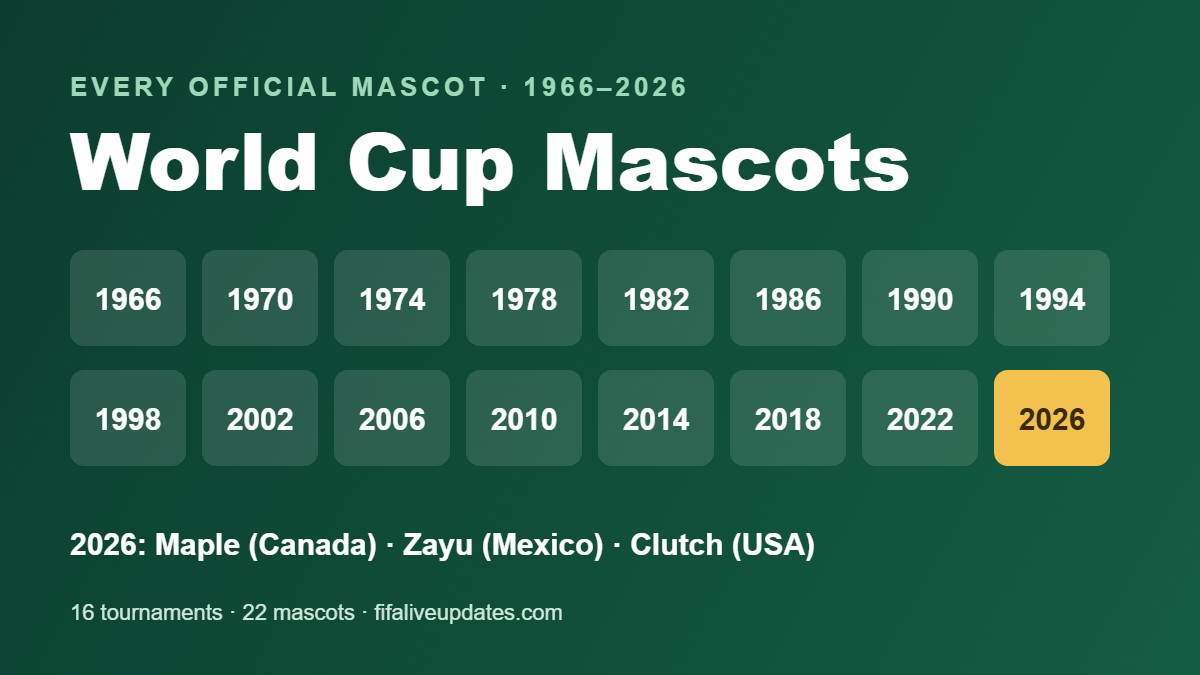
Every FIFA World Cup since 1966 has had an official mascot. The first was World Cup Willie, a lion in a Union Jack shirt created for England 1966. The most recent are Maple, Zayu and Clutch, a moose, a jaguar and a bald eagle who represented Canada, Mexico and the United States at the 2026 World Cup. In between came oranges, peppers, wolves, armadillos and even a talking football.
This guide lists every World Cup mascot from 1966 to 2026 with its name, animal or character and host country, explains the story behind each one, and looks at the most famous and the most unusual mascots in tournament history.
World Cup 2026 mascots: Maple, Zayu and Clutch
FIFA unveiled the three official mascots of the 2026 World Cup on 25 September 2025. With the tournament shared between three host countries for the first time, FIFA chose one mascot for each nation. Each one is also given a playing position and a shirt number linked to that country’s football history.
| Mascot | Animal | Country | Position | Shirt number |
|---|---|---|---|---|
| Maple | Moose | Canada | Goalkeeper | 1 |
| Zayu | Jaguar | Mexico | Forward (striker) | 9 |
| Clutch | Bald eagle | United States | Midfielder | 10 |
Maple the moose (Canada)
Maple wears Canada’s red and plays in goal. The name comes from the maple leaf, Canada’s national symbol, and FIFA describes the character as a street-style-loving artist, a music fan and a dedicated goalkeeper who travels across every Canadian province and territory. The number 1 shirt honours the goalkeepers who wore it at Canada’s first two World Cups, Tino Lettieri in 1986 and Dayne St. Clair in 2022. Canada is home to one of the largest moose populations in the world.
Zayu the jaguar (Mexico)
Zayu wears Mexico’s traditional green and plays up front. The jaguar has deep roots in Mexican history: ancient civilisations including the Maya linked it with strength and bravery. FIFA says the name is inspired by unity, strength and joy, and the character celebrates Mexican culture through dance, food and tradition. Zayu’s number 9 is a nod to great Mexican strikers such as Hugo Sánchez, Jared Borgetti and Enrique Borja.
Clutch the bald eagle (United States)
Clutch wears the blue of the United States and plays in midfield. The bald eagle is the national bird of the USA, and the name refers to the ability to perform under pressure, the “clutch” moment. FIFA describes Clutch as curious, optimistic and full of a thirst for adventure. The number 10 shirt links to American attacking stars such as Landon Donovan and Christian Pulisic.
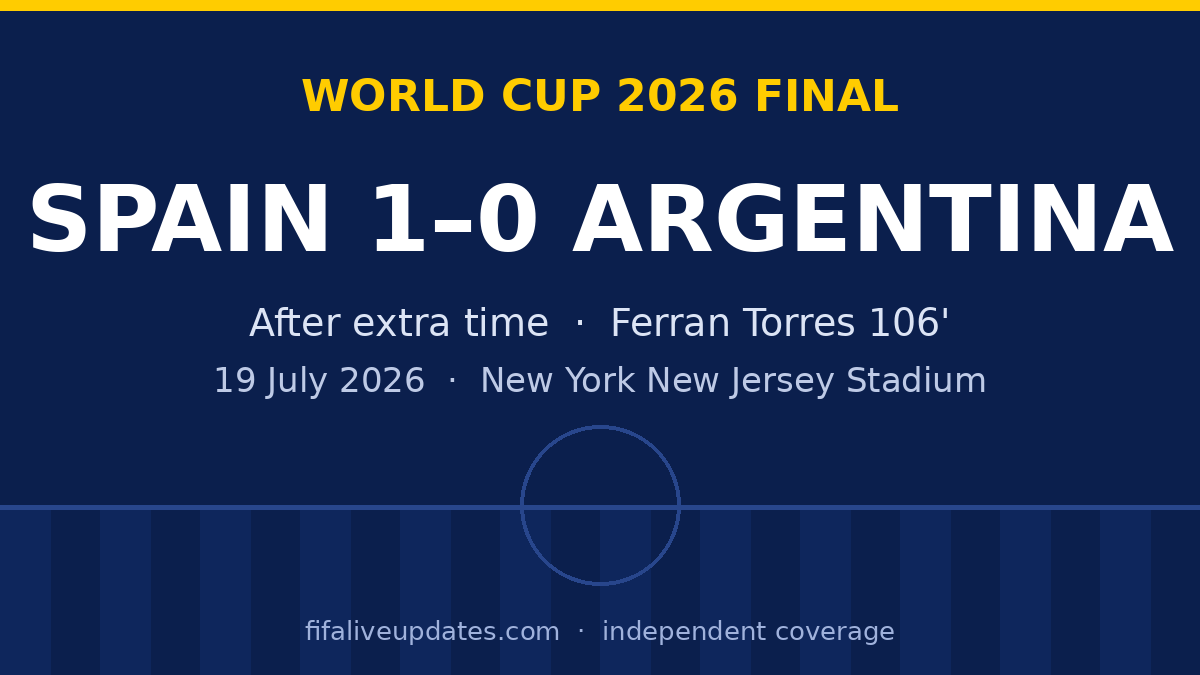
The three mascots also appeared as playable characters in the FIFA Heroes video game, each with a special ability, alongside players from the 2026 World Cup. The tournament itself was won by Spain; see our World Cup 2026 winner article for the full story.
Every World Cup mascot: full list 1966–2026
| Year | Host | Mascot | What it is |
|---|---|---|---|
| 1966 | England | World Cup Willie | Lion |
| 1970 | Mexico | Juanito | Boy in a sombrero |
| 1974 | West Germany | Tip and Tap | Two boys |
| 1978 | Argentina | Gauchito | Boy dressed as a gaucho |
| 1982 | Spain | Naranjito | Orange |
| 1986 | Mexico | Pique | Jalapeño pepper |
| 1990 | Italy | Ciao | Stick figure with a football head |
| 1994 | USA | Striker | Dog |
| 1998 | France | Footix | Rooster |
| 2002 | South Korea and Japan | Ato, Kaz and Nik | Futuristic “Spheriks” |
| 2006 | Germany | Goleo VI and Pille | Lion and a talking football |
| 2010 | South Africa | Zakumi | Leopard |
| 2014 | Brazil | Fuleco | Three-banded armadillo |
| 2018 | Russia | Zabivaka | Wolf |
| 2022 | Qatar | La’eeb | Floating headdress character |
| 2026 | Canada, Mexico, USA | Maple, Zayu and Clutch | Moose, jaguar and bald eagle |
There were no official mascots at the World Cups from 1930 to 1962. The tradition began in England in 1966 and has continued at every tournament since. To see who won each of these tournaments, check our FIFA World Cup winners list.
The story behind every World Cup mascot
1966 England: World Cup Willie
World Cup Willie was the first mascot in the history of a major sports tournament of this kind. He was a cheerful lion, a symbol strongly linked with England, wearing a Union Jack shirt with “World Cup” written across it. Willie appeared on badges, toys and posters and even had his own song. England went on to win the tournament at Wembley, which helped make him one of the best-remembered mascots of all.
1970 Mexico: Juanito
Mexico chose a human mascot: Juanito, a smiling boy wearing the host nation’s kit and a large sombrero with “México 70” on it. His friendly design matched a tournament that is still remembered for colour and attacking football, with Pelé’s Brazil winning the trophy.
1974 West Germany: Tip and Tap
For the first time, a World Cup had two mascots. Tip and Tap were two boys in German kit, one wearing “WM” (Weltmeisterschaft) and the other “74” on his shirt. They represented friendship and togetherness, and West Germany won the tournament on home soil.
1978 Argentina: Gauchito
Gauchito was a boy dressed as a gaucho, the traditional horseman of the Argentine plains, wearing a hat, neckerchief and Argentina’s sky blue and white stripes. Like Willie in 1966, he saw the hosts lift the trophy.
1982 Spain: Naranjito
Naranjito (“little orange”) was an orange wearing Spain’s kit and holding a football. The orange was chosen as a symbol of the Valencia region and of Spanish produce. He became extremely popular in Spain and starred in his own animated television series.
1986 Mexico: Pique
Mexico’s second World Cup produced one of the most unusual mascots ever: Pique, a jalapeño pepper with a moustache and a sombrero. The name comes from “picante”, meaning spicy. That tournament belonged to Diego Maradona and Argentina.
1990 Italy: Ciao
Ciao was the most abstract mascot in World Cup history: a stick figure made of blocks in the colours of the Italian flag, with a football for a head. The name is the familiar Italian greeting. Ciao’s modern, minimalist design still divides opinion.
1994 USA: Striker
Striker the World Cup Pup was a dog in a red, white and blue kit. He was designed by a Warner Bros. animation team, which gave him a cartoon look aimed at introducing football to a wider American audience at the first World Cup held in the United States.
1998 France: Footix
Footix was a blue rooster, the cockerel being a traditional symbol of France. The name combines “football” with the “-ix” ending made famous by the Asterix comics. France won their first World Cup on home soil, and the name Footix is still used in France today, sometimes jokingly, to describe a fair-weather football fan.
2002 South Korea and Japan: Ato, Kaz and Nik
The first World Cup in Asia had three futuristic creatures known as the Spheriks. Ato was the coach, while Kaz and Nik were players in a fictional sport called Atmoball. The idea was ambitious, but the characters were less popular than many earlier mascots.
2006 Germany: Goleo VI and Pille
Goleo VI was a lion in a Germany shirt, accompanied by Pille, a talking football. Goleo is often remembered for wearing a shirt but no shorts, and the company that produced the official soft toys ran into financial trouble during the tournament. Even so, the pair are among the most recognisable mascots of the 2000s.
2010 South Africa: Zakumi
Zakumi was a leopard with green hair, in the colours of the South African team. The name combines “ZA”, the international code for South Africa, with “kumi”, a word meaning ten in several African languages, a reference to the year 2010. He was the mascot of the first World Cup in Africa.
2014 Brazil: Fuleco
Fuleco was a Brazilian three-banded armadillo, a species that rolls into a ball when threatened, which made it a natural fit for football. The name mixes “futebol” and “ecologia” (ecology), and the mascot was used to raise awareness of the endangered species.
2018 Russia: Zabivaka
Zabivaka was a wolf wearing goggles and a Russia kit. His name means “the one who scores” in Russian. He was chosen by public vote, beating a tiger and a cat in the final round of voting.
2022 Qatar: La’eeb
La’eeb was a floating character shaped like a traditional Arab headdress, the ghutra. The name means “super-skilled player” in Arabic. FIFA described La’eeb as coming from a “mascot-verse”, and the design was unlike any earlier World Cup mascot. Argentina won the tournament, beating France on penalties in the final.
The most famous World Cup mascots
Popularity is subjective, but a handful of mascots are remembered far beyond their own tournaments:
- World Cup Willie (1966): the original, and still a nostalgic symbol of England’s only World Cup win.
- Naranjito (1982): hugely popular in Spain, with his own TV cartoon and a huge range of merchandise.
- Footix (1998): linked forever with France’s first world title, and still part of everyday French football language.
- Zakumi (2010): the face of the first African World Cup, alongside the sound of the vuvuzela.
- Zabivaka (2018): a fan favourite, chosen by public vote and widely shared on social media.
- Maple, Zayu and Clutch (2026): the first trio to represent three host nations, and playable characters in the FIFA Heroes video game.
The most unusual World Cup mascots
Not every mascot has been a hit. Some designs were bold experiments that fans still debate today:
- Pique (1986): a chilli pepper with a moustache is not an obvious choice for a football tournament, but it is now remembered with real affection in Mexico.
- Ciao (1990): the block-shaped stick figure was a deliberately modern design. Some fans loved its simplicity, while others found it hard to warm to.
- The Spheriks (2002): Ato, Kaz and Nik came with a complex backstory about a fictional sport, which made them harder for casual fans to connect with.
- Goleo VI and Pille (2006): a lion without shorts and a talking football attracted plenty of jokes in Germany.
- La’eeb (2022): the floating headdress was unlike any mascot before it, and its “mascot-verse” story was one of the most imaginative concepts FIFA has used.
Unusual does not always mean unpopular. Several of these characters are now collectors’ items, and old mascot merchandise from the 1980s and 1990s regularly appears in football memorabilia sales.
World Cup mascots by type
Animals are the most common choice. Half of the 16 tournaments with mascots have featured at least one animal, usually one that is a national symbol of the host country.
| Type | Mascots | Examples |
|---|---|---|
| Big cats | 4 tournaments | World Cup Willie, Goleo VI, Zakumi, Zayu |
| Other animals | 6 tournaments | Striker (dog), Footix (rooster), Fuleco (armadillo), Zabivaka (wolf), Maple (moose), Clutch (eagle) |
| Human characters | 3 tournaments | Juanito, Tip and Tap, Gauchito |
| Food | 2 tournaments | Naranjito (orange), Pique (pepper) |
| Abstract or fantasy | 4 tournaments | Ciao, the Spheriks, Pille, La’eeb |
Some tournaments appear in more than one row because they had more than one mascot. Lions are the single most popular animal, used in both 1966 and 2006, and big cats in general have appeared four times.
Fun facts about World Cup mascots
- Multiple mascots: 1974 (Tip and Tap), 2002 (Ato, Kaz and Nik), 2006 (Goleo and Pille) and 2026 (Maple, Zayu and Clutch) all had more than one character. 2002 and 2026 are the only tournaments with three.
- Hosts who won with their mascot: England (1966), West Germany (1974), Argentina (1978) and France (1998) all won the World Cup at home.
- Mexico’s three mascots: Mexico is the only country to have had a mascot at three different World Cups: Juanito (1970), Pique (1986) and Zayu (2026).
- Chosen by fans: Zabivaka in 2018 was selected through a public vote.
- Video game role: the 2026 mascots appeared as playable characters alongside real World Cup players in FIFA Heroes.
- Shirt numbers: the 2026 mascots were each given a playing position and a squad number linked to their country’s football history.
How World Cup mascots are created
Mascots are usually developed by FIFA together with the host country’s organising committee. The design normally reflects something closely linked to the host nation, such as a national animal, a traditional costume or a regional product. Once approved, the mascot is used across official merchandise, broadcasts, stadium events, school programmes and social media in the build-up to the tournament.
The unveiling usually takes place a year or more before kick-off. For 2026, FIFA revealed Maple, Zayu and Clutch on 25 September 2025, roughly eight and a half months before the opening match on 11 June 2026. Read more about the tournament in our FIFA World Cup 2026 guide.
Why mascots matter
A mascot gives a World Cup a friendly face, especially for children. It also plays a big commercial role: soft toys, keyrings, clothing and video games featuring the mascot are among the best-selling official products at every tournament. For host nations, the mascot is a chance to show off something about their culture, from Spanish oranges to the Brazilian armadillo.
Good mascots also become part of football memory. Fans who grew up in the 1980s and 1990s often remember Naranjito, Pique or Striker as clearly as the players from those tournaments.
Mascots also help tournaments reach new audiences. In 1994, Striker was designed to make football feel familiar to American families who had grown up with other sports. In 2026, the three mascots were used to link fans across three very different countries, with each character carrying its own national colours, culture and football history into the same tournament.
What about the 2030 World Cup mascot?
The 2030 World Cup will be hosted by Spain, Portugal and Morocco, with three centenary matches in Uruguay, Argentina and Paraguay. At the time of writing, we could not find any official announcement of a 2030 mascot. Based on past tournaments, an unveiling would be expected around a year before the tournament. Follow the latest plans in our 2030 World Cup hosts, dates and format guide.
FAQs about World Cup mascots
What are the 2026 World Cup mascots called?
The 2026 World Cup mascots are Maple the moose (Canada), Zayu the jaguar (Mexico) and Clutch the bald eagle (United States). FIFA unveiled them on 25 September 2025.
What was the first World Cup mascot?
The first World Cup mascot was World Cup Willie, a lion created for the 1966 World Cup in England.
What was the 2022 World Cup mascot?
The 2022 World Cup mascot in Qatar was La’eeb, a floating character based on the traditional ghutra headdress. The name means “super-skilled player” in Arabic.
How many World Cup mascots are there?
There have been mascots at 16 World Cups, from 1966 to 2026. Counting each character separately, there are 22 individual mascots, because several tournaments had two or three.
Which animal has been a World Cup mascot most often?
The lion, used in 1966 (World Cup Willie) and 2006 (Goleo VI). Big cats in general, including a leopard and a jaguar, have appeared four times.
What was the 2018 World Cup mascot?
The 2018 World Cup mascot in Russia was Zabivaka, a wolf whose name means “the one who scores”.
What was the 2014 World Cup mascot?
The 2014 World Cup mascot in Brazil was Fuleco, a three-banded armadillo, chosen to raise awareness of the species.