Every World Cup starts long before the opening match. For the 2026 tournament, 206 national teams entered qualifying alongside the three automatic hosts, and the process ran for two and a half years before the final 48 were known. Since the World Cup expanded to 48 teams, the route has changed: more places for every region, a guaranteed place for Oceania, a new inter-confederation play-off, and six automatic spots already handed out for 2030.
This guide explains how World Cup qualification works from start to finish: how places are shared, how each region runs its competition, how the play-off decides the last two spots, what happened in the 2026 cycle, and what we know so far about qualifying for 2030.
How Many Teams Qualify for the World Cup?
The 2026 World Cup was the first with 48 teams, up from 32. Those 48 places are shared between FIFA’s six continental confederations. Each confederation runs its own qualifying competition, and its results decide who fills that region’s places. FIFA sets the number of places; the confederations decide the format.
From 16 Teams to 48
Qualifying is almost as old as the tournament itself. The first World Cup in 1930 was played by invitation, and qualifying matches were first needed for the 1934 edition, when more teams wanted to enter than the finals could hold.
The size of the finals has grown in four main steps. The tournament was planned around 16 teams from 1934 to 1978, grew to 24 teams in 1982, moved to 32 teams in 1998 and expanded to 48 teams in 2026. Every expansion changed qualifying, because it gave more places to regions outside Europe and South America.
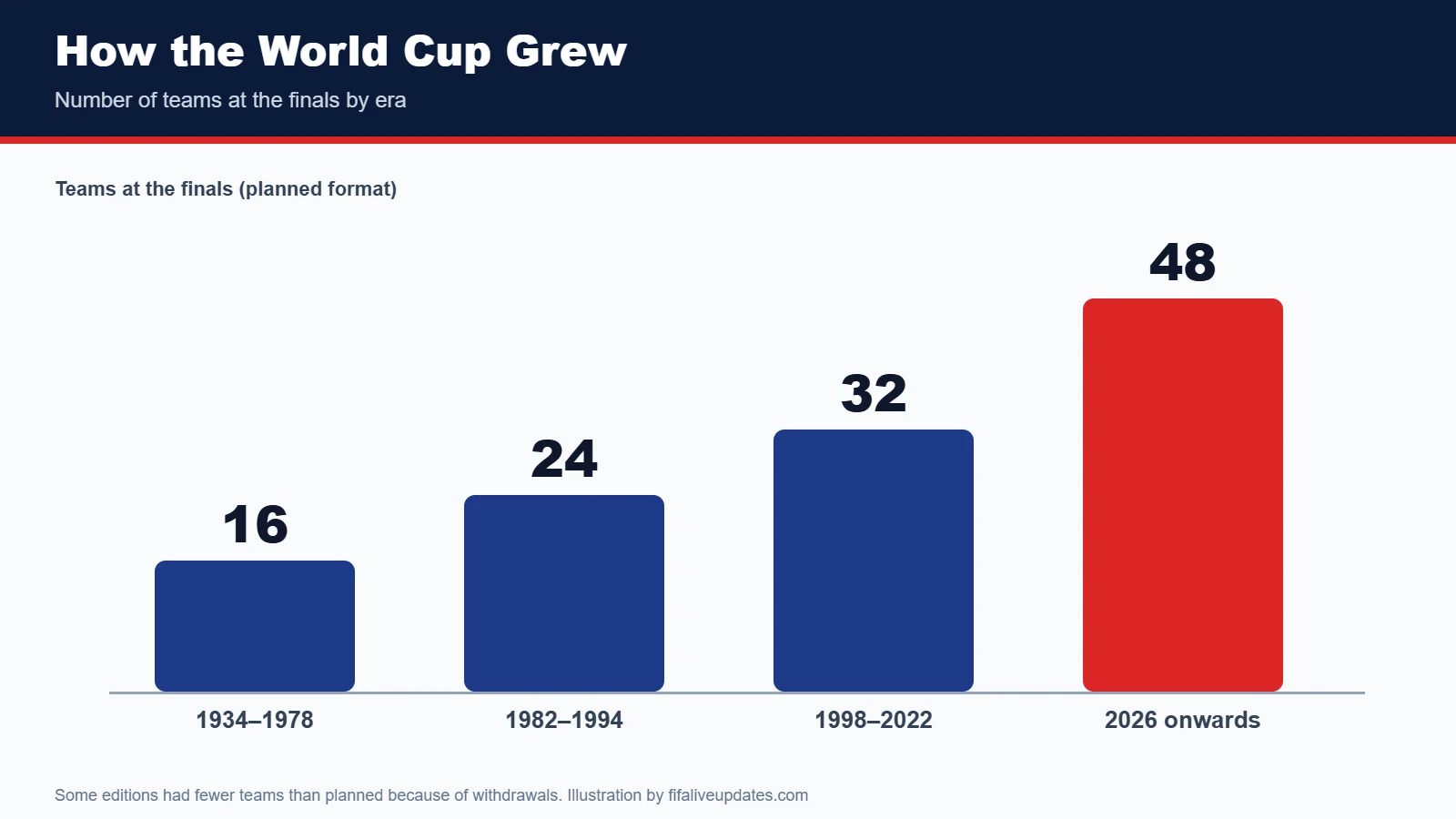
| Era | Teams at the finals | What changed for qualifying |
|---|---|---|
| 1934–1978 | 16 (planned) | Qualifying introduced; most places went to Europe and South America |
| 1982–1994 | 24 | More places for Africa, Asia and CONCACAF |
| 1998–2022 | 32 | Further growth for Africa and Asia; Oceania still had no guaranteed place |
| 2026 onwards | 48 | Every region gains places; Oceania gets a direct place; six-team play-off added |
World Cup Places by Confederation
In March 2017, FIFA set out how the 48 places would be shared. Forty-six go directly to confederations. The last two are decided by a six-team play-off between confederations. Host nations take places from their own confederation’s allocation.
| Confederation | Region | Direct places | Play-off entries |
|---|---|---|---|
| UEFA | Europe | 16 | 0 |
| CAF | Africa | 9 | 1 |
| AFC | Asia | 8 | 1 |
| CONCACAF | North and Central America, Caribbean | 6 | 2 |
| CONMEBOL | South America | 6 | 1 |
| OFC | Oceania | 1 | 1 |
| Total | 46 | 6 teams for 2 places |
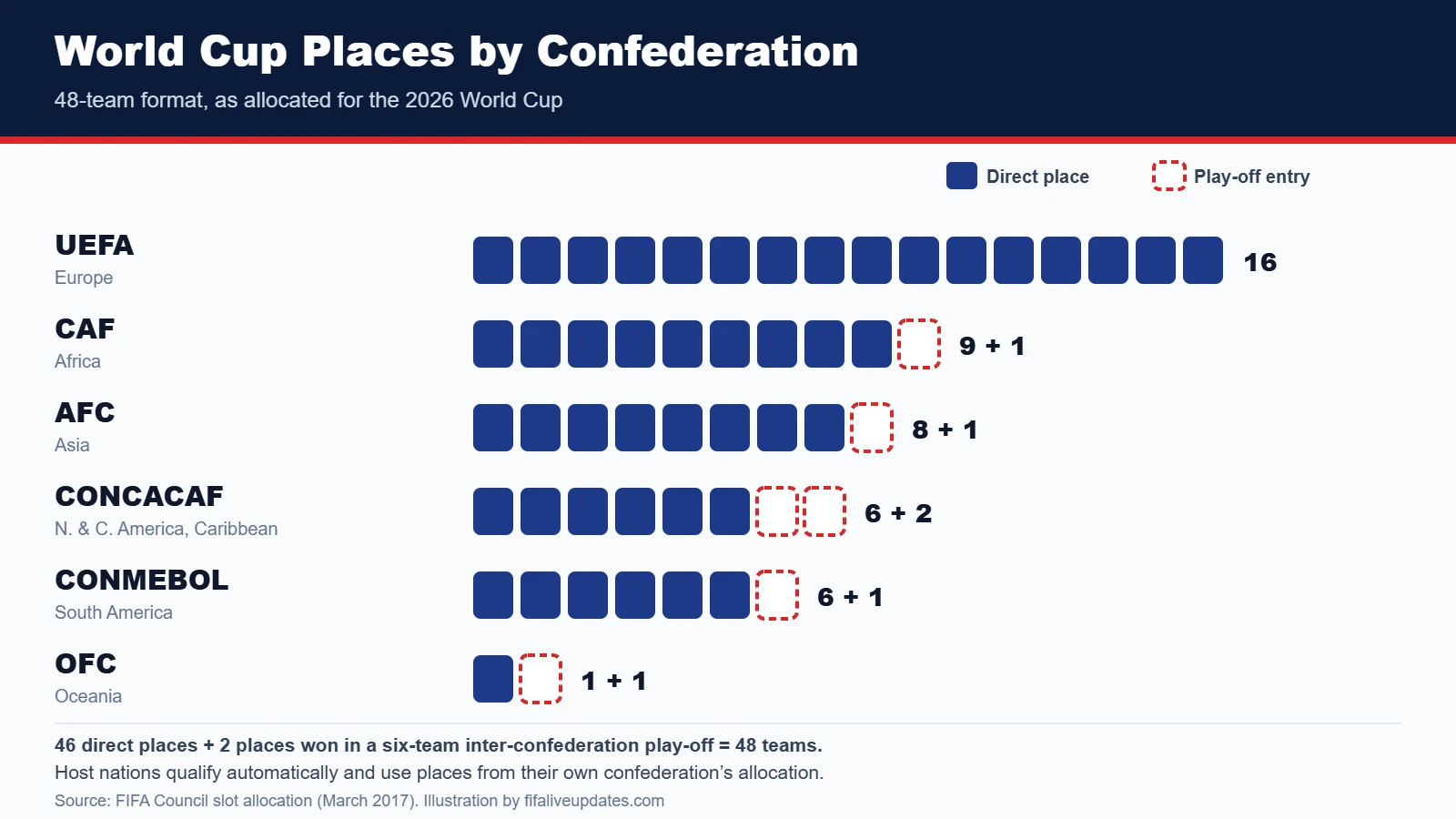
The share of places roughly follows the number of strong teams in each region and FIFA’s aim to spread the tournament worldwide. Europe still has the most places, but Africa and Asia gained the most from the expansion to 48 teams.
The 2026 Qualifying Cycle in Numbers
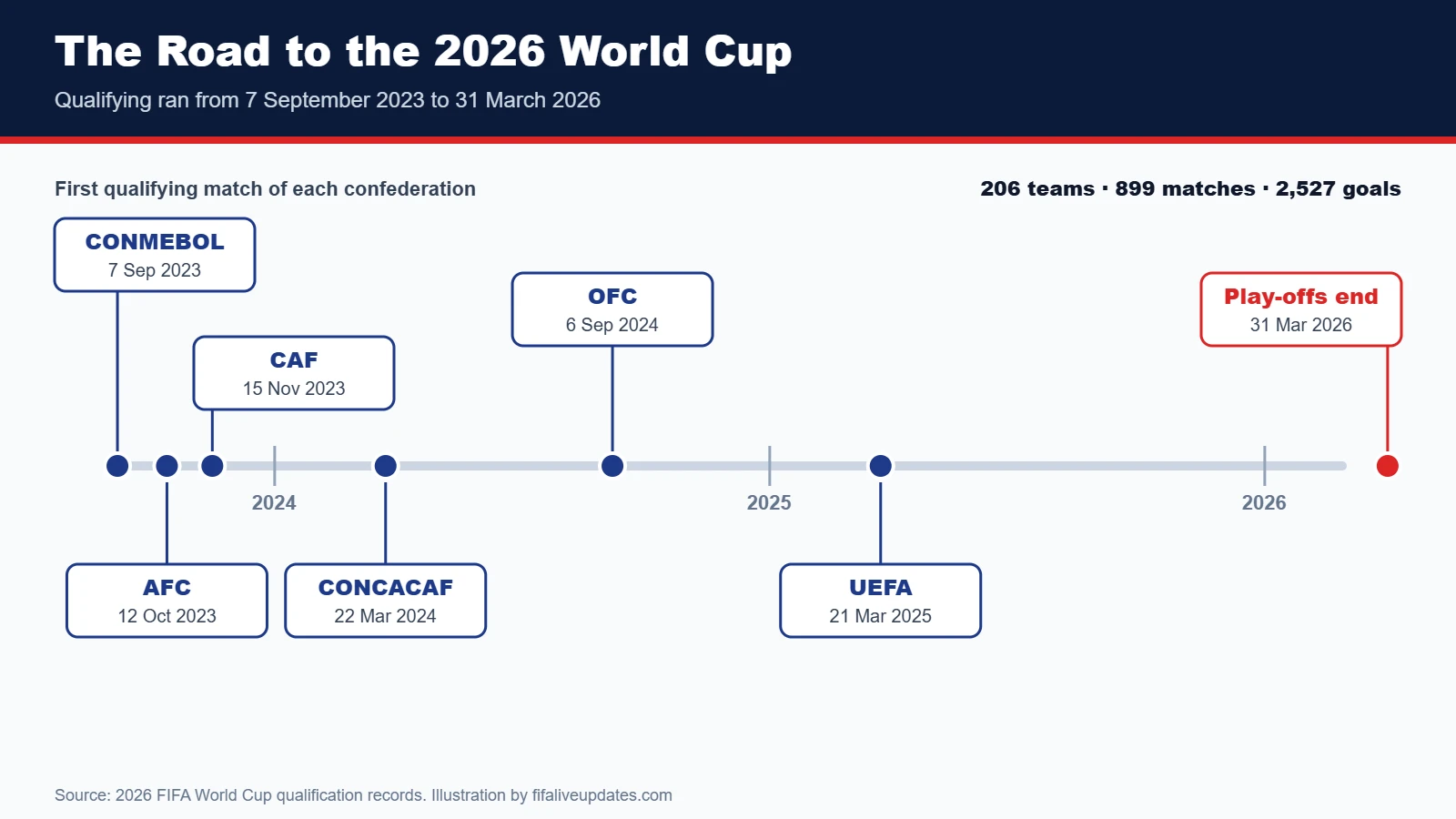
Qualifying for 2026 began on 7 September 2023 and ended on 31 March 2026. Each confederation started at a different time, depending on how many rounds its format needed. South America and Asia began first because their competitions were the longest; Europe started last because its format was the shortest.
| Figure | 2026 qualifying |
|---|---|
| Teams entered | 206 (plus 3 automatic hosts) |
| First match | 7 September 2023 |
| Last match | 31 March 2026 |
| Matches played | 899 |
| Goals scored | 2,527 (2.81 per match) |
| First-time qualifiers | Cape Verde, Curaçao, Jordan, Uzbekistan |
| Confederation | First qualifying match |
|---|---|
| CONMEBOL | 7 September 2023 |
| AFC | 12 October 2023 |
| CAF | 15 November 2023 |
| CONCACAF | 22 March 2024 |
| OFC | 6 September 2024 |
| UEFA | 21 March 2025 |
Qualifying matches are played in FIFA’s international windows, the set periods when clubs must release players for national teams. That is why qualifiers are spread over many months rather than played in one block.
How Each Confederation Qualified for 2026
Each region chooses its own format. Here is how the six confederations filled their places for the 2026 finals, and who came through.
UEFA (Europe): 16 places
Europe’s teams were drawn into 12 groups, six of four teams and six of five. The 12 group winners qualified directly. The 12 runners-up joined the four best-ranked Nations League group winners that had not already finished in the top two of their group. Those 16 teams played four play-off paths of single-leg semi-finals and finals on 26 and 31 March 2026, and the four path winners qualified.
The 16 European qualifiers were England, France, Croatia, Portugal, Norway, Germany, the Netherlands, Switzerland, Scotland, Spain, Austria, Belgium, Bosnia and Herzegovina, Sweden, Turkey and the Czech Republic.
CAF (Africa): 9 places + 1 play-off entry
Africa used nine groups of six. Each group winner qualified directly. The four best runners-up then played off, and the winner went to the inter-confederation play-off.
Africa’s direct qualifiers were Morocco, Tunisia, Egypt, Algeria, Ghana, Cape Verde, Senegal, South Africa and Ivory Coast. DR Congo later added a tenth African team through the inter-confederation play-off. Cape Verde reached the World Cup for the first time.
AFC (Asia): 8 places + 1 play-off entry
After the early rounds, 18 teams played in three groups of six. The top two in each group, six teams in total, qualified. Teams finishing third and fourth moved to a fourth round of two groups of three, where the group winners took Asia’s last two direct places. The two fourth-round runners-up then met over two legs for the play-off entry.
Asia’s direct qualifiers were Japan, Iran, Uzbekistan, Jordan, South Korea, Australia, Qatar and Saudi Arabia. Iraq became the ninth Asian team through the play-off. Jordan and Uzbekistan both qualified for the first time.
CONCACAF (North and Central America, Caribbean): 6 places + 2 play-off entries
The three hosts, Canada, Mexico and the United States, qualified automatically and used half of the region’s six places. The other teams competed for the remaining three. In the final round, 12 teams played in three groups of four. The group winners, Panama, Curaçao and Haiti, qualified, and the two best runners-up, Jamaica and Suriname, went to the inter-confederation play-off. Curaçao reached its first World Cup. Our guide to how CONCACAF and CAF teams reached the 2026 finals covers those campaigns in detail.
CONMEBOL (South America): 6 places + 1 play-off entry
South America uses the simplest format. All ten teams play each other home and away in one league table, 18 matches each. For 2026, the top six qualified: Argentina, Brazil, Ecuador, Paraguay, Uruguay and Colombia. Bolivia, in seventh, went to the play-off.
OFC (Oceania): 1 place + 1 play-off entry
For the first time, Oceania had a guaranteed place. The region’s qualifying ended with a four-team knockout stage. New Zealand won it and qualified directly, while New Caledonia, the losing finalist, went to the inter-confederation play-off.
What the 48-Team Format Changed
The clearest way to see the impact of expansion is to compare the 2022 and 2026 allocations. In the 32-team era, some regions shared half-places, meaning their best non-qualifier went into a two-team intercontinental play-off. The 48-team format replaced those with the six-team play-off.
| Confederation | 2022 places (32 teams) | 2026 places (48 teams) |
|---|---|---|
| UEFA | 13 | 16 |
| CAF | 5 | 9 + 1 play-off entry |
| AFC | 4.5 | 8 + 1 play-off entry |
| CONCACAF | 3.5 | 6 + 2 play-off entries |
| CONMEBOL | 4.5 | 6 + 1 play-off entry |
| OFC | 0.5 | 1 + 1 play-off entry |
Africa gained the most, almost doubling its direct places from five to nine. Asia doubled from four direct places to eight. Oceania, which had not had a guaranteed place before, now has one. Europe gained three places, the smallest increase relative to its size.
Why Big Teams Can Still Miss Out
More places do not guarantee that every famous team qualifies. Italy, four-time world champions, are not among the 16 European qualifiers for 2026, after also missing the 2018 and 2022 tournaments. In Europe only group winners qualify directly, and a single bad night in a one-leg play-off can end a campaign. Our World Cup winners list shows how much history some of these nations carry, yet qualifying treats every team the same.
The opposite is also true. Expansion opened the door for smaller nations: Curaçao, with a population of around 150,000, became one of the smallest countries ever to reach a World Cup.
How the Inter-Confederation Play-off Works
The play-off decides the last two places at the World Cup. It has six teams: one from each confederation except UEFA, plus a second team from the host confederation.
- The two highest-ranked teams in the FIFA World Ranking are seeded and go straight to the play-off finals.
- The four unseeded teams play two knockout semi-finals.
- Each semi-final winner faces a seeded team. The two winners of those finals qualify for the World Cup.
The 2026 Play-off
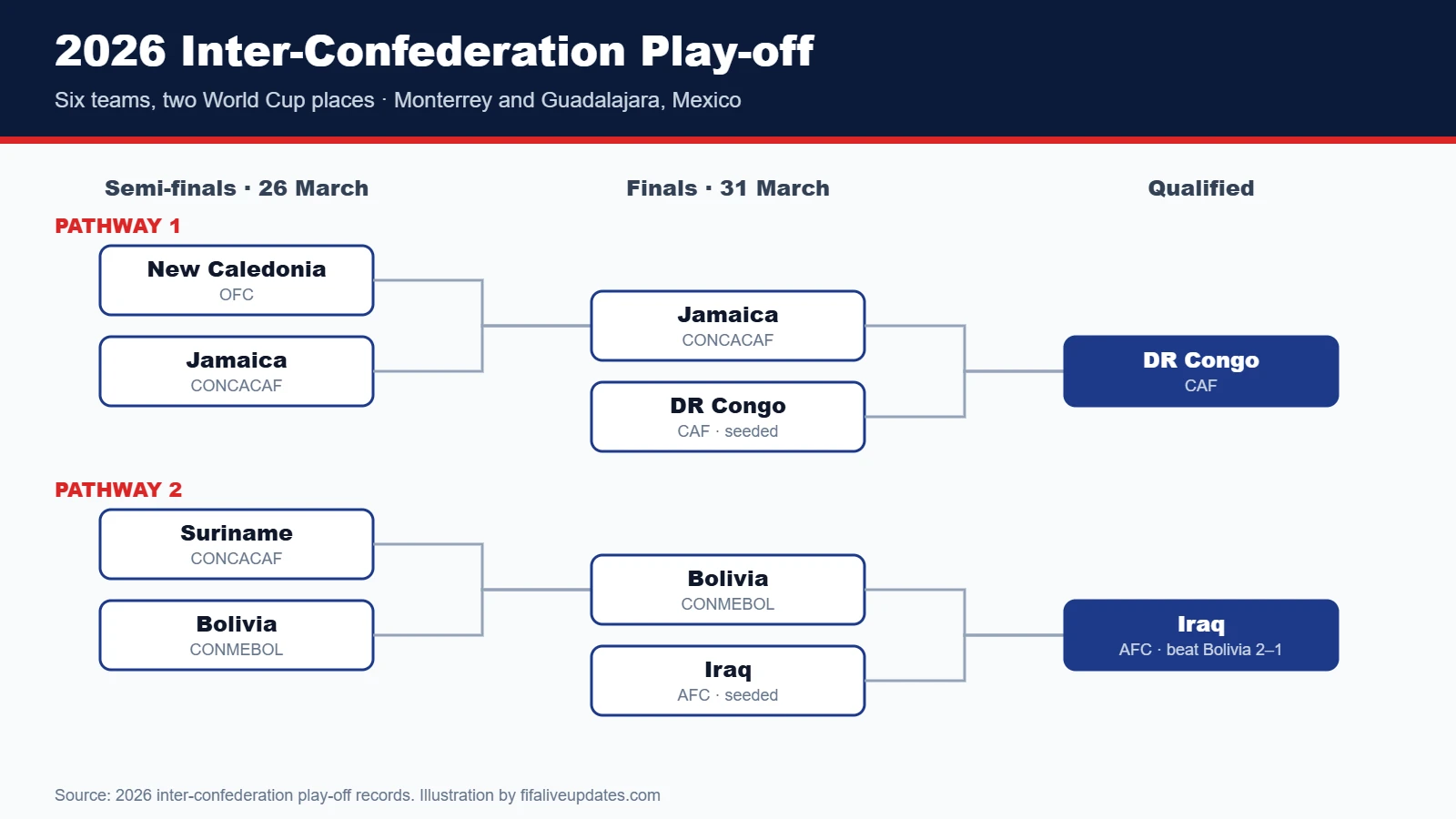
The 2026 play-off was held in Mexico on 26 and 31 March 2026, at the stadiums in Monterrey and Guadalajara that later hosted World Cup matches. DR Congo and Iraq were the seeded teams. Jamaica, Suriname, Bolivia and New Caledonia played the semi-finals.
DR Congo won Pathway 1 to reach the finals. In Pathway 2, Iraq beat Bolivia 2–1 in Monterrey to qualify for their first World Cup since 1986.
| Team | Confederation | Status |
|---|---|---|
| DR Congo | CAF | Seeded, qualified |
| Iraq | AFC | Seeded, qualified |
| Jamaica | CONCACAF | Unseeded |
| Suriname | CONCACAF | Unseeded |
| Bolivia | CONMEBOL | Unseeded, lost the Pathway 2 final |
| New Caledonia | OFC | Unseeded |
Do Host Nations Qualify Automatically?
Yes. A host nation qualifies automatically, and its place comes out of its own confederation’s allocation. When a tournament has co-hosts, the FIFA Council decides how many of them qualify automatically. All three 2026 hosts were given automatic places, which is why CONCACAF’s own qualifying competition decided only three direct places.
The reigning champion does not qualify automatically. Holders lost their automatic place from the 2006 tournament onwards, so every team other than the hosts must earn its place.
Seeding, Rankings and Tie-breakers
The FIFA World Ranking matters throughout qualifying. Confederations use it to seed their draws, so stronger teams are kept apart in the early rounds, and FIFA uses it to seed the inter-confederation play-off. Lower-ranked teams often have to play extra preliminary rounds before the main group stage.
When teams finish level on points, competitions usually separate them by goal difference, then goals scored, and then by other criteria such as head-to-head results. The exact order is set in each competition’s regulations, so it can differ between confederations.
How Qualification for the 2030 World Cup Will Work
Six teams are already through to the 2030 World Cup. Morocco, Portugal and Spain qualify as hosts. Argentina, Paraguay and Uruguay qualify because each will stage one of the three centenary matches that open the tournament. FIFA confirmed these automatic places in October 2023, and the FIFA Congress formally appointed the 2030 hosts in December 2024.
Much of the rest is still being decided. As of 31 October 2026, this is what has been reported:
- Number of teams: not yet confirmed. CONMEBOL has proposed 64 teams, while UEFA and CONCACAF want to keep 48.
- CONCACAF: qualifying is due to begin in the September–October 2027 window with a first round for lower-ranked teams, followed by a group stage that the top 13 teams enter and a final round of three groups of four.
- UEFA: plans a new league-style format based on the 2028–29 Nations League, with full details expected later.
- CONMEBOL: three of its teams are already qualified; how the other seven will qualify has not been announced.
- CAF and OFC: no changes from their 2026 formats have been announced.
We will update this section as FIFA and the confederations confirm their formats. For the edition after that, see our guide to the 2034 World Cup in Saudi Arabia.
Key Qualification Terms
- Confederation: one of FIFA’s six regional bodies (AFC, CAF, CONCACAF, CONMEBOL, OFC, UEFA) that runs qualifying in its region.
- Direct place: a World Cup place won straight from a confederation’s own qualifying competition.
- Inter-confederation play-off: the six-team mini-tournament that decides the last two World Cup places.
- Seeding: ranking teams before a draw so the strongest are kept apart.
- International window: a period in FIFA’s calendar when clubs must release players for national-team matches.
Frequently Asked Questions
How many teams entered 2026 World Cup qualifying?
206 teams entered qualifying, and the three hosts qualified automatically. Qualifying ran from 7 September 2023 to 31 March 2026.
Which confederation has the most World Cup places?
UEFA, with 16 direct places in the 48-team format. Africa is next with nine, followed by Asia with eight.
Does Oceania get a guaranteed World Cup place?
Yes. Since the expansion to 48 teams, Oceania has one direct place, plus one team in the inter-confederation play-off. New Zealand took that place for 2026.
Which teams made their World Cup debut in 2026?
Four teams qualified for the first time: Cape Verde, Curaçao, Jordan and Uzbekistan.
How long does World Cup qualifying take?
For 2026 it took about two and a half years, from September 2023 to March 2026. Longer formats, such as South America’s ten-team league and Asia’s multi-round system, start earliest, while Europe’s group stage and play-offs fit into roughly a year.
How many places does Africa have at the World Cup?
Africa has nine direct places in the 48-team format, plus one team in the inter-confederation play-off. In 2026 that play-off place became a tenth African qualifier when DR Congo came through.
Does the World Cup holder qualify automatically?
No. Only hosts qualify automatically. The holder must qualify like everyone else, a rule in place since the 2006 tournament.
When does 2030 World Cup qualifying start?
CONCACAF has said its first round will be played in the September–October 2027 international window. Other confederations had not published full dates as of 31 October 2026.
Conclusion
World Cup qualification is really six separate competitions feeding one tournament. Each confederation gets a fixed number of places, runs its own format, and sends its next-best team to a small play-off for the last two spots. The 2026 cycle showed what the 48-team format changes: four first-time qualifiers, a guaranteed place for Oceania and a play-off that sent DR Congo and Iraq to the finals.
With six teams already through for 2030 and the size of that tournament still under discussion, the next cycle will bring more changes. We will keep this guide updated as the formats are confirmed.
Keep reading: see every champion in our FIFA World Cup winners list, check the record holders in World Cup all-time top scorers, or relive how the last tournament ended in our FIFA World Cup 2026 winner guide.
Sources: FIFA, slot allocation for the 2026 World Cup (March 2017); UEFA, European qualifiers for the 2026 World Cup; 2026 FIFA World Cup qualification (overview and statistics); 2026 inter-confederation play-offs; Arab News, Iraq beat Bolivia to qualify (March 2026); FIFA, hosts of the 2030 and 2034 World Cups; NBC Sports, 2030 World Cup qualifying (October 2026); SuperSport, automatic 2030 places (October 2023).