The 2030 FIFA World Cup will be unlike any tournament before it. It will celebrate 100 years since the first World Cup in Uruguay in 1930, and it will be spread across three continents and six countries. Here is everything confirmed so far about the hosts, stadiums, dates and format.
2030 World Cup at a Glance
- Main hosts: Morocco, Spain and Portugal
- Centenary hosts: Uruguay, Argentina and Paraguay (one match each)
- When: June and July 2030, with the final expected on 21 July
- Teams: 48 planned, with a 64-team proposal under discussion but not approved
- Matches: 104 if the 2026 format is kept, 101 of them in Morocco, Spain and Portugal
- Final venue: not yet decided
The sections below explain each of these points in more detail, along with what fans should know about travel, tickets and the debates surrounding the tournament.
Who Is Hosting the 2030 World Cup?
FIFA awarded the 2030 World Cup to a joint bid from Morocco, Spain and Portugal. The decision was formally ratified at the FIFA Congress in December 2024, at the same meeting that confirmed Saudi Arabia as host of the 2034 tournament.
To mark the centenary, three South American countries will each stage one opening match:
- Uruguay, host and winner of the very first World Cup in 1930, with a match at the historic Estadio Centenario in Montevideo.
- Argentina, runner-up in 1930, with a match at the Estadio Monumental in Buenos Aires.
- Paraguay, home of the South American confederation CONMEBOL, with a match in Asunción.
After these centenary games, the teams involved will travel to Europe and Africa, where the rest of the tournament will be played.
Back to Where It All Began
The centenary matches are a nod to football history. The first World Cup was staged entirely in Montevideo in July 1930, with only 13 teams taking part. Uruguay beat Argentina 4-2 in the final at the Estadio Centenario, a stadium built for the tournament and named after the 100th anniversary of Uruguay’s first constitution.
FIFA has also agreed to hold a special centenary celebration ceremony in Montevideo, and the first of the three South American matches will be played at the Centenario. For Argentina and Uruguay, the 1930 finalists, and for Paraguay, home of CONMEBOL, the matches are a way of keeping South America at the heart of the anniversary even though most of the tournament will take place elsewhere.
In total, Morocco, Spain and Portugal are expected to stage 101 of the matches, with one match in each of the three South American countries.
How the 2030 Bid Came Together
The joint bid took several years to take shape. Spain and Portugal had been working together on a 2030 campaign, and in March 2023 Morocco announced it was joining them, creating a bid that linked Europe and Africa across the Strait of Gibraltar.
For Morocco, it was the end of a long wait. The country had bid unsuccessfully for the World Cup five times before: for 1994, 1998, 2006, 2010 and 2026. Its recent record as a host of major events, including the 2025 Africa Cup of Nations, strengthened its case.
In October 2023 the FIFA Council agreed that the Morocco, Portugal and Spain bid would be the only candidate for 2030, with three centenary matches in South America. Because the 2030 tournament would involve teams from UEFA, CAF and CONMEBOL, FIFA applied its principle of confederation rotation and invited only members of the Asian and Oceania confederations to bid for 2034. That process led directly to Saudi Arabia being confirmed for 2034 at the same Congress in December 2024.
2030 World Cup Dates
Published schedules point to the tournament taking place in June and July 2030. Reports based on the bid plan place the centenary celebrations in South America in early-to-mid June, the official opening in Morocco, Spain or Portugal shortly afterwards, and the final on Sunday 21 July 2030. FIFA is expected to confirm the full match schedule closer to the tournament.
2030 World Cup Stadiums
The three main hosts proposed 20 stadiums between them, in addition to the three South American centenary venues.
| Country | Number of stadiums | Notable venues |
|---|---|---|
| Spain | 11 | Santiago Bernabéu (Madrid), Camp Nou (Barcelona), Metropolitano (Madrid), San Mamés (Bilbao), La Cartuja (Seville) |
| Morocco | 6 | Hassan II Stadium (Casablanca), Prince Moulay Abdellah (Rabat), Ibn Batouta (Tangier), Marrakesh, Fez, Agadir |
| Portugal | 3 | Estádio da Luz and Estádio José Alvalade (Lisbon), Estádio do Dragão (Porto) |
| Uruguay | 1 | Estadio Centenario (Montevideo) |
| Argentina | 1 | Estadio Monumental (Buenos Aires) |
| Paraguay | 1 | Asunción (exact venue to be confirmed) |
The venue for the final has not yet been officially decided. Madrid’s Santiago Bernabéu, Barcelona’s Camp Nou and the new Hassan II Stadium near Casablanca, planned as one of the largest football stadiums in the world, are seen as the leading candidates.
Hassan II Stadium: The Planned Giant
The most eye-catching project is the new Hassan II Stadium, being built in Benslimane, between Casablanca and Rabat. It is planned to hold around 115,000 spectators, which would make it the largest football-specific stadium in the world once it is completed. Morocco has openly pushed for it to host the final.
Spain’s football federation, meanwhile, has put forward the Santiago Bernabéu and the redeveloped Camp Nou as its candidates. FIFA has said only that it will decide the final venue in due course, and reports in Spanish media in late 2026 suggested an announcement is not expected before 2028. For comparison, the venue for the 2026 final, in New Jersey, was confirmed in February 2024, a little over two years before the tournament.
Is the Stadium List Final?
Not yet. The 20 European and African venues above were proposed in the bid, but FIFA has not published a final, confirmed list, and the Spanish selection in particular has been the subject of debate as clubs redevelop their grounds. It is normal for host line-ups to change slightly between the bid and the tournament, so treat any list as provisional until FIFA confirms the match schedule.
How Many Teams Will Play?
The 2030 World Cup is currently planned with 48 teams, the same as the 2026 tournament in Canada, Mexico and the United States. CONMEBOL has proposed expanding the centenary edition to 64 teams, and FIFA leaders have said they are open to discussing it, but no expansion has been approved.
If the 48-team format stays, the structure is likely to mirror 2026: 12 groups of four, followed by a Round of 32 and then the usual knockout rounds, for a total of 104 matches.
Could the Tournament Grow to 64 Teams?
The idea of a one-off 64-team World Cup for the centenary was first raised in March 2025 and is backed by CONMEBOL. In July 2026, after the 48-team tournament in North America, FIFA president Gianni Infantino said the proposal would be examined and discussed by FIFA’s committees, arguing that smaller nations need a route to the finals.
There is strong opposition, however. UEFA president Aleksander Ceferin has called the idea a bad one, and the president of the Asian Football Confederation, Sheikh Salman bin Ibrahim Al Khalifa, has also said he does not agree with it. Critics point to a crowded international calendar, weaker group matches and extra strain on players and hosts. Any change would need FIFA Council approval, and no timeline for a decision has been set.
Qualification for 2030
All six host countries are expected to qualify automatically. Every other nation will have to earn its place through qualifying competitions run by the six continental confederations. For 2026, places were split as follows: 16 for Europe, 9 for Africa, 8 for Asia, 6 for North and Central America, 6 for South America, 1 for Oceania, and 2 for an intercontinental play-off. The exact allocation for 2030 will be confirmed by FIFA.
The position of Morocco, Spain and Portugal is clear: when the FIFA Council backed their bid in 2023, it said they would qualify automatically from the existing slot allocation. Argentina, Paraguay and Uruguay will each host a match, and they are widely expected to receive automatic places too, but the final allocation of slots for 2030 still has to be set out by FIFA. If you want to see how the expanded 48-team system worked in practice, our guide to 2026 qualifying in CONCACAF and Africa shows how the extra places were shared out.
Why the 2030 World Cup Matters
- It is the first World Cup to be played on three continents: Africa, Europe and South America.
- Morocco will become only the second African nation to host World Cup matches, after South Africa in 2010.
- Spain last hosted in 1982, while Portugal will host World Cup matches for the first time.
- Uruguay returns as a host exactly 100 years after staging the first tournament.
What Each Host Brings to the Tournament
The six hosts have very different football stories, which is part of what makes 2030 so unusual.
Spain
Spain staged the 1982 World Cup and won the trophy in 2010. With 11 proposed venues, including two of the most famous club stadiums in the world, it is expected to host the largest share of matches.
Portugal
Portugal has never hosted World Cup matches before, but it staged Euro 2004 and has modern stadiums in Lisbon and Porto. Its three proposed venues are all home to the country’s biggest clubs: Benfica, Sporting and Porto.
Morocco
Morocco’s national team made history at the 2022 World Cup in Qatar by becoming the first African side to reach the semi-finals. Hosting in 2030 builds on that momentum and on years of investment in stadiums and transport.
Uruguay, Argentina and Paraguay
Uruguay won the first World Cup in 1930 and again in 1950. Argentina, runner-up in 1930, hosted and won the tournament in 1978 and has since lifted the trophy in 1986 and 2022. Paraguay has never hosted the World Cup, but as the home of CONMEBOL it represents the whole South American confederation in the centenary celebrations.
Travel, Time Zones and Climate: What Fans Should Know
A World Cup across three continents creates some unusual practical questions for supporters planning ahead.
Getting Between Countries
Most of the action will take place on the Iberian Peninsula and in Morocco, which are separated only by the Strait of Gibraltar, around 14km wide at its narrowest point. Ferries link southern Spain with northern Morocco, and there are frequent flights between the main host cities. Spain has an extensive high-speed rail network, and Morocco’s Al Boraq high-speed line connects Tangier with Rabat and Casablanca, so fans may be able to cover some routes by train.
Travel to the South American centenary matches is a different matter. Buenos Aires, Montevideo and Asunción are thousands of kilometres from the main hosts, and teams playing there will need to make a long-haul flight to Europe or Africa for the rest of their schedule.
Time Zones
During the tournament, Spain will be two hours ahead of UTC, while Portugal and Morocco will be one hour ahead. That makes kick-off times convenient for viewers in Europe, Africa and the Middle East. Argentina and Uruguay are three hours behind UTC, so the opening centenary matches will be played well ahead of European evening slots.
Climate
June and July are the hottest months in much of southern Spain and inland Morocco, and cities such as Seville and Marrakesh regularly see very high afternoon temperatures in summer. Heat was a major talking point at the 2026 World Cup in North America, and kick-off times and player welfare are likely to be discussed again for 2030. In South America, by contrast, the centenary matches will be played in winter.
Tickets and Entry Requirements
No 2030 tickets are on sale yet, and FIFA has not announced when sales will open. When they do, buy only through FIFA’s official platform and be wary of resale sites that claim to offer early seats. Fans should also check entry requirements well in advance: Spain and Portugal are part of the Schengen area, while Morocco, Argentina, Paraguay and Uruguay each set their own rules. Costs can add up quickly, as fans discovered with parking passes at the 2026 World Cup.
Challenges and Criticism
The 2030 plan has been welcomed as a celebration of football history, but it has also drawn criticism.
- Travel and the environment: spreading matches across three continents means extra long-haul flights for teams, officials and fans, which environmental groups and some commentators have questioned.
- Player welfare: teams involved in the South American openers face a long journey and a change of climate and time zone early in the tournament.
- Cost and construction: building and upgrading stadiums, transport and accommodation is a major investment, particularly for the new venues planned in Morocco.
- The bidding process: with 2030 awarded to a single bid and 2034 limited to Asian and Oceanian members, some critics argued there was little real competition for either tournament.
Supporters of the plan argue that it shares the benefits of hosting more widely, uses many existing stadiums in Spain and Portugal, and gives Africa its second World Cup.
How 2030 Compares With Recent World Cups
| Tournament | Host(s) | Teams | Continents |
|---|---|---|---|
| 2018 | Russia | 32 | 1 |
| 2022 | Qatar | 32 | 1 |
| 2026 | Canada, Mexico, United States | 48 | 1 |
| 2030 | Morocco, Spain, Portugal (plus Uruguay, Argentina, Paraguay) | 48 (planned) | 3 |
| 2034 | Saudi Arabia | 48 (planned) | 1 |
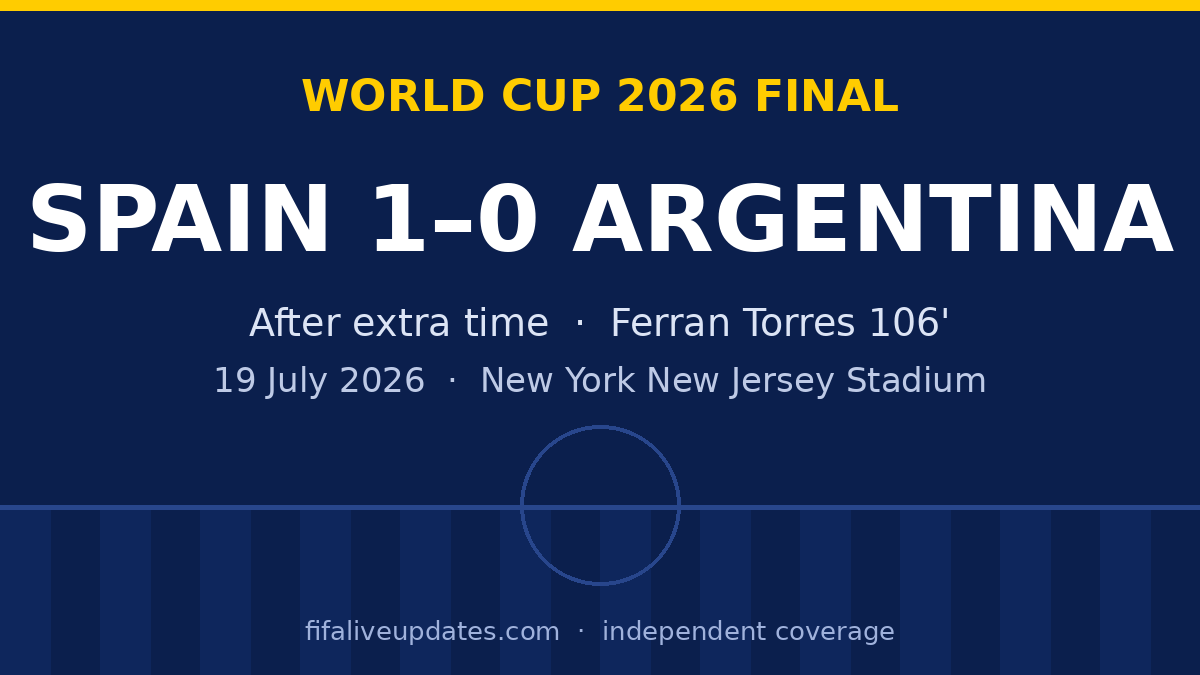
The jump from one host to six reflects how much the World Cup has grown. The 2026 tournament was the first with 48 teams and 104 matches, and 2030 is set to keep that scale while adding a unique centenary twist. For a reminder of how the 2026 edition ended, see our report on the 2026 World Cup winner.
Frequently Asked Questions
Where is the 2030 World Cup being held?
Mainly in Morocco, Spain and Portugal, with three centenary matches in Uruguay, Argentina and Paraguay.
When does the 2030 World Cup start?
In June 2030. The final is expected to be played on 21 July 2030, though FIFA has not yet published the official match schedule.
Will the 2030 World Cup have 64 teams?
Not at the moment. The tournament is planned for 48 teams. A 64-team proposal has been discussed but not approved.
Where will the 2030 World Cup final be played?
It has not been decided. The new Hassan II Stadium in Morocco, the Santiago Bernabéu in Madrid and Camp Nou in Barcelona are the main candidates, and a decision is reportedly not expected before 2028.
How many matches will be played in South America?
Three: one each in Uruguay, Argentina and Paraguay. The remaining matches will be played in Morocco, Spain and Portugal.
Which is the biggest stadium for 2030?
The planned Hassan II Stadium near Casablanca, with a projected capacity of around 115,000, would be the largest venue if it is completed as planned.
Can I buy 2030 World Cup tickets yet?
No. FIFA has not yet opened ticket sales or announced a sales timeline. Use only FIFA’s official ticketing channels when sales begin.
Will VAR and semi-automated offside be used in 2030?
Video technology has been used at every World Cup since 2018, and it is expected to continue. Our guide to the offside rule and VAR explains how the current system works.
Keep reading: see who holds the scoring records in World Cup all-time top scorers, or read our 2027 Women’s World Cup in Brazil guide.
Related guide: How World Cup qualification works explains how places are shared between confederations and what has been confirmed so far for 2030.