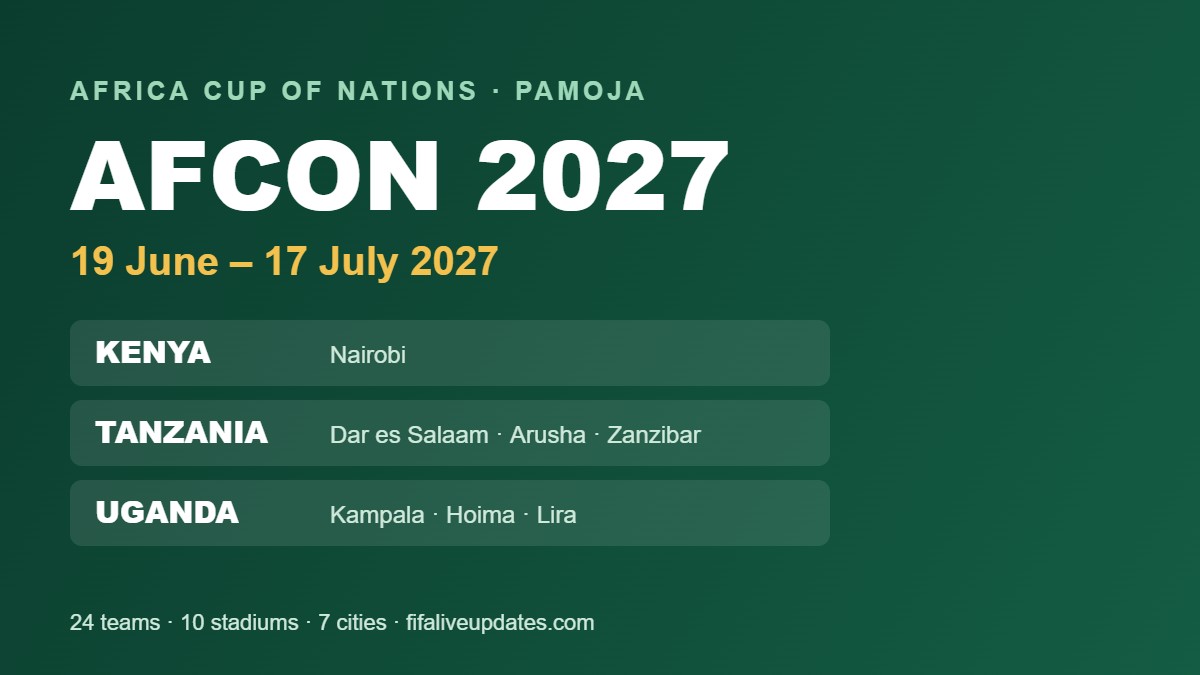
The 2027 Africa Cup of Nations (AFCON 2027) will be played from 19 June to 17 July 2027 in Kenya, Tanzania and Uganda. It is the first AFCON shared by three host countries and the first held in East Africa since Ethiopia hosted in 1976. Twenty-four teams will compete across 10 stadiums in seven cities, and the tournament will also be the last AFCON held in an odd-numbered year before the competition moves to a four-year cycle from 2028.
This guide covers everything you need to know about AFCON 2027: dates, hosts and venues, how qualification works, the qualifying groups, the format, the teams to watch, the dispute over the 2025 title and the full list of past winners.
AFCON 2027 at a glance
| Item | Details |
|---|---|
| Official name | TotalEnergies CAF Africa Cup of Nations PAMOJA 2027 |
| Edition | 36th |
| Dates | 19 June – 17 July 2027 |
| Hosts | Kenya, Tanzania and Uganda |
| Teams | 24 |
| Venues | 10 stadiums in 7 host cities |
| Organiser | Confederation of African Football (CAF) |
| Qualifiers | 48 teams, 12 groups, September 2026 – March 2027 |
| Previous edition | AFCON 2025 in Morocco (title disputed) |
When is AFCON 2027?
AFCON 2027 starts on 19 June 2027 and the final is on 17 July 2027. The dates were confirmed in FIFA’s international match calendar when the FIFA Council met in Vancouver in April 2026.
Playing in June and July is an important change. Recent editions have often been held in January and February, in the middle of the European club season, which meant African players had to leave their clubs for several weeks. A summer tournament avoids that clash, although it does overlap with the 2027 CONCACAF Gold Cup, which takes place from 19 June to 11 July 2027.
Who is hosting AFCON 2027?
CAF awarded the tournament to the joint bid from Kenya, Tanzania and Uganda on 27 September 2023. The bid was called “Pamoja”, a Swahili word meaning “together”, and that name is now part of the tournament’s official title.
It is a historic choice for several reasons:
- It is the first AFCON with three host nations.
- It is the first tournament in the CECAFA region (East and Central Africa) since Ethiopia 1976, more than fifty years ago.
- It is the first time any of the three countries has hosted the Africa Cup of Nations.
- It coincides with the 70th anniversary of the competition, which was first played in 1957.
AFCON 2027 venues and host cities
The tournament is planned to use 10 stadiums in seven cities. Several are new or being renovated, so the final list depends on construction being completed on time.
| Country | City | Stadium | Capacity |
|---|---|---|---|
| Kenya | Nairobi | Raila Odinga International Stadium (new) | 60,000 |
| Kenya | Nairobi | Moi International Sports Centre, Kasarani (renovated) | 60,000 |
| Kenya | Nairobi | Nyayo National Stadium | 30,000 |
| Tanzania | Dar es Salaam | Benjamin Mkapa Stadium | 60,000 |
| Tanzania | Arusha | Samia Suluhu Hassan Stadium (new) | 30,000 |
| Tanzania | Zanzibar | Amaan Stadium | 15,000 |
| Tanzania | Zanzibar | Fumba Stadium | 35,000 |
| Uganda | Kampala | Mandela National Stadium, Namboole (renovated) | 64,125 |
| Uganda | Hoima | Hoima City Stadium | 20,000 (expected) |
| Uganda | Lira | Akii Bua Stadium | 20,000 |
The original plan was for each country to provide three stadiums. That was later expanded, while some proposed cities, including Eldoret, Kakamega and Dodoma, were left out. CAF has not yet confirmed which stadium will host the opening match and the final.
How AFCON 2027 qualification works
Qualifying for AFCON 2027 started with a preliminary round in March 2026 and continues through the group stage until March 2027. The format is:
- Preliminary round (March 2026): the lowest-ranked nations played two-legged ties. South Sudan, Burundi, Somalia, Lesotho, Eritrea and Ethiopia went through to the group stage.
- Group stage: 48 teams in 12 groups of four (A to L), with each team playing six matches, home and away.
- Qualification: the top two teams in each group qualify, giving 24 places in total.
- Host groups: Kenya, Tanzania and Uganda have already qualified as hosts but still play in the qualifying groups. In those groups, only the best-placed team other than the host qualifies.
Qualifying match windows
| Matchdays | Dates |
|---|---|
| Preliminary round | 25–31 March 2026 |
| Matchdays 1 and 2 | 21 September – 6 October 2026 |
| Matchdays 3 and 4 | 9–17 November 2026 |
| Matchdays 5 and 6 | 22–30 March 2027 |
Qualifiers are played during FIFA’s international windows, the same periods used for World Cup qualifiers and friendlies. For a general explanation of how international qualifying works, see our guide to how World Cup qualification works.
AFCON 2027 qualifying groups
| Group | Teams |
|---|---|
| A | Morocco, Gabon, Niger, Lesotho |
| B | Egypt, Angola, Malawi, South Sudan |
| C | Ivory Coast, Ghana, The Gambia, Somalia |
| D | South Africa, Guinea, Kenya (host), Eritrea |
| E | DR Congo, Equatorial Guinea, Sierra Leone, Zimbabwe |
| F | Burkina Faso, Benin, Mauritania, Central African Republic |
| G | Cameroon, Comoros, Namibia, Congo |
| H | Tunisia, Uganda (host), Libya, Botswana |
| I | Algeria, Zambia, Togo, Burundi |
| J | Senegal, Mozambique, Sudan, Ethiopia |
| K | Mali, Cape Verde, Rwanda, Liberia |
| L | Nigeria, Madagascar, Tanzania (host), Guinea-Bissau |
Groups to watch
- Group C is the toughest on paper, with Ivory Coast and Ghana, two former champions, likely competing for the top two places alongside The Gambia.
- Group D puts South Africa and Guinea together with host Kenya, so only one of the non-host teams is guaranteed a place if Kenya finish in the top two.
- Group H includes Tunisia and host Uganda, while Group L pairs three-time champions Nigeria with host Tanzania.
- Group K features Cape Verde, who reached the round of 32 at the 2026 World Cup, alongside Mali.
Matchdays 3 and 4 are being played in the current November 2026 window, and the final two rounds in March 2027 will decide the last places.
AFCON 2027 tournament format
The finals will follow the 24-team format used at recent editions:
- Group stage: six groups of four teams.
- Qualification for the knockouts: the top two in each group plus the four best third-placed teams reach the round of 16.
- Knockout rounds: round of 16, quarter-finals, semi-finals, third-place match and the final, all single matches with extra time and penalties if needed.
That makes a total of 52 matches, with the champions playing seven games over four weeks. If you want to understand how shootouts decide knockout ties, read our penalty shootout rules guide.
Who are the AFCON defending champions?
The answer is unusually complicated. At AFCON 2025 in Morocco, Senegal beat the hosts 1–0 in the final on 18 January 2026, with Pape Gueye scoring in extra time. However, in March 2026 CAF stripped Senegal of the title and awarded it to Morocco following an appeal.
Senegal took the case to the Court of Arbitration for Sport (CAS). A hearing was held on 8 October 2026, and a final ruling was expected by the end of November 2026. Until CAS decides, the 2025 title remains officially with Morocco but disputed by Senegal, which means the identity of the defending champions at AFCON 2027 is still not fully settled.
Teams to watch at AFCON 2027
Qualification is still running, but several teams are expected to arrive in East Africa among the favourites:
- Morocco: officially the 2025 champions and one of Africa’s strongest squads, led by players such as Achraf Hakimi and Brahim Díaz. Morocco also reached the quarter-finals of the 2026 World Cup.
- Senegal: champions in 2021 and winners on the pitch in the 2025 final, with a deep squad and plenty of tournament experience.
- Egypt: the record seven-time champions, still built around Mohamed Salah.
- Nigeria: three-time winners with attacking talent such as Ademola Lookman and Victor Osimhen, when fit.
- Ivory Coast: the 2023 champions on home soil, who will want to show that title was no one-off.
- Algeria, Cameroon and Ghana: former champions who are always dangerous at AFCON.
- Cape Verde: one of the stories of the 2026 World Cup, where they reached the round of 32 and pushed Argentina hard in a 3–2 defeat.
The three hosts will also attract attention. Kenya, Tanzania and Uganda have limited AFCON history, but home crowds in Nairobi, Dar es Salaam and Kampala could make them difficult opponents.
How the hosts have done at AFCON before
None of the three hosts has ever won the Africa Cup of Nations. Uganda’s best result came in 1978, when they reached the final and finished as runners-up. Kenya and Tanzania have qualified only occasionally and have never gone deep into the tournament. Automatic qualification as hosts gives all three a guaranteed place and the biggest home stage their football has ever had.
Hosting gives all three nations a rare chance to build football infrastructure and grow the game in the region. New and renovated stadiums in Nairobi, Arusha and Kampala are expected to be used long after the tournament.
AFCON winners: recent champions
| Edition | Host | Winner | Runner-up |
|---|---|---|---|
| 2010 | Angola | Egypt | Ghana |
| 2012 | Gabon and Equatorial Guinea | Zambia | Ivory Coast |
| 2013 | South Africa | Nigeria | Burkina Faso |
| 2015 | Equatorial Guinea | Ivory Coast | Ghana |
| 2017 | Gabon | Cameroon | Egypt |
| 2019 | Egypt | Algeria | Senegal |
| 2021 | Cameroon | Senegal | Egypt |
| 2023 | Ivory Coast | Ivory Coast | Nigeria |
| 2025 | Morocco | Morocco (awarded; under appeal) | Senegal won the final on the pitch |
Most AFCON titles by country
| Country | Titles |
|---|---|
| Egypt | 7 |
| Cameroon | 5 |
| Ghana | 4 |
| Nigeria | 3 |
| Ivory Coast | 3 |
| Algeria | 2 |
| Morocco | 2 (including the disputed 2025 title) |
Senegal currently have one official title (2021). If CAS rules in their favour, they would move to two and Morocco would go back to one.
AFCON all-time records
The Africa Cup of Nations has a long history, dating back to the first tournament in Sudan in 1957. Some of the records that AFCON 2027 players will be chasing:
| Record | Holder |
|---|---|
| Most titles | Egypt, 7 |
| Most consecutive titles | Egypt, 3 (2006, 2008, 2010) |
| All-time top scorer | Samuel Eto’o (Cameroon), 18 goals |
| Most titles as a player | Ahmed Hassan (Egypt), 4 |
| Most tournaments played | Rigobert Song (Cameroon) and Ahmed Hassan (Egypt), 8 each |
Egypt’s run of three straight titles between 2006 and 2010 is the most dominant period in the tournament’s history. Mohamed Salah, Egypt’s biggest star of the modern era, has reached the final but is still chasing his first AFCON winner’s medal, which adds extra interest if Egypt qualify for 2027.
AFCON 2027 key dates
| Date | Event |
|---|---|
| 27 September 2023 | CAF awards AFCON 2027 to Kenya, Tanzania and Uganda |
| 25–31 March 2026 | Qualifying preliminary round |
| 21 September – 6 October 2026 | Qualifying matchdays 1 and 2 |
| 9–17 November 2026 | Qualifying matchdays 3 and 4 |
| 22–30 March 2027 | Qualifying matchdays 5 and 6 |
| 19 June 2027 | Opening match of AFCON 2027 |
| 17 July 2027 | AFCON 2027 final |
Why AFCON 2027 is a turning point
AFCON 2027 is more than just another edition. CAF has announced that from 2028 the Africa Cup of Nations will be played every four years instead of every two. That makes 2027 the last edition in the old two-year rhythm and the last in an odd-numbered year.
The change is designed to fit better with the global calendar and to reduce the number of times European clubs have to release African players. It also means each AFCON will become a bigger, rarer event, similar to the European Championship. For comparison, see our Euro 2028 guide.
The summer dates of 19 June to 17 July 2027 also mean that, for the first time in several editions, players will not have to leave their clubs in the middle of the season. That should help teams bring their strongest squads.
What AFCON 2027 means for East African football
For decades, the biggest African football tournaments have usually been held in North, West or Southern Africa. East Africa has passionate supporters, especially in Nairobi, Kampala and Dar es Salaam, but has rarely had the chance to stage a major event. AFCON 2027 changes that.
The tournament is expected to leave behind new stadiums, improved training facilities and better transport links. It should also give young players in the region the chance to watch Africa’s best teams in person, which can inspire the next generation. Local clubs and leagues in Kenya, Tanzania and Uganda hope the attention will bring more investment, sponsorship and television coverage.
If the three countries deliver a successful tournament, it could also strengthen future joint bids from the region for other CAF and FIFA competitions.
Challenges for the hosts
Hosting a 24-team tournament across three countries is a major undertaking. The main challenges are:
- Stadium readiness: several venues are new or under renovation, including the Raila Odinga International Stadium in Nairobi, the Samia Suluhu Hassan Stadium in Arusha and the Mandela National Stadium in Kampala. CAF will inspect progress before confirming the final list.
- Travel: teams and fans will move between three countries. Good air links between Nairobi, Dar es Salaam, Zanzibar and Entebbe will be important.
- Training sites and hotels: 24 teams need training pitches and accommodation that meet CAF standards.
- Weather: June and July are cooler months in much of East Africa, which should help, but conditions vary between the coast and the highlands.
How to follow AFCON 2027
Tickets, the official match schedule and broadcast partners are normally announced by CAF in the months before the tournament, after the final draw. The final draw for the groups is expected to take place after qualifying finishes in March 2027. Until then, the key dates for fans are the remaining qualifying windows in November 2026 and March 2027.
For other major tournaments coming up, see our guides to the 2027 Women’s World Cup in Brazil, the 2030 World Cup and the 2034 World Cup in Saudi Arabia.
FAQs about AFCON 2027
When is AFCON 2027?
AFCON 2027 will be played from 19 June to 17 July 2027.
Where is AFCON 2027 being held?
AFCON 2027 will be hosted jointly by Kenya, Tanzania and Uganda, the first time the tournament has had three host nations.
How many teams will play at AFCON 2027?
Twenty-four teams will play at the finals: the three hosts plus 21 qualifiers from the 12 qualifying groups.
Who won AFCON 2025?
Senegal beat Morocco 1–0 after extra time in the final, but CAF later awarded the title to Morocco. Senegal appealed to the Court of Arbitration for Sport, and a decision was expected by the end of November 2026.
Is AFCON moving to every four years?
Yes. From 2028, the Africa Cup of Nations will be held every four years, so AFCON 2027 is the last edition in the two-year cycle.
Have Kenya, Tanzania and Uganda qualified automatically?
Yes. All three qualified automatically as hosts, although they still play in the qualifying groups. In their groups, only the best team other than the host qualifies.
Where will the AFCON 2027 final be played?
CAF has not yet confirmed the venue for the final. The largest planned stadiums are the Mandela National Stadium in Kampala, the Benjamin Mkapa Stadium in Dar es Salaam and the new Raila Odinga International Stadium in Nairobi, each holding around 60,000 or more.
Which country has won the most AFCON titles?
Egypt have won the most AFCON titles, with seven.