Saudi Arabia will host the 2034 FIFA World Cup. It will be the 25th edition of the men’s tournament, the second held in the Middle East after Qatar 2022, and the first 48-team World Cup to be staged entirely in one country.
The decision gives the Kingdom a decade to deliver one of the most ambitious building programmes in football history. This guide covers how Saudi Arabia won the hosting rights, the five host cities and 15 proposed stadiums, the unresolved question of dates, the team’s World Cup record, and the criticism that has followed the bid.
When Was Saudi Arabia Confirmed as Host?
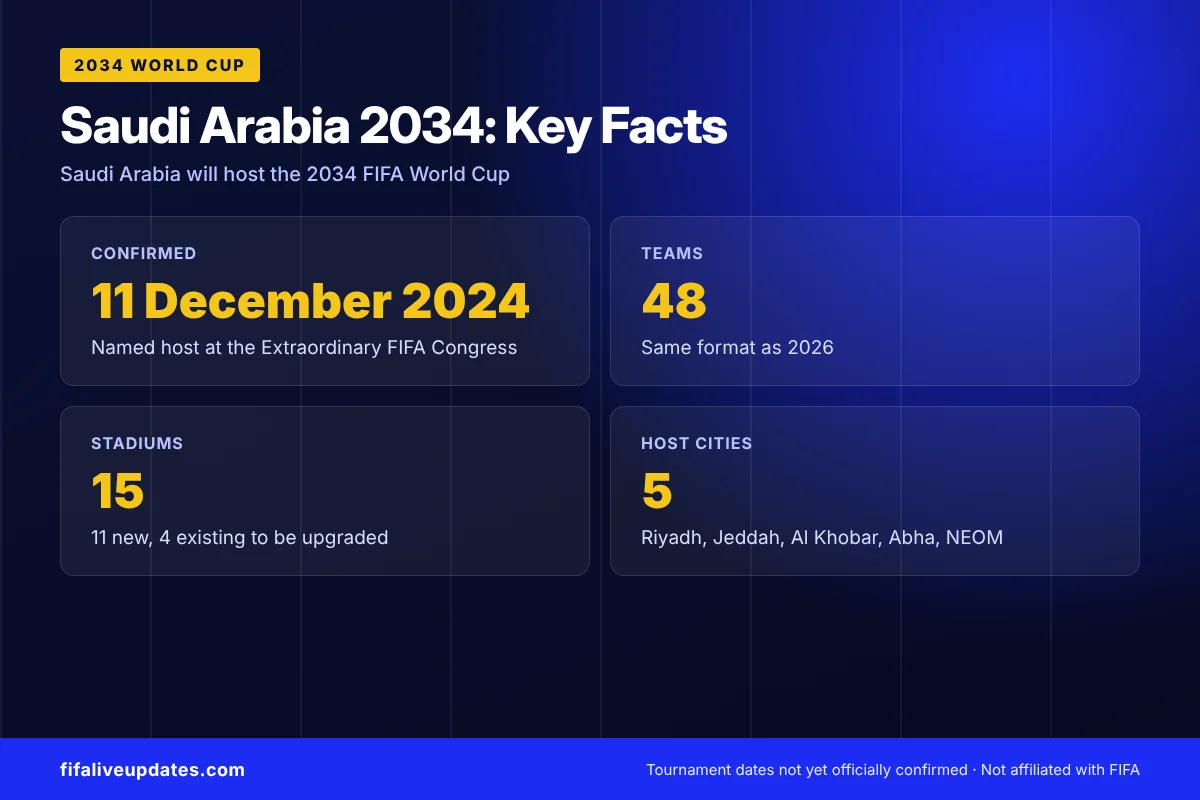
FIFA confirmed Saudi Arabia as the 2034 host at an Extraordinary FIFA Congress on 11 December 2024. Saudi Arabia was the only bidder after FIFA limited the 2034 race to members of the Asian and Oceanian confederations. The same Congress confirmed Morocco, Spain and Portugal as hosts of the 2030 World Cup.
Why Was Saudi Arabia the Only Candidate?
In October 2023 the FIFA Council adopted a principle of confederation rotation. Because the 2026 World Cup is in North America (Concacaf) and the 2030 edition is spread across Europe, Africa and South America, only nations from Asia (AFC) and Oceania (OFC) were invited to bid for 2034. The deadline to declare interest was extremely short, which critics said favoured a single, well-prepared candidate.
Australia had explored a bid, possibly with New Zealand, but Football Australia announced in October 2023 that it would not pursue one. Indonesia also considered a joint bid before backing Saudi Arabia, and talk of a wider South-East Asian bid never developed. That left Saudi Arabia unopposed, and the Congress confirmed it by acclamation rather than a contested vote. Norway’s football federation abstained in protest at the bidding process.
How FIFA Rated the Saudi Bid
Before the Congress, FIFA published its evaluation report on the bid. Saudi Arabia received an average technical score of 4.2 out of 5, reported as the highest ever given to a World Cup bid and higher than the joint Canada, Mexico and United States bid for 2026. The score covered areas such as stadiums, accommodation, transport, team facilities and commercial potential.
The same report classed the human rights aspects of the bid as a medium risk, and flagged the scale of construction as a challenge, since most of the venues and much of the supporting infrastructure did not yet exist when the bid was submitted. FIFA argued that hosting the tournament could act as a catalyst for reform, a view that human rights groups strongly dispute (see the controversies section below).
How Many Teams Will Play?
The 2034 World Cup will feature 48 teams, following the expansion first used at the 2026 tournament in Canada, Mexico and the United States. That means 104 matches if the 2026 format of 12 groups of four followed by a Round of 32 is kept.
As hosts, Saudi Arabia will qualify automatically. The remaining 47 places will be decided through the six continental qualifying competitions. If you want to understand how those places are shared out, our explainer on how World Cup qualification works breaks down the slot allocation and qualifying formats confederation by confederation.
Host Cities and Stadiums
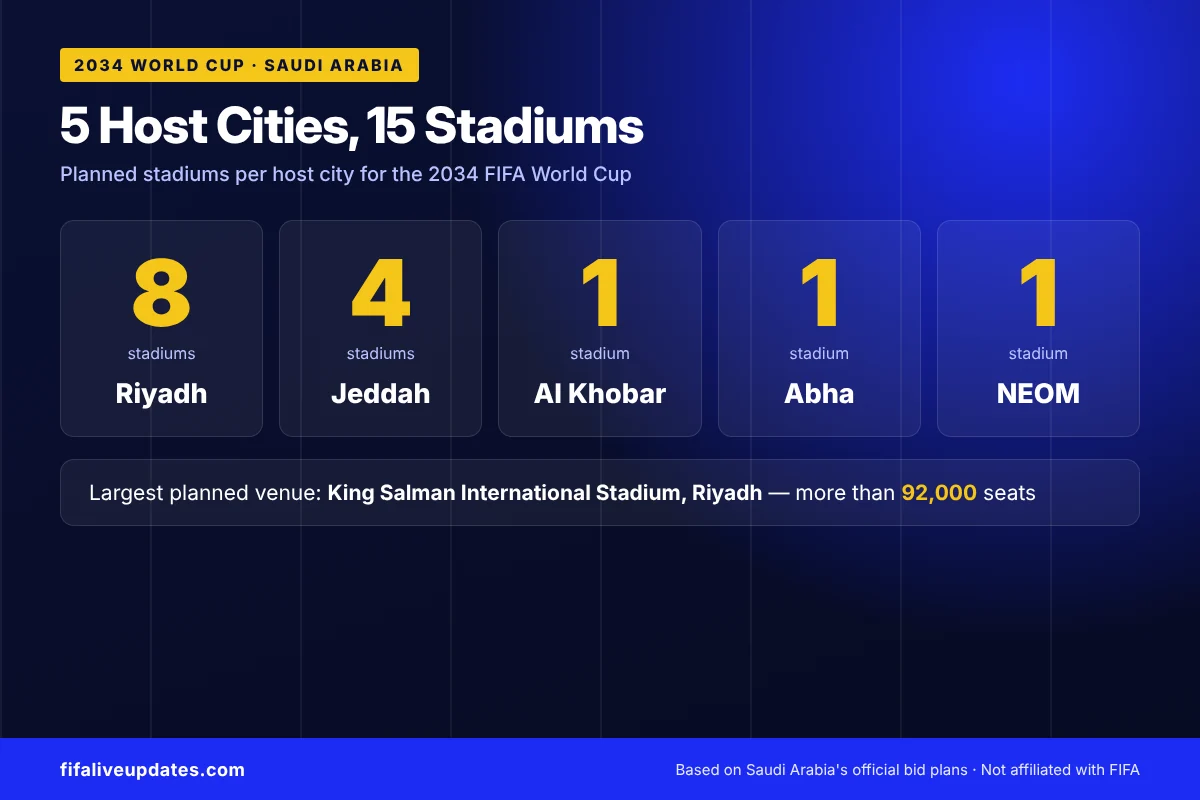
Saudi Arabia’s official bid includes 15 stadiums spread across five host cities. Many of these venues are still to be built or redeveloped.
| Host city | Planned stadiums | Notes |
|---|---|---|
| Riyadh | 8 | The capital and main hub, including the planned King Salman Stadium with a capacity of more than 92,000 |
| Jeddah | 4 | Red Sea port city and Saudi Arabia’s second-largest city |
| Al Khobar | 1 | In the Eastern Province on the Gulf coast |
| Abha | 1 | Mountain city in the south-west of the country |
| NEOM | 1 | A stadium planned as part of the NEOM development in the north-west |
The King Salman Stadium in Riyadh is expected to be the centrepiece of the tournament, but FIFA has not yet published a match schedule naming the venues for the opening game or the final.
According to the bid, the King Salman Stadium is earmarked for both the opening match and the final, with a planned capacity of around 92,760. All of the new venues were scheduled to be completed by 2032.
The 15 Proposed Stadiums in Detail
The bid book combined a handful of existing grounds, due to be renovated or expanded, with a large number of brand-new stadiums. Every venue was planned to hold around 45,000 spectators or more. The table below lists the stadiums as presented in Saudi Arabia’s bid.
| Stadium | Location | Planned capacity | Status |
|---|---|---|---|
| King Salman International Stadium | Riyadh | 92,000+ | New |
| King Fahd Sports City Stadium | Riyadh | 70,000 | Existing, to be renovated |
| Prince Mohammed bin Salman Stadium | Qiddiya, Riyadh | 46,000 | New |
| New Murabba Stadium | Riyadh | 45,000+ | New |
| ROSHN Stadium | Riyadh | 45,000 | New |
| South Riyadh Stadium | Riyadh | 47,000 | New |
| King Saud University Stadium | Riyadh | 46,000 | Existing, to be expanded |
| Prince Faisal bin Fahd Sports City Stadium | Riyadh | 45,000 | New |
| King Abdullah Sports City Stadium | Jeddah | 58,000 | Existing, to be renovated |
| Jeddah Central Stadium | Jeddah | 45,000 | New |
| Qiddiya Coast Stadium | Near Jeddah | 46,000 | New |
| King Abdullah Economic City Stadium | Near Jeddah | 45,000 | New |
| Aramco Stadium | Al Khobar | 46,000 | New |
| King Khalid University Stadium | Abha | 45,000+ | Existing, to be expanded |
| NEOM Stadium | NEOM | 46,000 | New |
Several designs drew attention when they were unveiled. King Fahd Sports City Stadium has a roof inspired by a traditional Arabian tent, Jeddah Central Stadium echoes the architecture of the historic Al-Balad district, and the NEOM Stadium was designed to sit more than 350 metres above ground as part of the city skyline. Many of the new grounds are intended to become permanent homes for Saudi Pro League clubs after the tournament.
Reported Changes to the Stadium Plan
The stadium list may not be final. In October 2026, Semafor reported that Saudi Arabia’s Public Investment Fund was set to drop plans for five venues on cost grounds: King Abdullah Economic City, Qiddiya Coast, ROSHN, New Murabba and NEOM. Reuters had earlier reported that the NEOM stadium, linked to the stalled The Line project, had been shelved. These reports had not been officially confirmed by FIFA or the Saudi organisers at the time of writing, and any change to the venue list would need FIFA’s approval. Construction work continues on the King Salman and Prince Mohammed bin Salman stadiums in Riyadh.
A Guide to the Five Host Cities
Riyadh
The capital is the heart of the tournament, with more than half of the proposed stadiums. As well as the national stadium and the existing King Fahd Sports City, Riyadh’s venues are tied to major new districts such as Qiddiya, an entertainment and sports development on the edge of the city, and New Murabba. Riyadh is also home to some of the country’s biggest clubs, including Al-Hilal, Al-Nassr and Al-Shabab.
Jeddah
Saudi Arabia’s main Red Sea city is the gateway for millions of pilgrims travelling to Mecca, so it already has extensive experience of handling large numbers of visitors. King Abdullah Sports City, known as the Shining Jewel, has hosted international matches and domestic cup finals, and the city is home to Al-Ittihad and Al-Ahli.
Al Khobar
Al Khobar sits in the Eastern Province on the Gulf coast, close to Dammam and Dhahran, the centre of Saudi Arabia’s oil industry. Its planned Aramco Stadium, with a design inspired by swirling sea currents, is named after the state energy company.
Abha
Abha, in the mountainous Asir region in the south-west, is the most unusual host city. Its altitude gives it a noticeably milder climate than the rest of the country, and its stadium is the existing King Khalid University ground, which is due to be expanded.
NEOM
NEOM is the futuristic development in the north-west, near the Gulf of Aqaba. Its stadium was the most eye-catching design in the bid, but as noted above, its future is now uncertain following reports that the project has been scaled back.
Summer or Winter? The Dates Question
The exact dates of the 2034 World Cup have not been decided. Summer temperatures in Saudi Arabia regularly exceed 40°C, so a tournament in the traditional June and July window would be very challenging. Qatar 2022 was moved to November and December for the same reason, and a similar winter schedule is widely considered possible for 2034. Another factor is the Islamic calendar, as Ramadan falls in the winter months around 2034. FIFA is expected to announce the dates closer to the tournament.
FIFA’s own evaluation report noted that local climatic conditions would favour matches between October and April. However, the obvious winter window is complicated by Ramadan, which is expected to run from around 11 November to 10 December in 2034. Fasting during daylight hours would make a tournament during that period difficult for many players and supporters.
As a result, there has been speculation that the tournament could be pushed into January 2035. The Athletic reported in 2025 that this option was being considered, and FIFA president Gianni Infantino has spoken generally about the need for more flexibility in scheduling major tournaments. Saudi officials have also said a summer tournament has not been ruled out. Until FIFA makes an announcement, any dates should be treated as unconfirmed. A winter World Cup would again force the major European leagues to pause their seasons, as they did for Qatar 2022.
Saudi Arabia’s Football Background
- Saudi Arabia have qualified for the World Cup several times, first appearing in 1994, when they reached the Round of 16.
- At the 2022 World Cup, they beat eventual champions Argentina 2–1 in the group stage, one of the biggest shocks in tournament history.
- The country will also host the AFC Asian Cup in 2027, which is expected to serve as a major test event.
- As hosts, Saudi Arabia will qualify automatically for 2034.
Saudi Arabia’s World Cup Record
By the time they host in 2034, Saudi Arabia will be making at least their eighth World Cup appearance. Their record so far is below.
| Tournament | Stage reached | Key results |
|---|---|---|
| 1994 USA | Round of 16 | Beat Morocco 2–1 and Belgium 1–0; lost 3–1 to Sweden |
| 1998 France | Group stage | Lost to Denmark and hosts France; drew 2–2 with South Africa |
| 2002 Korea/Japan | Group stage | Lost 8–0 to Germany, 1–0 to Cameroon and 3–0 to Ireland |
| 2006 Germany | Group stage | Drew 2–2 with Tunisia; lost to Ukraine and Spain |
| 2018 Russia | Group stage | Lost 5–0 to hosts Russia; beat Egypt 2–1 |
| 2022 Qatar | Group stage | Beat Argentina 2–1; lost to Poland and Mexico |
| 2026 USA/Canada/Mexico | Group stage | Drew 1–1 with Uruguay, lost 4–0 to Spain, drew 0–0 with Cape Verde |
The high point remains 1994, when Saeed Al-Owairan’s solo run and finish against Belgium became one of the most famous goals in World Cup history. The 2022 win over Argentina, with second-half goals from Saleh Al-Shehri and Salem Al-Dawsari, was the country’s first victory in an opening World Cup match. At the 2026 finals, under Hervé Renard, Saudi Arabia finished bottom of Group H with two points. Building a team capable of going deep into a home tournament is now one of the federation’s biggest projects.
The 2027 Asian Cup: A Dress Rehearsal
Before the World Cup, Saudi Arabia will stage the 19th AFC Asian Cup, running from 7 January to 5 February 2027. The tournament features 24 teams and 51 matches across eight stadiums in three cities: five in Riyadh, two in Jeddah and one in Al Khobar. Saudi Arabia open against Palestine at King Fahd Sports City Stadium in Riyadh, which will also host the final.
The Asian Cup will give organisers a chance to test transport, ticketing, security and fan services on a smaller scale. It will be the largest international football tournament the country has staged, following events such as the Spanish and Italian Super Cups and the 2023 FIFA Club World Cup in Jeddah. For more on how FIFA’s expanded club competition has developed since, see our 2025 Club World Cup recap.
Controversies and Criticism
Saudi Arabia’s hosting rights have been among the most debated in FIFA’s history. The main areas of criticism are:
- Human rights: Amnesty International said the bid’s human rights strategy ignored many of the biggest risks, and Human Rights Watch raised similar concerns. Issues cited include freedom of expression, the treatment of women and LGBTQ+ people, and restrictions on peaceful protest.
- Migrant workers: With so many stadiums, hotels and transport links to build, campaigners have focused on the protection of migrant labourers and the kafala sponsorship system, echoing the scrutiny Qatar faced before 2022.
- The bidding process: The short timeline, the rotation rule and the lack of any rival bid led critics to argue that the outcome was effectively decided in advance. Norway’s abstention at the Congress reflected that frustration.
- Climate and calendar: Extreme summer heat makes a June–July tournament difficult, while a winter event clashes with domestic seasons around the world and with Ramadan.
- Cost and deliverability: The reported plans to drop several stadiums show how expensive the project is, even for a country with Saudi Arabia’s resources.
Supporters of the bid point to the country’s young, football-loving population, the growth of the Saudi Pro League since the arrival of stars such as Cristiano Ronaldo in 2023, and FIFA’s argument that hosting could accelerate social change.
How 2034 Compares with Recent and Future World Cups
| Tournament | Hosts | Teams | Matches |
|---|---|---|---|
| 2022 | Qatar | 32 | 64 |
| 2026 | Canada, Mexico, USA | 48 | 104 |
| 2030 | Morocco, Portugal, Spain (plus centenary matches in Argentina, Paraguay and Uruguay) | 48 | 104 |
| 2034 | Saudi Arabia | 48 | 104 (if 2026 format kept) |
The comparison with Qatar is unavoidable. Both are Gulf states with hot summers, both relied on huge stadium-building programmes, and both faced similar criticism. The big difference is size: Qatar staged a 32-team tournament in eight stadiums around a single metropolitan area, whereas Saudi Arabia must host 48 teams and 104 matches across a country of more than two million square kilometres, which makes internal flights and transport planning far more important. For the full picture of the next edition, read our guide to the 2030 World Cup hosts, dates and format, and see how the first 48-team tournament played out in our 2026 World Cup winner coverage.
Frequently Asked Questions
Where is the 2034 World Cup?
In Saudi Arabia, across five host cities: Riyadh, Jeddah, Al Khobar, Abha and NEOM.
When is the 2034 World Cup?
The year is 2034, but the months have not been confirmed. A winter tournament, like Qatar 2022, is a possibility.
How many stadiums will be used?
Saudi Arabia’s bid lists 15 stadiums, eight of them in Riyadh.
Who else bid to host the 2034 World Cup?
Nobody. Australia and Indonesia both considered bids but withdrew or backed Saudi Arabia, so Saudi Arabia was the only candidate.
Where will the 2034 World Cup final be played?
Saudi Arabia’s bid names the planned King Salman International Stadium in Riyadh, with a capacity of more than 92,000, as the venue for the opening match and the final. FIFA has not yet published the official match schedule.
Will Saudi Arabia qualify automatically?
Yes. As hosts, Saudi Arabia receive an automatic place, so they will not need to go through Asian qualifying.
How did FIFA rate the Saudi bid?
FIFA’s evaluation gave the bid an average score of 4.2 out of 5, reported as the highest in World Cup bidding history, while classing the human rights risk as medium.
Is the 2034 World Cup going to be in winter?
It has not been decided. FIFA’s evaluation said the climate favours an October to April window, but Ramadan falls in November and December 2034, so a January 2035 start has been discussed in media reports. A summer event has not been officially ruled out.
Keep reading: look back at every champion in our FIFA World Cup winners list and the record holders in World Cup all-time top scorers.