Few rules in football cause as much debate as offside, especially now that VAR can check every goal frame by frame. This guide explains the offside law in plain language and shows how video technology is used to review decisions at tournaments such as the World Cup.
Why Football Has an Offside Rule
Without offside, attackers could simply wait next to the opposition goalkeeper for a long ball, a tactic often called “goal hanging”. The law forces forwards to time their runs and gives defenders a way to push up and squeeze the space in midfield. In other words, offside shapes the whole geometry of a football match, not just the moment a goal is scored.
A Brief History of the Law
Offside has been part of the game since the Football Association published its first laws in 1863. That early version was very strict: a player was offside if they were in front of the ball when it was kicked forward, much like in rugby today.
The biggest change came in 1925, when the number of opponents needed to keep an attacker onside was reduced from three to two. Defences had become so skilled at catching forwards offside that many matches were tight, low-scoring affairs, and the change was designed to give attackers more room.
Later revisions moved the law steadily in favour of the attacking side. By the 1990s a player level with the second-last opponent was onside, and in the 2000s the definitions of “interfering with play” were tightened so that only players genuinely involved in an attack are penalised. The basic idea, however, has stayed the same for more than a century.
What Is Offside?
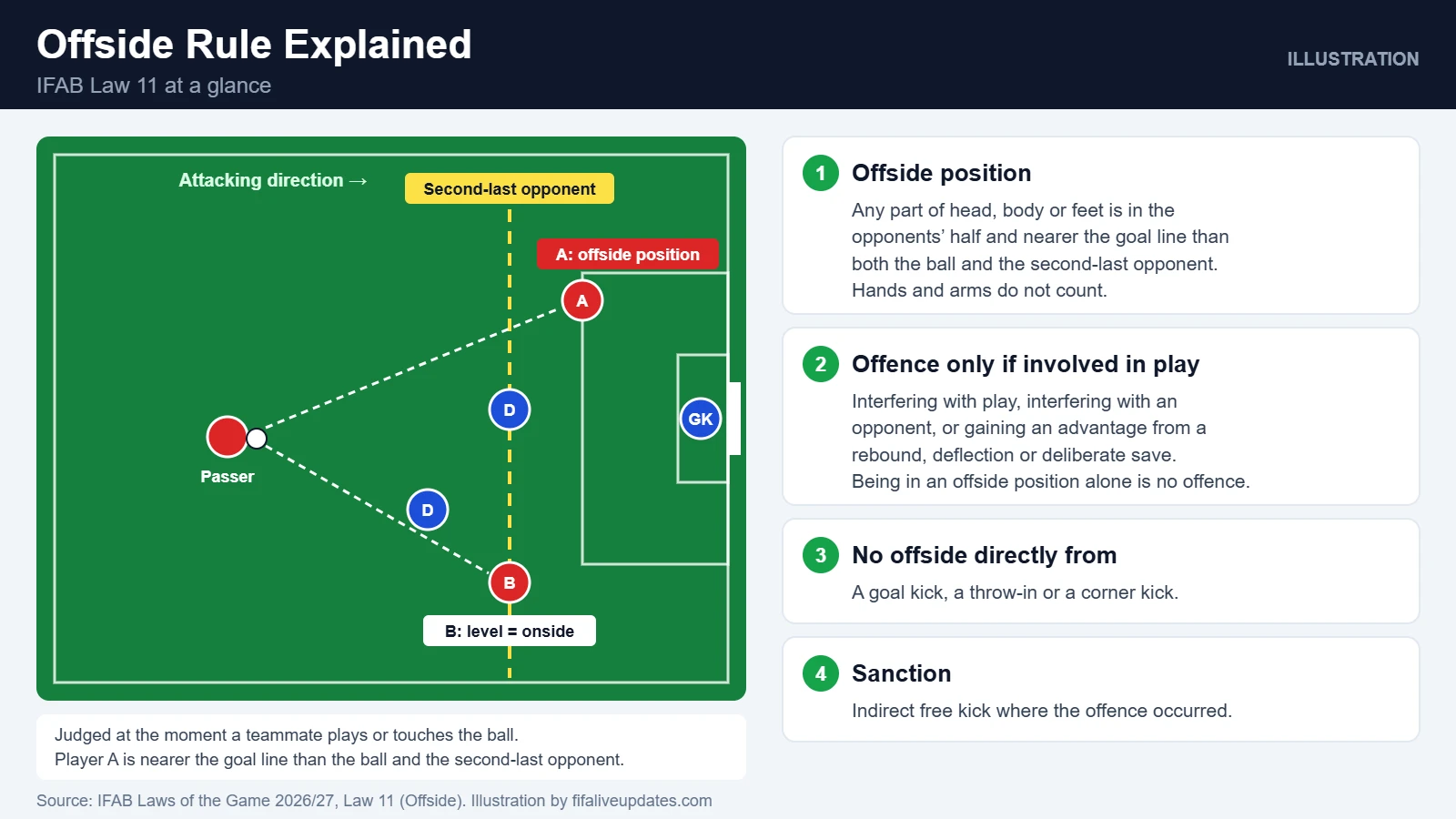
Under the Laws of the Game, a player is in an offside position if, at the moment a teammate plays or touches the ball, all three of these are true:
- The player is in the opponents’ half of the pitch (not counting the halfway line itself).
- Any part of their head, body or feet is nearer to the opponents’ goal line than the ball.
- Any part of their head, body or feet is nearer to the goal line than the second-last opponent. The goalkeeper usually counts as one of the last two opponents.
The hands and arms of all players, including goalkeepers, are not considered when judging offside. A player who is exactly level with the second-last opponent, or level with the last two opponents, is onside.
Where Does the Arm End?
Because arms are ignored, officials need a clear boundary between the arm and the body. The Laws of the Game state that, for offside purposes, the upper boundary of the arm is in line with the bottom of the armpit. A shoulder ahead of the last defender can therefore make a player offside, while an outstretched arm cannot.
The Moment That Matters
Offside is judged at the instant the ball is played or touched by a teammate, not when the receiving player collects it. The Laws specify that the first point of contact with the ball is used. This is why an attacker can be well behind the defence when they receive a pass and still be onside: what counts is where they stood when the pass was made.
It also explains why television freeze-frames cause so much argument. Choosing the exact frame of contact can make a difference of several centimetres when players are sprinting in opposite directions.
Being Offside Is Not Always an Offence
Simply standing in an offside position is not punished. A player is only penalised if they become involved in active play by:
- Interfering with play, for example by playing or touching a ball passed by a teammate.
- Interfering with an opponent, for example by blocking the goalkeeper’s line of vision or challenging an opponent for the ball.
- Gaining an advantage, for example by playing a ball that rebounds to them off the goalpost, crossbar, match official or an opponent.
Deliberate Play, Deflections and Saves
One of the trickier parts of the law concerns balls that come off an opponent. If a defender deliberately plays the ball, for example with a controlled pass, clearance or header, an attacker who was in an offside position is generally no longer penalised for receiving it. A fresh phase of play has effectively begun.
A deflection or rebound is different. If the ball simply bounces off a defender, the attacker who was offside when their teammate played it is still offside. The same applies to a deliberate save: if a goalkeeper or outfield player tries to stop the ball going into the goal, an attacker in an offside position cannot profit from the rebound.
Referees decide whether a defender’s touch was deliberate by looking at factors such as how far the ball travelled, whether the defender could see it coming and whether they had time and space to control it.
When Offside Does Not Apply
There is no offside offence if a player receives the ball directly from:
- A goal kick
- A throw-in
- A corner kick
A player also cannot be offside in their own half of the pitch.
What About Free Kicks and Other Situations?
Offside does apply to free kicks. When a team swings a free kick into the penalty area, attackers must stay level with or behind the second-last defender at the moment the ball is struck, which is why defensive lines often step up just before the kick is taken.
A few other details are worth knowing:
- A defender who leaves the field of play without the referee’s permission is treated as being on their own goal line for offside purposes, so they cannot step off the pitch to catch an attacker offside.
- Any player can be in an offside position, including a goalkeeper who has gone forward for a late corner or free kick.
- An attacker who is in an offside position but does not touch the ball or affect an opponent is not penalised, even if the ball passes close by.
What Happens After an Offside Offence?
The referee awards an indirect free kick to the defending team from the place where the offence occurred. If a goal was scored, it is disallowed.
Offside Scenarios: Worked Examples
The law is easier to understand when you apply it to real match situations. Here are five common scenarios and how a referee would judge them.
1. The Through Ball
A midfielder plays a pass between two centre-backs. At the moment of the pass, the striker’s shoulder is ahead of the second-last defender. The striker runs on and scores. Verdict: offside. The shoulder can be used to score, so it counts, and the goal is disallowed.
2. The Player Who Stays Out of It
A winger is in an offside position on the far side of the pitch when a teammate shoots from distance. The winger does not move towards the ball and is nowhere near the goalkeeper’s line of sight. The shot goes in. Verdict: goal stands. Being in an offside position is not an offence on its own.
3. The Blocked View
An attacker stands in an offside position directly in front of the goalkeeper as a teammate shoots. The attacker does not touch the ball, but the goalkeeper cannot see the shot. Verdict: offside, because the attacker is interfering with an opponent by blocking their line of vision.
4. The Rebound off the Post
A striker is onside and shoots, but the ball hits the post and rebounds to a teammate who was in an offside position when the shot was taken. Verdict: offside. The teammate has gained an advantage from being in that position.
5. The Defender’s Miscontrol
A long ball is played towards an attacker standing in an offside position. A defender, with plenty of time, tries to control the ball but miscontrols it, and the attacker scores. Verdict: usually a goal, because the defender deliberately played the ball. If the defender had instead made a goal-saving block or the ball had simply deflected off them, the attacker would still be penalised.
What Is VAR?
VAR stands for Video Assistant Referee. It is a team of officials who watch the match on screens and can recommend that the on-field referee looks again at a decision. VAR was used at the men’s World Cup for the first time in Russia in 2018.
VAR can only intervene in four types of match-changing situation:
- Goals, including whether there was an offside or a foul in the build-up
- Penalty decisions
- Direct red cards, plus (under the 2026/27 Laws) red cards that result from a clearly incorrect second yellow card
- Mistaken identity, when the wrong player (or a player from the wrong team) is cautioned or sent off
The guiding principle is “minimum interference, maximum benefit”. VAR should only step in for a clear and obvious error or a serious missed incident. The final decision is always made by the referee on the pitch, sometimes after watching replays on a pitch-side monitor.
How a VAR Review Works, Step by Step
Most VAR activity happens without fans noticing. The process usually follows the same pattern:
- The check: the VAR team automatically checks every goal and every reviewable incident in the background while play continues. If nothing is wrong, the game carries on and the check is “complete”.
- The recommendation: if the VAR sees a clear and obvious error or a serious missed incident, they tell the referee through their earpiece and recommend a review.
- Factual decisions: some decisions, such as whether a player was in an offside position or whether the ball crossed a line, are matters of fact. The referee can accept the VAR’s advice on these without going to the monitor.
- The on-field review: for subjective decisions, such as whether a challenge was a foul or whether an offside player interfered with an opponent, the referee normally goes to the pitch-side monitor to watch the replays before deciding.
- The final call: the referee then either confirms or changes the original decision and signals it by drawing the shape of a screen with their hands.
This is why offside decisions are often resolved quickly from the VAR room, while penalty and red card incidents more often lead to a trip to the monitor.
VAR Changes in the 2026/27 Laws of the Game
At its annual general meeting in February 2026, the International Football Association Board (IFAB), which writes the Laws of the Game, approved three adjustments to the VAR protocol. The new Laws took effect on 1 July 2026, and the changes were also used at the 2026 World Cup, which kicked off on 11 June.
- Second yellow cards: VAR can now check a red card that results from a clearly incorrect second yellow card. It cannot recommend a second yellow that the referee did not show.
- Wrong team penalised: the mistaken identity rule was widened so VAR can step in when the referee punishes a player from the wrong team.
- Corner kicks: competitions may allow VAR to correct a clearly wrongly awarded corner, but only if this can be done immediately without delaying the restart.
There was no change to the wording of the offside law itself for 2026/27. IFAB agreed to continue its offside trials and to keep monitoring semi-automated offside technology.
Semi-Automated Offside Technology
At the 2022 World Cup in Qatar, FIFA introduced semi-automated offside technology. Special cameras under the stadium roof track the ball and up to 29 points on each player’s body, and a sensor inside the ball records the exact moment it is kicked. The system alerts the video officials to a possible offside within seconds, and a 3D animation is then shown to fans in the stadium and on television to explain the decision.
Upgrades at the 2026 World Cup
FIFA introduced an upgraded version of the system for the 2026 World Cup in the United States, Canada and Mexico. The main changes were:
- Faster flags: a real-time audio alert tells the assistant referee when a player is more than 10cm offside, so the flag can go up straight away. Earlier versions used at FIFA club tournaments only alerted officials when a player was more than 50cm offside. The assistant referee still makes the final decision.
- Player avatars: every player at the tournament was scanned before it began to create a lifelike 3D avatar, which is used in the animations that explain offside decisions.
- Sensor ball: the official match ball, the adidas Trionda, contains a sensor that records data 500 times per second and feeds it to the VAR system to help pinpoint the moment of contact.
The technology still has limits. It deals only with the position of players, so it cannot decide whether an offside player interfered with an opponent. FIFA has also acknowledged that it can struggle when players are on the ground or tightly bunched together, and the very closest calls still need human checking.
Why Tight Offside Calls Still Cause Debate
Even with cameras and sensors, offside remains the most argued-about decision in football. There are a few reasons for this.
Millimetre Margins
The law has no tolerance built in: a player is either level or ahead. When technology can measure tiny margins, attackers can be ruled offside by a toe or a shoulder, which many fans feel goes against the spirit of a rule designed to stop goal hanging. Others argue that a clear line, applied the same way every time, is fairer than guesswork.
Why Assistants Keep the Flag Down
In VAR matches, assistant referees are encouraged to delay raising the flag for tight offsides until the attack has finished. If they flag too early and get it wrong, a goal or penalty can never be awarded because play has already stopped. If they wait, VAR can always disallow a goal later. The downside is that fans sometimes celebrate goals that are then ruled out.
Possible Future Changes
Football’s lawmakers continue to trial alternative versions of the offside law. One widely discussed idea, backed by former Arsenal manager Arsène Wenger in his role at FIFA, would only penalise an attacker if their whole body was ahead of the second-last defender. For now, though, Law 11 is unchanged, and any player with a scoring body part ahead of the line is in an offside position.
Common Offside Myths
- Myth: a player level with the defender is offside. Fact: level is onside.
- Myth: you can be offside from a throw-in. Fact: there is no offside from a throw-in, goal kick or corner kick.
- Myth: being in an offside position is always a foul. Fact: it is only an offence if the player becomes involved in active play.
- Myth: the arms count. Fact: hands and arms are ignored when judging offside.
- Myth: it is about where the player is when they receive the ball. Fact: offside is judged at the moment a teammate plays or touches the ball.
- Myth: any touch by a defender makes the attacker onside. Fact: a deflection, rebound or deliberate save does not reset offside; only a deliberate play does.
- Myth: the semi-automated system makes the decision. Fact: it supports the officials, who still make the final call.
Frequently Asked Questions
Can a player be offside in their own half?
No. A player in their own half cannot be in an offside position.
Is it offside if the ball comes from an opponent?
Generally no, if the opponent deliberately played the ball. The exception is a deliberate save by an opponent, which does not reset offside.
What is the punishment for offside?
An indirect free kick to the opposing team.
Can a goalkeeper be offside?
Yes, in theory. Any player can be in an offside position, so a goalkeeper who has gone up for a late corner or free kick is judged in the same way as an outfield player.
Can you be offside from a free kick?
Yes. Offside applies to free kicks. The only restarts that are exempt are goal kicks, throw-ins and corner kicks.
Does VAR check every goal?
Yes. The VAR team checks every goal in the background for offside, fouls in the build-up and whether the ball went out of play. Most checks are completed quickly without the referee needing to stop and review.
Can VAR overturn a second yellow card?
Under the 2026/27 Laws of the Game, VAR can check a red card that results from a clearly incorrect second yellow card. This change was also used at the 2026 World Cup.
Who has the final say on offside?
The on-field officials. The semi-automated system and VAR provide information and recommendations, but the referee makes the final decision, and the assistant referee still decides whether to raise the flag.
Offside and VAR decisions have shaped many famous World Cup moments. To see how the tournament’s biggest matches have played out, read our list of FIFA World Cup winners and our all-time World Cup top scorers.
Keep reading: our FIFA World Cup 2026 guide explains the 48-team format, the 2030 World Cup guide covers what comes next, and our Club World Cup 2025 recap looks back at Chelsea’s title run.