Soccer positions can look confusing at first. Commentators talk about full-backs, wing-backs, holding midfielders, number 10s and false 9s, and the same player may be called something different in the United States, the UK or Australia. This guide has soccer positions explained in plain English: what each role does on the field, the skills it needs, the numbers traditionally linked to it, and how positions change between formations.
Every team has 11 players on the field: one goalkeeper and ten outfield players. The Laws of the Game only name one position, the goalkeeper. Everything else, from centre-backs to strikers, is a tactical role chosen by the coach. That is why positions are flexible and why a player can change role during a match.
Soccer positions at a glance
| Area | Position | Short name | Main job |
|---|---|---|---|
| Goal | Goalkeeper | GK | Stop shots and organise the defence |
| Defence | Centre-back | CB | Block the middle, win headers and tackles |
| Defence | Full-back (right-back / left-back) | RB / LB | Defend the wide areas and support attacks |
| Defence | Wing-back | RWB / LWB | Cover the whole flank in a back three or five |
| Defence | Sweeper / libero | SW | Spare defender behind the back line (now rare) |
| Midfield | Defensive midfielder | CDM / DM | Protect the defence and win the ball back |
| Midfield | Central midfielder | CM | Link defence and attack, control possession |
| Midfield | Attacking midfielder | CAM / No. 10 | Create chances behind the striker |
| Midfield | Wide midfielder | RM / LM | Work the flanks in a flat midfield |
| Attack | Winger | RW / LW | Beat full-backs, cross and cut inside to shoot |
| Attack | Striker / centre-forward | ST / CF | Score goals and lead the line |
| Attack | Second striker / false 9 | SS / F9 | Drop deep to link play and create space |
How many positions are there in soccer?
There is no official number. In simple terms, there are four position groups: goalkeeper, defenders, midfielders and forwards. Within those groups, most coaches and analysts use around 10 to 15 named roles, depending on how detailed they want to be.
Because each team has 11 players, a formation decides how many players fill each group. A 4-4-2 uses four defenders, four midfielders and two forwards, while a 4-3-3 uses four defenders, three midfielders and three forwards. You can read more about squad numbers and substitutes in our guide to how many players are on a soccer team.
Goalkeeper (GK)
The goalkeeper is the only player allowed to handle the ball, and only inside their own penalty area. Their main job is to stop the opponent from scoring, but modern goalkeepers do much more than make saves.
What a goalkeeper does
- Makes saves from shots, headers and penalties.
- Claims crosses and corners in the box.
- Organises the defence by talking and pointing, because they can see the whole field.
- Starts attacks with throws, kicks and short passes to defenders.
- Acts as a “sweeper keeper”, rushing out to clear balls played behind the defence.
Good goalkeepers need quick reactions, bravery, strong communication and, increasingly, good footwork. The keeper wears a different coloured shirt from both teams and the referee so that officials can identify them. The goalkeeper traditionally wears number 1.
The best goalkeepers at each World Cup receive the Golden Glove; see every winner in our World Cup Golden Glove winners list.
Defenders
Defenders form the team’s back line. Their first job is to stop the opposition from creating chances, but in modern soccer they also start attacks and, in the case of full-backs and wing-backs, join them.
Centre-back (CB)
Centre-backs, also called central defenders or centre-halves in the UK, play in the middle of the defence. Most teams use two, while teams with a back three use three.
- Main tasks: marking strikers, winning headers, making tackles and interceptions, blocking shots and clearing danger.
- Key skills: strength, heading, positioning, concentration and reading the game. Ball-playing centre-backs also need accurate passing to break the opponent’s press.
- Traditional numbers: 4, 5 and 6, depending on the country.
Centre-backs usually work as a pair: one steps up to challenge while the other covers the space behind. They also control the defensive line, which is important for catching attackers offside. Our guide to the offside rule explains how this works.
Full-back (RB and LB)
Full-backs play on the right and left of a back four. The right-back and left-back defend against the opponent’s wingers and stop crosses coming into the box.
- Main tasks: defending one-on-one, tracking runners, covering the centre-backs and supporting attacks by overlapping the winger.
- Key skills: speed, stamina, tackling and crossing.
- Traditional numbers: 2 (right-back) and 3 (left-back).
Modern full-backs are often among the fittest players on the team, because they are expected to defend and attack along the whole flank. Some teams use “inverted” full-backs, who move into central midfield when their team has the ball.
Wing-back (RWB and LWB)
Wing-backs are used in formations with three centre-backs, such as 3-5-2 or 3-4-3. They are more attacking than full-backs and are responsible for the entire flank on their own. When the team attacks, they act almost like wingers; when the team defends, they drop back to form a back five.
The role needs outstanding stamina, crossing ability and tactical discipline.
Sweeper (libero)
The sweeper played behind the other defenders to “sweep up” any ball that got through. In the libero version, made famous by Franz Beckenbauer, the sweeper also stepped forward with the ball to start attacks. The pure sweeper has mostly disappeared from top-level soccer because modern teams defend with a flat line and use offside traps, but the idea lives on in ball-playing centre-backs and sweeper keepers.
Midfielders
Midfielders connect defence and attack. They usually cover the most distance in a match and touch the ball more than most other players. Different midfield roles balance defending, passing and attacking in different ways.
Defensive midfielder (CDM or DM)
The defensive midfielder, also called a holding midfielder or “number 6”, sits just in front of the defence.
- Main tasks: breaking up attacks, intercepting passes, covering for full-backs who push forward and recycling possession with simple passes.
- Key skills: tackling, positioning, awareness, short passing and discipline.
There are different types. A “destroyer” focuses on winning the ball back, while a “deep-lying playmaker” (sometimes called a regista) uses long and accurate passing to control the game from deep. Spain’s Rodri, who won the Golden Ball at the 2026 World Cup, is a modern example of a defensive midfielder who controls the tempo of a match. See the full list in our World Cup Golden Ball winners guide.
Central midfielder (CM)
The central midfielder, often called the “number 8”, works in the middle of the field and links every part of the team.
- Main tasks: receiving the ball from defenders, moving it forward, pressing opponents, arriving in the box to shoot and helping defend.
- Key skills: passing range, stamina, vision and decision-making.
A “box-to-box” midfielder covers ground from one penalty area to the other, defending one moment and attacking the next.
Attacking midfielder (CAM or number 10)
The attacking midfielder plays in the space between the opponent’s midfield and defence, behind the striker. This area is often called “the hole”.
- Main tasks: creating chances with through balls, dribbling past opponents, shooting from distance and linking up with the forwards.
- Key skills: creativity, close control, vision and quick thinking.
The number 10 shirt is closely linked with this role because of famous playmakers who wore it, such as Pelé, Diego Maradona and Lionel Messi.
Wide midfielder (RM and LM)
Wide midfielders play on the right and left of a flat midfield four, most commonly in a 4-4-2. They are more defensive than wingers: they track back to help the full-back, then provide width and crosses when the team attacks.
Forwards
Forwards, also called attackers, are mainly responsible for scoring goals and creating chances close to the opponent’s goal. They are also the first line of defence when a team presses high.
Winger (RW and LW)
Wingers play high up on the flanks in formations such as 4-3-3 or 4-2-3-1.
- Main tasks: beating full-backs one-on-one, crossing, cutting inside to shoot and stretching the defence.
- Key skills: pace, dribbling, crossing and finishing.
- Traditional numbers: 7 (right) and 11 (left).
An “inverted winger” plays on the side opposite to their stronger foot, for example a left-footed player on the right wing. This allows them to cut inside onto their stronger foot to shoot or pass.
Striker or centre-forward (ST or CF)
The striker is the team’s main goalscorer and usually plays closest to the opponent’s goal.
- Main tasks: finishing chances, making runs behind the defence, holding up the ball for team-mates and pressing defenders.
- Key skills: finishing with both feet and the head, movement, strength and composure.
- Traditional number: 9.
There are many striker types. A “target man” is tall and strong and wins headers; a “poacher” lives in the penalty area and scores from close range; a “complete forward” can do everything. The World Cup’s top scorer receives the Golden Boot; see every winner in our World Cup Golden Boot winners list.
Second striker and false 9
A second striker plays just behind or alongside the main striker, mixing goalscoring with creativity. The false 9 is a centre-forward who regularly drops into midfield instead of staying high. This pulls centre-backs out of position and creates space for wingers and midfielders to run into. Messi famously played the role for Barcelona under Pep Guardiola.
Soccer position numbers explained
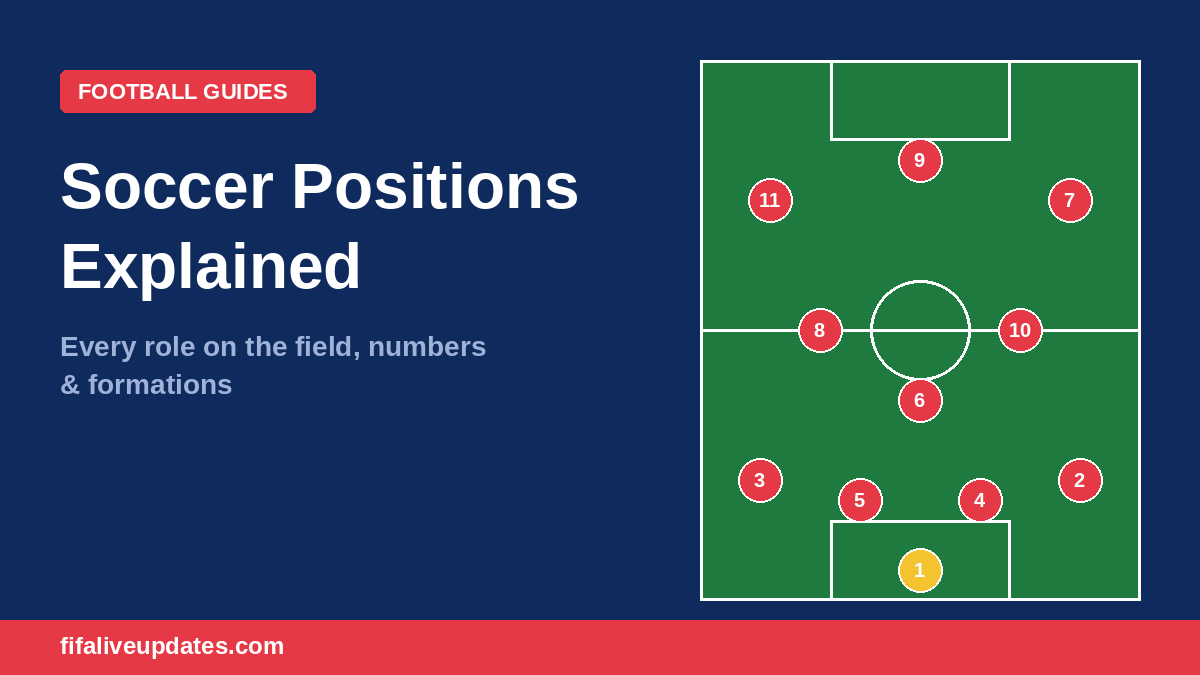
Shirt numbers used to show a player’s position, because teams numbered their starting line-up from 1 to 11. Today players at professional level can usually choose any squad number, but the traditional numbers are still used to describe roles.
| Number | Traditional position |
|---|---|
| 1 | Goalkeeper |
| 2 | Right-back |
| 3 | Left-back |
| 4 | Centre-back or defensive midfielder |
| 5 | Centre-back |
| 6 | Defensive midfielder or centre-back |
| 7 | Right winger |
| 8 | Central midfielder |
| 9 | Striker |
| 10 | Attacking midfielder or second striker |
| 11 | Left winger |
The exact meaning of 4, 5 and 6 differs between countries. In England, 5 and 6 have traditionally been centre-backs, while in many other countries 4 is a centre-back and 5 or 6 is a defensive midfielder. That is why analysts often say “a number 6” to mean a holding midfielder.
How formations change positions
A formation is the shape a team uses, written from defence to attack (the goalkeeper is not counted). The same player may have a different role depending on the formation.
| Formation | Positions used | Strengths |
|---|---|---|
| 4-4-2 | GK, 2 CB, 2 FB, 2 CM, 2 wide midfielders, 2 strikers | Simple, balanced, two players up front |
| 4-3-3 | GK, 2 CB, 2 FB, 1 DM, 2 CM, 2 wingers, 1 striker | Strong pressing and width in attack |
| 4-2-3-1 | GK, 2 CB, 2 FB, 2 DM, 2 wide attackers, 1 CAM, 1 striker | Solid defence with a creative number 10 |
| 3-5-2 | GK, 3 CB, 2 wing-backs, 3 CM, 2 strikers | Extra centre-back and control in midfield |
| 3-4-3 | GK, 3 CB, 2 wing-backs, 2 CM, 2 wide forwards, 1 striker | Very attacking with wide forwards |
| 5-3-2 | GK, 3 CB, 2 wing-backs, 3 CM, 2 strikers | Defensive shape, often used to protect a lead |
Formations also change during a match. A 4-3-3 might become a 4-5-1 when defending, as the wingers drop back. A team that has a player sent off often switches to a 4-4-1 to stay compact; our guide to red card rules in soccer explains what happens in that situation.
US, UK and Australian position names
Soccer is played across the English-speaking world, and some position names differ by country. The roles are the same, but you may hear different words on TV.
| Common US term | Common UK / Australian term |
|---|---|
| Goalie | Goalkeeper, keeper |
| Center back | Centre-half, centre-back |
| Outside back | Full-back |
| Holding midfielder | Holding midfielder, anchor man |
| Outside midfielder | Wide midfielder |
| Forward | Forward, striker, centre-forward |
Modern hybrid roles
Top-level soccer has blurred the lines between traditional positions. Coaches now describe what a player does with and without the ball, rather than only where they stand. Here are some hybrid roles you will often hear about:
- Inverted full-back: a full-back who moves into central midfield when their team has possession, helping to control the ball and protect against counter-attacks.
- Ball-playing centre-back: a central defender who carries the ball forward or plays long, accurate passes to start attacks, instead of simply clearing it.
- Sweeper keeper: a goalkeeper who plays far off their line, clears through balls and acts as an extra passer when the team builds from the back.
- Inside forward: a wide attacker who starts on the wing but moves inside to score, similar to an inverted winger.
- Pressing forward: a striker whose main job without the ball is to chase defenders and goalkeepers to force mistakes high up the field.
These roles show that modern players need a wider set of skills than ever. A defender who can pass, a midfielder who can tackle and a forward who can press are all highly valued, which is why many young players are encouraged to learn more than one position.
Which soccer position is the hardest?
There is no official answer, because each position needs different strengths. Many coaches argue that goalkeeper is the most mentally demanding, because one mistake can lead directly to a goal. Central midfield is often called the most tactically demanding, since the player must defend, pass and attack while constantly reading the game. Full-backs and wing-backs usually have the highest physical demands, as they run up and down the whole flank.
How to choose the right soccer position
If you are a young player or a parent of one, these questions can help you find a suitable position:
- Do you enjoy stopping attacks and winning tackles? Try centre-back or defensive midfield.
- Are you fast with plenty of stamina? Full-back, wing-back or winger may suit you.
- Do you like having the ball and making passes? Central or attacking midfield could be your role.
- Do you love scoring goals? Striker or winger is the natural choice.
- Are you brave, with quick hands and good reflexes? Give goalkeeping a try.
Most youth coaches recommend that young players try several positions before specialising. Playing in different roles helps them understand the whole game and become more complete players.
Positions in small-sided and youth soccer
Youth soccer often uses smaller teams, such as 4v4, 7v7 or 9v9, on smaller fields. With fewer players, positions are simpler. In 7v7, for example, a team might use a goalkeeper, two or three defenders, two or three midfielders and one forward. The same principles apply, but every player has to attack and defend more. Field sizes for youth games are covered in our soccer field dimensions guide.
Frequently asked questions
What are the 11 positions in soccer?
In a common 4-3-3 formation the 11 positions are: goalkeeper, right-back, left-back, two centre-backs, a defensive midfielder, two central midfielders, a right winger, a left winger and a striker. The exact positions depend on the formation.
What is the most important position in soccer?
Every position matters, but the goalkeeper is often called the most important single role because they are the last line of defence and the only player who can use their hands.
What does CDM mean in soccer?
CDM stands for central defensive midfielder, a player who sits in front of the defence to protect it and win the ball back.
What does CAM mean in soccer?
CAM stands for central attacking midfielder, the creative player who plays behind the striker, often wearing number 10.
What is the difference between a winger and a wing-back?
A winger is an attacker who plays high on the flank. A wing-back is a defender in a back three or five who covers the whole flank, defending and attacking.
Can a goalkeeper play as an outfield player?
Yes. A goalkeeper can switch places with an outfield player during a match, as long as the referee is told and the change is made when the ball is out of play. The player must also change into the correct shirt.
For the official rules on players and the goalkeeper, see IFAB Law 3 – The Players and FIFA.com.