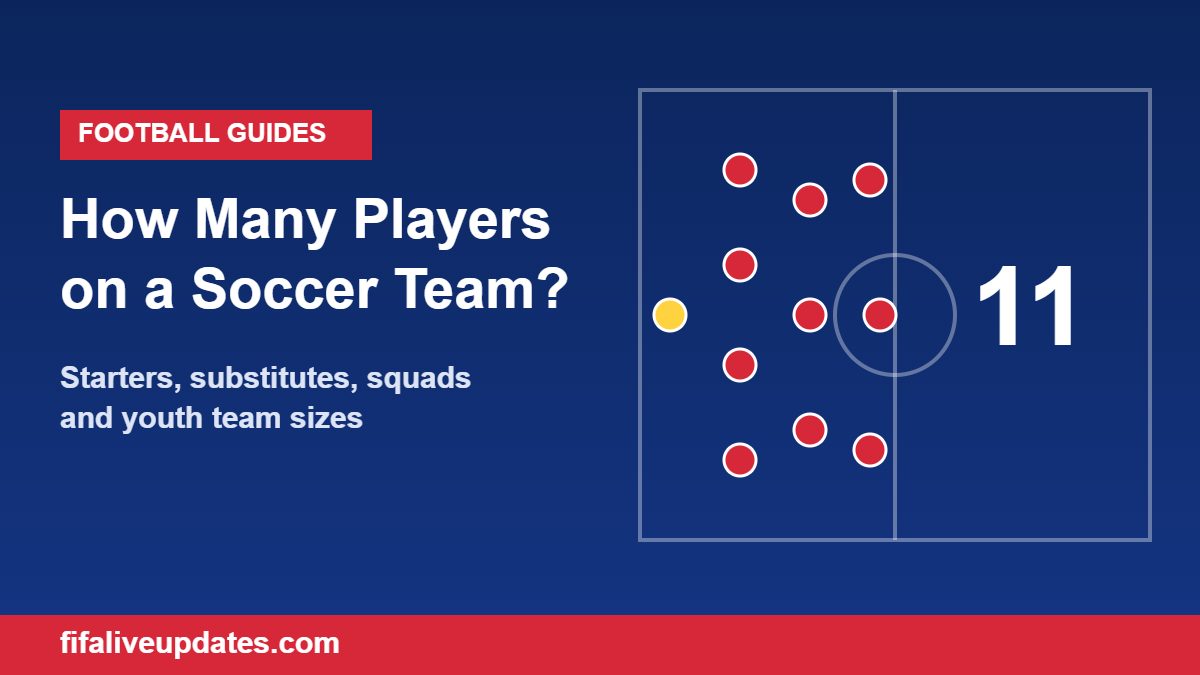
A soccer team has 11 players on the field at one time, including one goalkeeper. Teams can also name substitutes on the bench, and in most professional competitions a team may make up to five substitutions during a match. If a team drops below seven players, the match cannot continue.
That is the quick answer. This guide explains everything else you need to know: how many substitutes are allowed, how big full squads are, how many players youth teams use, what happens after red cards, and how the 11 players are usually arranged. The official rules come from Law 3 of the IFAB Laws of the Game, which applies to soccer worldwide.
How Many Players on a Soccer Team: Quick Facts
| Question | Answer |
|---|---|
| Players on the field per team | 11 (including 1 goalkeeper) |
| Total players on the field | 22 |
| Minimum players to start or continue | 7 |
| Substitutions in most top competitions | Up to 5 (in 3 stoppages, plus half-time) |
| Extra substitute in extra time | 1 more, where competition rules allow |
| World Cup squad size (2026) | 26 players |
| Premier League matchday squad | 20 players (11 starters + 9 substitutes) |
11 Players on the Field
Under the Laws of the Game, a match is played by two teams, each with no more than 11 players. One of those players must be the goalkeeper. That means there are 22 players on the field when both teams are at full strength.
The goalkeeper is the only player allowed to handle the ball, and only inside their own penalty area. The other 10 players are outfield players, usually divided into defenders, midfielders and forwards. The goalkeeper must wear colors that are different from the other players and the referees, so everyone can tell them apart.
Any outfield player can swap places with the goalkeeper, as long as the referee is told first and the change happens during a stoppage in play.
What Is the Minimum Number of Players?
A match cannot start or continue if either team has fewer than seven players. This rule usually comes into play after several red cards or injuries when a team has no substitutes left.
If a team is reduced to six players, the referee must stop the match. What happens next, such as awarding the game to the other team, depends on the competition rules. In practice this is very rare in professional soccer.
Competitions can set a higher minimum if they choose, but they cannot set a lower one than seven.
How Many Substitutes Are Allowed in Soccer?
Substitutes are players who can come on to replace a teammate during the game. The rules on substitutes have two parts: how many can be named on the bench, and how many can actually be used.
Substitutions in Official Competitions
In top-level competitions, including the World Cup, the major European leagues and MLS, teams can make up to five substitutions in a match. To avoid wasting time, they can only make them during three separate stoppages, plus at half-time.
The five-substitute rule began as a temporary measure in 2020 to protect players during a crowded fixture schedule. The IFAB later made it a permanent option for competitions.
How Many Substitutes Can Be Named?
Competition rules decide how many substitutes can sit on the bench. In the Premier League, teams name nine substitutes, giving a matchday squad of 20. Many other leagues and tournaments also allow large benches, which gives coaches more choice for their five changes.
Extra Substitute in Extra Time
If a match goes to extra time, competitions can allow each team one additional substitution, even if they have already used all of their normal changes. This helps tired teams in long knockout games. Learn more in our guide to extra time in soccer.
Concussion Substitutes
Some competitions also use permanent concussion substitutes. If a player has a suspected head injury, the team can replace them without using one of their normal substitutions. The opposing team may then receive an extra substitution too. Whether this is used depends on the competition.
Can a Substituted Player Return?
In professional 11-a-side soccer, no. Once a player has been replaced, they cannot come back on in the same match. Some youth, amateur and recreational leagues allow “return substitutions”, where players can come on and off freely, but only if the competition rules permit it.
How Many Players Are in a Full Soccer Squad?
A squad is the full group of players registered for a team or tournament, not just the 11 starters. Squad sizes are set by each competition:
| Competition | Squad size | Notes |
|---|---|---|
| FIFA World Cup 2026 | 26 players | Including at least three goalkeepers |
| Premier League | Up to 25 registered senior players | Players under 21 can be added on top |
| Premier League matchday | 20 players | 11 starters + 9 substitutes |
| MLS | Up to 30-player roster | Rules on senior and supplemental spots |
World Cup squads have grown over time. For many years teams brought 23 players, before the limit rose to 26 in 2022. The larger squad helps teams cope with a busy schedule and the heat of summer tournaments. For more about the format, see our FIFA World Cup 2026 guide.
How Many Players on a Youth Soccer Team?
Young players usually play small-sided games with fewer players, smaller fields and smaller goals. This gives each child more touches of the ball and more chances to learn. In the United States, the US Soccer Player Development Initiatives recommend these formats:
| Age group | Format | Players on the field per team |
|---|---|---|
| U6–U8 | 4v4 | 4 (no goalkeepers) |
| U9–U10 | 7v7 | 7 (including a goalkeeper) |
| U11–U12 | 9v9 | 9 (including a goalkeeper) |
| U13 and older | 11v11 | 11 (including a goalkeeper) |
Other countries have their own youth programs, so always check with your local league. Youth field sizes are explained in our guide to soccer field dimensions.
Players in Other Types of Soccer
| Format | Players on the field per team |
|---|---|
| Standard soccer (11-a-side) | 11 |
| Futsal (FIFA indoor game) | 5 (including a goalkeeper) |
| Beach soccer | 5 (including a goalkeeper) |
| Small-sided leagues | Usually 5, 6 or 7, set by the league |
Futsal and beach soccer both use rolling substitutions, which means players can come on and off many times during a game. This is very different from the standard 11-a-side game.
What Happens When a Player Gets a Red Card?
A player who receives a red card is sent off and cannot be replaced. The team must continue with one fewer player. A team with 10 players is often described as “down to 10 men”.
If a team receives several red cards, it keeps losing players. Once a team falls below seven, the match is stopped. A player who is sent off before kick-off can be replaced by a named substitute, but this is rare.
A yellow card is a caution. Two yellow cards in the same match lead to a red card.
How the 11 Players Line Up: Positions and Formations
The 11 players are usually split into four groups:
- Goalkeeper (1): protects the goal and can use their hands in the penalty area.
- Defenders: center-backs and full-backs who stop the other team from scoring.
- Midfielders: link defense and attack, win the ball back and create chances.
- Forwards: strikers and wingers whose main job is to score goals.
Coaches arrange their 10 outfield players in a formation. Formations are written as numbers from defense to attack, and they always add up to 10, because the goalkeeper is not counted.
| Formation | Defenders | Midfielders | Forwards |
|---|---|---|---|
| 4-4-2 | 4 | 4 | 2 |
| 4-3-3 | 4 | 3 | 3 |
| 4-2-3-1 | 4 | 5 (2 + 3) | 1 |
| 3-5-2 | 3 | 5 | 2 |
Teams often change formation during a game, especially when they are chasing a goal or protecting a lead.
The Team Captain
Each team has a captain, who wears an armband. The captain has no special rights under the Laws of the Game, but they are expected to set an example and help the referee manage the team. Captains also take part in the coin toss before kick-off and before a penalty shootout. For shootout procedure, see our guide to penalty shootout rules.
Team Officials and Coaching Staff
A team is more than its players. The Laws also recognize team officials, such as the head coach, assistant coaches, doctors and physiotherapists. They sit in the technical area next to the field.
Team officials can be shown yellow and red cards for misconduct, just like players. A coach who is sent off must leave the technical area and its surroundings.
Why Does Soccer Use 11 Players?
The number 11 became standard in the 19th century as the modern rules of soccer took shape in England. It has stayed the same ever since. Eleven players give a good balance between space and contact: enough players to make teamwork important, but enough space on a full-size field for skill and passing.
Changing the number would also change the size of the field and the way the game is played, which is why the rule has never been altered at the professional level.
How Many Goalkeepers Does a Team Have?
Only one goalkeeper can be on the field for each team at any time. However, squads always include backup goalkeepers. At the World Cup, each squad must include at least three goalkeepers, because an injury to the starting keeper is a serious problem.
If a goalkeeper is injured or sent off and the team has no substitutions left, an outfield player must go in goal. That player puts on a goalkeeper shirt and can then handle the ball inside the penalty area. It is one of the most dramatic situations in soccer, and it does happen occasionally at the professional level.
How Team Size Rules Have Changed Over Time
The 11-player rule has been stable for well over a century, but the rules on substitutes have changed a lot:
- Early years: for much of soccer’s history, no substitutes were allowed at all. An injured player simply left the team a player short.
- 1970 World Cup: substitutions were used at the World Cup for the first time.
- 1990s: the number of substitutions allowed in a match increased to three.
- 2020: the IFAB introduced a temporary option of five substitutions during the pandemic.
- 2022 onwards: five substitutions became a permanent option for competitions.
Each change was designed to protect players and keep matches competitive as the game became faster and more physically demanding.
Playing With Fewer Than 11 Players
When a team loses a player to a red card, it must play on with 10, and the coach usually changes tactics. Common responses include:
- Dropping a forward: many teams remove an attacker and keep a solid defensive shape.
- Sitting deeper: the team defends closer to its own goal and looks for counter-attacks.
- Using substitutions: fresh legs can replace tired players who now have more ground to cover.
Playing with 10 players is a big disadvantage, but it is not always decisive. Teams with fewer players have held on for draws or even won matches, especially when they already had a lead.
Team Size in Soccer vs Other Sports
| Sport | Players on the field per team |
|---|---|
| Soccer | 11 |
| American football | 11 |
| Rugby union | 15 |
| Baseball | 9 |
| Ice hockey | 6 |
| Basketball | 5 |
Soccer and American football both use 11 players per side, but soccer has far fewer substitutions. In American football, players move on and off freely between plays, while in soccer a substituted player cannot return.
Is a Women’s Soccer Team the Same Size?
Yes. Women’s soccer follows the same Laws of the Game, so teams have 11 players on the field, the same minimum of seven, and the same substitution rules in professional competitions. Squad sizes for women’s tournaments are set by each competition, just as they are for men’s events.
How a Substitution Works, Step by Step
Substitutions follow a set procedure under the Laws of the Game:
- The team tells the referee or fourth official that it wants to make a change.
- The referee allows the substitution only during a stoppage in play.
- The player being replaced leaves the field, usually at the nearest point on the boundary line, unless the referee says otherwise.
- The substitute enters at the halfway line once the other player is off the field.
- The substitution is complete when the new player enters the field. From that moment, they are a player and the replaced player cannot return.
Leaving at the nearest point of the boundary line was introduced to stop players from walking slowly across the field to waste time. Any time lost on substitutions is still added at the end of the half.
How Coaches Choose the Starting 11
Picking the 11 starters is one of a coach’s biggest decisions. Coaches usually consider:
- Fitness: players returning from injury may start on the bench.
- The opponent: a coach may pick a more defensive team against a strong attack.
- Formation: the system the team plays decides how many defenders, midfielders and forwards start.
- Fixture schedule: in busy periods, coaches rotate players to avoid fatigue.
With five substitutions now allowed, the bench has become much more important. Many coaches plan to use attacking substitutes in the second half, when opponents are tired.
Frequently Asked Questions
How many players are on a soccer team?
A soccer team has 11 players on the field, including a goalkeeper. Full squads also include substitutes, with sizes set by each competition.
How many players are on the field in total?
There are 22 players on the field when both teams have 11 players.
How many substitutes are allowed in soccer?
Most top competitions allow up to five substitutions per team, made during three stoppages plus half-time. One extra substitution may be allowed in extra time.
What is the minimum number of players in soccer?
A match cannot start or continue if a team has fewer than seven players.
How many players are on a World Cup squad?
Teams at the 2026 World Cup could name 26 players, including goalkeepers.
How many players are on a Premier League matchday squad?
Twenty: 11 starters and 9 substitutes.
How many players are on a youth soccer team?
It depends on age. US Soccer recommends 4v4 for U6–U8, 7v7 for U9–U10, 9v9 for U11–U12 and 11v11 from U13.
Can a player who is subbed off come back on?
Not in professional 11-a-side soccer. Some youth and amateur leagues allow return substitutions if their rules permit it.
How long does a soccer game last?
A professional game lasts 90 minutes plus added time. Read our full guide on how long a soccer game lasts.