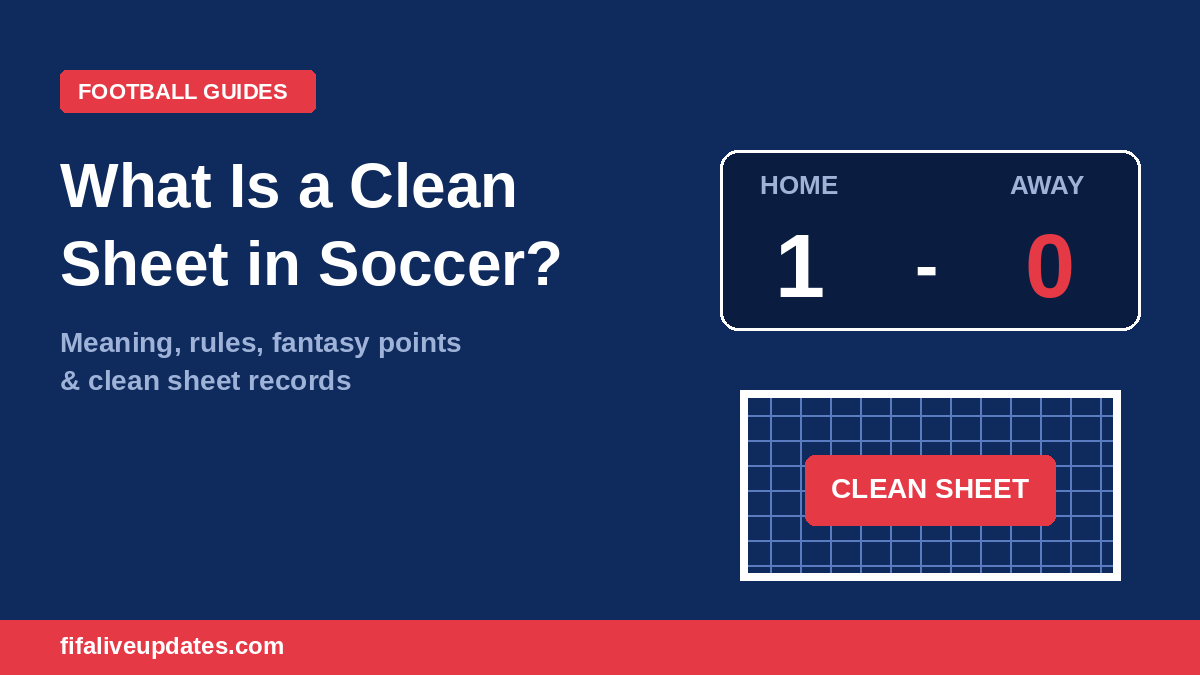
A clean sheet in soccer means a team did not concede a single goal during a match. If the final score is 1-0, 3-0 or even 0-0, the team that let in zero goals has kept a clean sheet. The term is used for the whole team, but it is most closely linked with goalkeepers and defenders, whose main job is to stop the opposition from scoring.
This guide explains what a clean sheet is in soccer, where the phrase comes from, who gets the credit, how clean sheets work in extra time, penalty shoot-outs and fantasy football, and the biggest clean sheet records in the World Cup and the Premier League.
What is a clean sheet in soccer?
A clean sheet is recorded when a team finishes a match without conceding a goal. It does not matter whether the team wins or draws:
- A 1-0 win is a clean sheet for the winning team.
- A 0-0 draw is a clean sheet for both teams.
- A 2-1 win is not a clean sheet, because the winning team conceded once.
In American sports language, a clean sheet is the same as a shutout. US broadcasters and Major League Soccer often say a goalkeeper “recorded a shutout”, while in the UK, Canada and Australia you are more likely to hear “kept a clean sheet”. Both phrases mean exactly the same thing.
| Final score | Team A clean sheet? | Team B clean sheet? |
|---|---|---|
| Team A 1-0 Team B | Yes | No |
| Team A 0-0 Team B | Yes | Yes |
| Team A 3-1 Team B | No | No |
| Team A 0-2 Team B | No | Yes |
Where does the term “clean sheet” come from?
The exact origin of the phrase is not certain. The most common explanation is that it comes from the days when match results and statistics were written down by hand. A team that conceded no goals had nothing written against its name in the “goals against” column, so its record for that game stayed clean. The word “sheet” is also used for a record or score sheet in other sports and games, which supports this explanation.
Whatever its origin, the phrase has been part of everyday soccer language for decades, and today it appears in official statistics, award names and fantasy football rules.
Who gets credit for a clean sheet?
A clean sheet is a team achievement. Every player who defends, presses and blocks shots contributes to stopping the opposition from scoring. In practice, though, clean sheets are usually counted for three groups:
The team
League tables and team statistics often list how many clean sheets a team has kept in a season. It is a quick way to judge how strong a team’s defence is.
The goalkeeper
Goalkeepers are the players most closely associated with clean sheets. Award schemes such as the Premier League Golden Glove are based on the number of clean sheets a goalkeeper keeps. When a goalkeeper is substituted, data providers usually credit the clean sheet according to their own rules, for example only crediting a keeper who played the whole match or who did not concede while on the field. These rules are not set by the Laws of the Game and can differ between sources.
Defenders
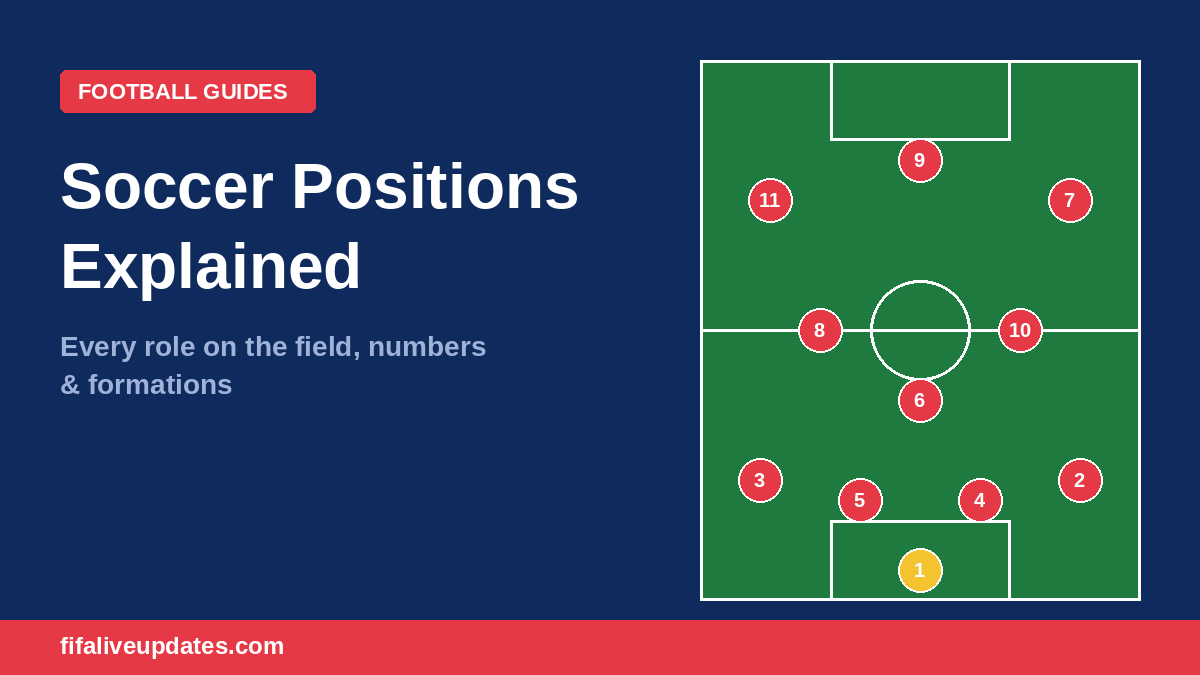
Centre-backs and full-backs are also judged by clean sheets, especially in fantasy football games, where defenders score points when their team does not concede. You can learn more about each defensive role in our guide to soccer positions explained.
Does a clean sheet count in extra time and penalty shoot-outs?
This is a common question, especially in knockout tournaments.
- Extra time counts. Extra time is part of the match, so a team must not concede during the 90 minutes or the 30 minutes of extra time to keep a clean sheet. Our guide to extra time in soccer explains how the two extra periods work.
- Penalty shoot-outs do not count. Goals scored in a penalty shoot-out are not part of the match score; they only decide who goes through. A team that draws 0-0 after extra time and then loses a shoot-out still keeps a clean sheet. See our penalty shootout rules guide for details.
- Penalties during the match count. A penalty kick scored during normal or extra time is a goal, so it ends the clean sheet.
- Own goals count. If a defender scores an own goal, the team has conceded, so the clean sheet is lost.
- Disallowed goals do not count. If a goal is ruled out for offside or a foul, including after a VAR review, the clean sheet survives.
Why are clean sheets important?
Clean sheets matter because a team that does not concede cannot lose. Even a 0-0 draw earns a point in a league, and a single goal at the other end turns a clean sheet into a win. That is why coaches often say that defensive solidity is the foundation of a successful team.
Clean sheets are also used to:
- Judge defensive quality. The number of clean sheets in a season is one of the simplest measures of a team’s defence.
- Compare goalkeepers. Along with saves and goals conceded, clean sheets are a key goalkeeper statistic.
- Decide awards. Several “Golden Glove” style awards are based mainly on clean sheets.
- Score fantasy points. Fantasy football games reward goalkeepers and defenders for clean sheets.
However, clean sheets do not tell the whole story. A goalkeeper behind a dominant team may face very few shots and keep many clean sheets, while a brilliant keeper in a weaker team may make many saves but rarely keep one. Analysts therefore also look at saves, save percentage and goals prevented compared with the quality of chances faced.
Clean sheets in fantasy football
Clean sheets are one of the main sources of points in fantasy soccer games. Rules differ between games, so always check the official rules of the game you play. In the official Fantasy Premier League game, for example, goalkeepers and defenders receive clean sheet points only if they play at least 60 minutes and their team does not concede while they are on the pitch. Midfielders receive a smaller bonus, and forwards do not receive clean sheet points.
Because of this, fantasy managers often pick defenders and goalkeepers from teams with strong defences or easy upcoming fixtures, hoping for several clean sheets in a row.
Clean sheet awards
Several major awards are closely linked to clean sheets:
| Award | Competition | How it is decided |
|---|---|---|
| Premier League Golden Glove | English Premier League | Goalkeeper with the most clean sheets in the season |
| FIFA World Cup Golden Glove | FIFA World Cup | Best goalkeeper of the tournament, chosen by FIFA’s technical experts (clean sheets are considered, but it is not a pure count) |
| Zamora Trophy | Spain’s La Liga | Goalkeeper with the lowest goals-conceded ratio (minimum number of matches required) |
The World Cup award is different from the Premier League version: it is a “best goalkeeper” award rather than a simple clean sheet count. See every winner in our World Cup Golden Glove winners list.
Most clean sheets in World Cup history
Two goalkeepers share the record for the most clean sheets at the men’s World Cup: England’s Peter Shilton and France’s Fabien Barthez, with 10 each (source: Guinness World Records). Shilton played at the 1982, 1986 and 1990 World Cups, while Barthez played in 1998, 2002 and 2006 and won the trophy with France in 1998.
| Goalkeeper | Country | World Cup clean sheets |
|---|---|---|
| Peter Shilton | England | 10 |
| Fabien Barthez | France | 10 |
| Emerson Leão | Brazil | 8 |
| Sepp Maier | West Germany | 8 |
| Cláudio Taffarel | Brazil | 8 |
| Hugo Lloris | France | 8 |
| Thibaut Courtois | Belgium | 8 |
Totals for players who featured at the 2026 World Cup were reported during the tournament, so treat the lower part of this table as an approximate guide. At the 2026 World Cup, Spain’s Unai Simón moved into the top group after keeping six clean sheets in Spain’s first seven matches, according to Sporting Tribune. Spain went on to win the tournament; read the full story in our 2026 World Cup winner recap.
Longest run without conceding at a World Cup
Italy’s Walter Zenga holds the record for the longest run without conceding at a World Cup: 517 minutes at Italia 90. His run ended when Argentina’s Claudio Caniggia scored in the semi-final, which Argentina went on to win on penalties.
Clean sheet records in the Premier League
The Premier League keeps detailed clean sheet records, and several are well known:
- Most Premier League clean sheets (career): Petr Čech, with 202 clean sheets for Chelsea and Arsenal.
- Most clean sheets in one season: Petr Čech, with 24 for Chelsea in 2004-05, when Chelsea conceded only 15 league goals.
- Longest run without conceding: Edwin van der Sar, who went 1,311 minutes without conceding for Manchester United in 2008-09.
Records can change every season, so check the official Premier League stats pages for the latest figures.
Clean sheets, goal difference and league tables
Clean sheets also help a team in the league table in less obvious ways. In most leagues, teams level on points are separated by goal difference (goals scored minus goals conceded). Every clean sheet keeps the “goals against” number down, which protects the team’s goal difference. Over a long season, a defence that keeps many clean sheets can be the difference between finishing above or below a rival on the final day.
In tournament group stages, the same logic applies. At the World Cup, teams level on points in a group are first separated by criteria set in the tournament regulations, which commonly include goal difference and goals scored. A goalless draw might not look exciting, but the clean sheet can still help a team progress. You can see how the current World Cup format works in our FIFA World Cup 2026 guide.
For this reason, many coaches set a clean sheet as a target before every match. Players know that if they keep the opponent out, they only need one goal at the other end to win.
How do teams keep a clean sheet?
Keeping a clean sheet is not just the goalkeeper’s job. It depends on how the whole team defends. Coaches focus on several key areas:
1. Defensive organisation
A well-organised back line keeps the right distances between players, moves together and catches attackers offside. Communication between the goalkeeper and centre-backs is vital, especially at set pieces. Learn how defenders use the offside line in our guide to the offside rule and VAR.
2. Protecting the penalty area
Most goals are scored from inside the penalty area. Defenders try to block shots, clear crosses and mark runners so that the opponent only gets low-quality chances from distance.
3. Midfield protection
A disciplined defensive midfielder screens the back four, intercepts passes and slows down counter-attacks before they reach the defence.
4. Pressing from the front
Modern teams start defending with their forwards. By pressing high, they win the ball close to the opponent’s goal and stop attacks before they begin.
5. Set-piece defending
Corners and free kicks are major sources of goals. Teams spend a lot of training time on zonal marking, man-marking or a mix of both to defend these situations.
6. Goalkeeping quality
Finally, the goalkeeper must make the saves when the defence is beaten. A keeper who commands the area, claims crosses and makes key saves can turn a narrow 1-0 win into a clean sheet that earns three points.
How to calculate clean sheet percentage
Raw clean sheet totals can be misleading, because a goalkeeper who has played 300 matches will naturally have more clean sheets than one who has played 50. To compare players fairly, analysts often use clean sheet percentage:
Clean sheet percentage = (clean sheets ÷ matches played) × 100
| Example | Matches | Clean sheets | Clean sheet % |
|---|---|---|---|
| Goalkeeper A | 38 | 15 | 39.5% |
| Goalkeeper B | 20 | 10 | 50.0% |
| Goalkeeper C | 100 | 30 | 30.0% |
In this example, Goalkeeper A has more clean sheets than Goalkeeper B, but Goalkeeper B keeps a clean sheet in a higher share of matches. These are example figures to show the calculation, not real player statistics.
Common clean sheet situations explained
Some match situations cause confusion about whether a clean sheet still counts. Here is how they usually work in statistics:
- Goalkeeper substituted at half-time with the score 0-0, and the team concedes later: the team does not keep a clean sheet. Whether the first keeper is credited depends on the data provider or fantasy game’s rules.
- Goalkeeper sent off: if the replacement keeper or an outfield player in goal concedes, the team loses its clean sheet. If no goal is conceded, the team keeps it.
- Match abandoned: if a match is abandoned and the result is replaced or replayed, statistics usually follow the official result recorded by the competition.
- Awarded results: when a competition awards a match result (for example 3-0) because of a rule breach, the statistics treatment depends on the competition’s own rules.
If you are tracking statistics for a league, fantasy game or school team, the safest approach is to follow the rules of the competition or the official data provider you are using.
Common myths about clean sheets
- “Only goalkeepers keep clean sheets.” False. A clean sheet belongs to the whole team, even if the goalkeeper usually gets the headlines.
- “A clean sheet means the team won.” Not always. A 0-0 draw is also a clean sheet.
- “More clean sheets always means a better goalkeeper.” Not necessarily. The quality of the defence in front of the keeper has a big effect.
Clean sheet vs shutout vs “nil”
Soccer fans around the world use several words for not conceding a goal:
| Term | Where it is common | Meaning |
|---|---|---|
| Clean sheet | UK, Ireland, Australia, Canada, worldwide soccer media | A team or keeper conceded no goals |
| Shutout | United States and Canada | Same as a clean sheet |
| “Nil” | UK and Australia (score reading) | Zero, as in “one-nil”; a “to nil” win is a clean sheet win |
So when a British commentator says “they won one-nil”, the winning team kept a clean sheet. An American commentator may describe the same game as “a 1-0 shutout”.
Clean sheets in youth and amateur soccer
At youth level, clean sheets are a great way to encourage young defenders and goalkeepers, whose good work is not always shown on the scoreboard. Many youth coaches celebrate clean sheets in the same way they celebrate goals, because it reminds players that defending is a team effort. The basic definition is exactly the same at every level: if the team concedes no goals in the match, it keeps a clean sheet.
Match length varies in youth soccer, but the rule does not change. Our guide on how long a soccer game is lists typical match lengths for different age groups.
Frequently asked questions
What does clean sheet mean in soccer?
A clean sheet means a team did not concede any goals during a match. It applies to wins and draws, such as 1-0 or 0-0.
Is a 0-0 draw a clean sheet?
Yes. In a 0-0 draw, both teams keep a clean sheet because neither team conceded.
Is a clean sheet the same as a shutout?
Yes. “Shutout” is the term usually used in the United States, while “clean sheet” is more common in the UK, Australia and international soccer coverage.
Does a penalty shoot-out goal break a clean sheet?
No. Penalty shoot-out goals are not part of the match result, so they do not affect clean sheets. Penalties scored during normal or extra time do count.
Do own goals count against a clean sheet?
Yes. An own goal is still a goal conceded, so the team loses its clean sheet.
Who has the most clean sheets in World Cup history?
Peter Shilton of England and Fabien Barthez of France share the record with 10 clean sheets each.
Who has the most clean sheets in Premier League history?
Petr Čech holds the Premier League record with 202 clean sheets.
For the official rules on how goals are scored and how a match result is decided, see IFAB Law 10 – Determining the Outcome of a Match.