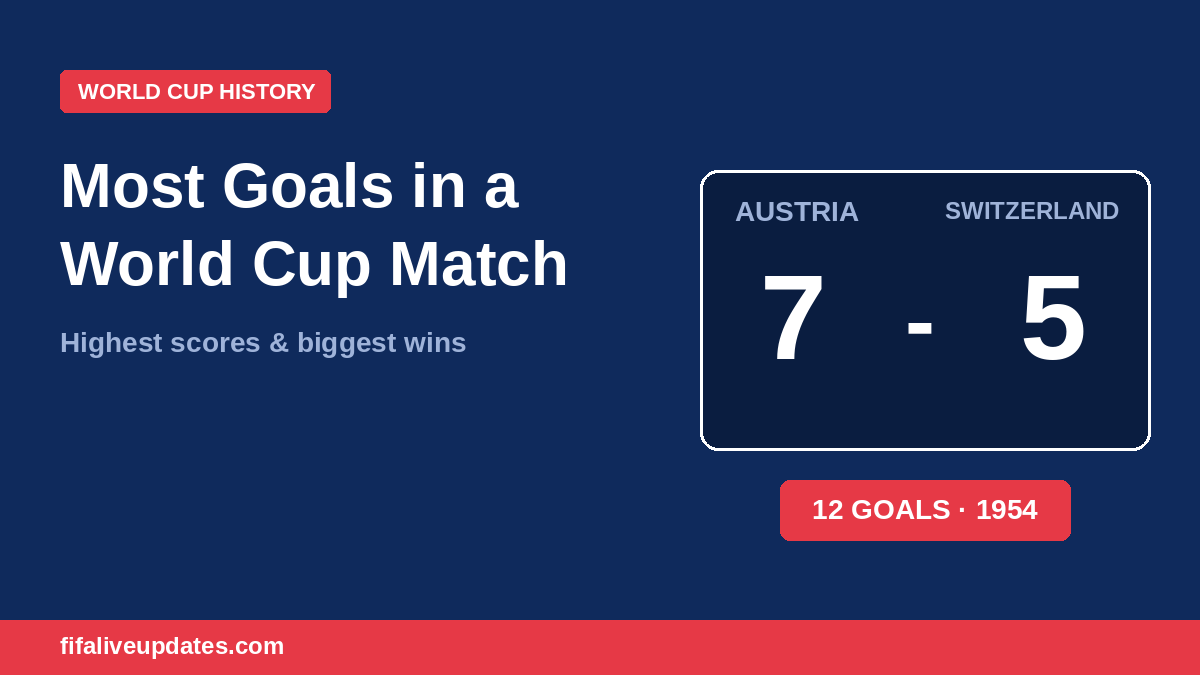
The match with the most goals in World Cup history is Austria 7-5 Switzerland at the 1954 World Cup. Twelve goals were scored in that quarter-final in Lausanne, a record that still stands more than 70 years later. The biggest winning margin belongs to Hungary’s 10-1 win over El Salvador in 1982.
This guide covers the most goals in a World Cup match in detail: the highest-scoring games ever played, the biggest wins, the most goals in a World Cup final, the most goals scored by one player in a single match, and how the record-breaking 2026 World Cup compares with the past.
Quick answer: World Cup match goal records
| Record | Match | Year |
|---|---|---|
| Most goals in a match | Austria 7-5 Switzerland (12 goals) | 1954 |
| Biggest winning margin | Hungary 10-1 El Salvador (9 goals) | 1982 |
| Most goals by one team in a match | Hungary 10-1 El Salvador (10 goals) | 1982 |
| Most goals in a final | Brazil 5-2 Sweden (7 goals) | 1958 |
| Most goals by one player in a match | Oleg Salenko, Russia vs Cameroon (5 goals) | 1994 |
| Biggest win in a semi-final | Brazil 1-7 Germany | 2014 |
Highest-scoring World Cup matches
Only a handful of World Cup matches have produced nine or more goals. Most of them came in the 1930s, 1950s and early 1980s, when tactics were more attacking and the gap between the strongest and weakest teams was often larger.
| Goals | Match | Year | Stage |
|---|---|---|---|
| 12 | Austria 7-5 Switzerland | 1954 | Quarter-final |
| 11 | Brazil 6-5 Poland (after extra time) | 1938 | First round |
| 11 | Hungary 8-3 West Germany | 1954 | Group stage |
| 11 | Hungary 10-1 El Salvador | 1982 | Group stage |
| 9 | Hungary 9-0 South Korea | 1954 | Group stage |
| 9 | West Germany 7-2 Turkey | 1954 | Group play-off |
| 9 | France 6-3 West Germany | 1958 | Third-place match |
| 9 | Yugoslavia 9-0 Zaire | 1974 | Group stage |
Notice how often 1954 appears. That tournament in Switzerland averaged more than five goals per game, the highest of any World Cup, and produced four of the matches in this table.
Austria 7-5 Switzerland: the 12-goal record
The record match was played on 26 June 1954 in Lausanne. It is often called the “Heat Battle of Lausanne” (Hitzeschlacht von Lausanne in German) because it was played in temperatures of around 40°C.
The game had an extraordinary start. The hosts Switzerland raced into a 3-0 lead in the first 20 minutes. Austria then scored three goals in about three minutes to equalise, and by half-time they led 5-4. The first half alone produced nine goals, still a World Cup record for a single half. Austria’s goalkeeper Kurt Schmied reportedly suffered from heatstroke during the match but stayed on the pitch, as substitutes were not allowed at the time.
Austria eventually won 7-5, with Theodor “Turl” Wagner scoring a hat-trick. They went on to finish third, their best ever World Cup result, while Switzerland were knocked out on home soil.
Other famous high-scoring World Cup matches
Brazil 6-5 Poland (1938)
This first-round match in Strasbourg finished 4-4 after 90 minutes and went to extra time on a heavy, waterlogged pitch. Brazil’s Leônidas and Poland’s Ernst Willimowski both scored hat-tricks; Willimowski scored four goals and became the first player to score four in a World Cup match. Brazil finally won 6-5, making it the highest-scoring game of the pre-war era.
Hungary 8-3 West Germany (1954)
Hungary’s “Golden Team”, unbeaten for years, thrashed West Germany 8-3 in the group stage. West Germany’s coach Sepp Herberger fielded a weakened side, partly to hide his strongest line-up. The two teams met again in the final, and West Germany won 3-2 in the famous “Miracle of Bern”, one of the greatest upsets in World Cup history.
Hungary 10-1 El Salvador (1982)
This is the only World Cup match in which a team scored 10 goals. Played in Elche, Spain, it also holds the record for the biggest winning margin. Substitute László Kiss scored a hat-trick in about seven minutes, the fastest in World Cup history. You can read more about record trebles in our World Cup hat-tricks guide.
France 6-3 West Germany (1958)
The 1958 third-place match in Gothenburg was a showcase for France’s Just Fontaine, who scored four goals to finish the tournament with 13, still the record for one World Cup. See every top scorer in our World Cup Golden Boot winners list.
Portugal 5-3 North Korea (1966)
North Korea stunned Portugal by taking a 3-0 lead in the quarter-final at Goodison Park in Liverpool. Eusébio then scored four goals, two of them penalties, and Portugal won 5-3 in one of the most famous comebacks in World Cup history.
Biggest wins in World Cup history
The biggest wins are measured by the goal difference between the two teams. Here are the largest winning margins at the men’s World Cup:
| Margin | Match | Year |
|---|---|---|
| 9 | Hungary 10-1 El Salvador | 1982 |
| 9 | Hungary 9-0 South Korea | 1954 |
| 9 | Yugoslavia 9-0 Zaire | 1974 |
| 8 | Sweden 8-0 Cuba | 1938 |
| 8 | Uruguay 8-0 Bolivia | 1950 |
| 8 | Germany 8-0 Saudi Arabia | 2002 |
| 7 | Turkey 7-0 South Korea | 1954 |
| 7 | Poland 7-0 Haiti | 1974 |
| 7 | Portugal 7-0 North Korea | 2010 |
| 7 | Spain 7-0 Costa Rica | 2022 |
Hungary’s 10-1 win is usually listed first because they scored more goals than in the two 9-0 results.
Germany 8-0 Saudi Arabia (2002)
Germany’s 8-0 win in Sapporo is the biggest World Cup win of the 21st century. Miroslav Klose scored a hat-trick, all with headers, on his way to becoming the World Cup’s all-time leading scorer. Our World Cup all-time top scorers list tracks how the record has changed since.
Spain 7-0 Costa Rica (2022)
Spain’s opening match in Qatar was their biggest ever World Cup win and the largest margin of the 2022 tournament.
Brazil 1-7 Germany: the most famous semi-final
On 8 July 2014 in Belo Horizonte, host nation Brazil lost 7-1 to Germany in the semi-final. Germany scored five goals in the first 29 minutes, four of them in a spell of about six minutes. It remains the biggest winning margin in a World Cup semi-final and Brazil’s heaviest ever World Cup defeat.
During the match, Miroslav Klose scored his 16th World Cup goal, passing Ronaldo Nazário to become the all-time leading scorer at that time. Germany went on to beat Argentina 1-0 after extra time in the final. Brazil fans still call the match the “Mineirazo”.
High-scoring matches in the modern era
Big scorelines are less common today, but recent World Cups have still produced plenty of memorable goal-fests:
- Netherlands 5-1 Spain (2014): the holders Spain were thrashed in their opening match in Salvador, with Robin van Persie’s famous diving header among the goals.
- England 6-1 Panama (2018): England’s biggest ever World Cup win, including a Harry Kane hat-trick.
- France 4-3 Argentina (2018): a thrilling round of 16 match in which a teenage Kylian Mbappé scored twice.
- Germany 4-1 England (2010): a round of 16 match remembered for Frank Lampard’s disallowed goal that had clearly crossed the line, which helped lead to goal-line technology.
Most goals in a World Cup final
| Goals | Final | Year |
|---|---|---|
| 7 | Brazil 5-2 Sweden | 1958 |
| 6 | Uruguay 4-2 Argentina | 1930 |
| 6 | England 4-2 West Germany (after extra time) | 1966 |
| 6 | Argentina 3-3 France (Argentina won on penalties) | 2022 |
| 6 | France 4-2 Croatia | 2018 |
| 6 | Italy 4-2 Hungary | 1938 |
The 1958 final in Stockholm is the highest-scoring final in World Cup history. A 17-year-old Pelé scored twice, including a famous goal in which he flicked the ball over a defender before volleying it in. Vavá also scored twice for Brazil, who won their first World Cup.
The 2022 final between Argentina and France is widely regarded as one of the greatest ever. Kylian Mbappé scored a hat-trick, the first in a final since Geoff Hurst in 1966, but Argentina won the penalty shoot-out. Our penalty shootout rules guide explains how shoot-outs work.
By contrast, the 2026 final was a tight 1-0 win for Spain over Argentina after extra time. Read the full story in our 2026 World Cup winner recap.
Most goals by one player in a World Cup match
The record for the most goals scored by one player in a single World Cup match is held by Russia’s Oleg Salenko, who scored five against Cameroon at the 1994 World Cup in the United States. Russia won 6-1. Remarkably, Cameroon’s consolation goal was scored by 42-year-old Roger Milla, the oldest goalscorer in World Cup history.
Salenko had also scored a penalty against Sweden earlier in the tournament, giving him six goals, and he shared the Golden Boot with Bulgaria’s Hristo Stoichkov. Russia were already eliminated, so it remains one of the strangest Golden Boot stories of all time.
Several players have scored four goals in one World Cup match, including Ernst Willimowski (1938), Eusébio (1966), Just Fontaine (1958) and Emilio Butragueño (1986, against Denmark).
The 2026 World Cup: a record for total goals
The 2026 World Cup in the United States, Canada and Mexico was the first with 48 teams and 104 matches. According to the 2026 FIFA World Cup statistics, it produced 308 goals, the most ever scored at a single World Cup, with an average of about 2.96 goals per match, the highest average since 1970.
Even so, no 2026 match came close to the all-time single-match records. The extra matches raised the total number of goals, but the strongest teams generally avoided the huge scorelines seen in the 1950s. Kylian Mbappé won the Golden Boot with 10 goals.
The record for most goals at a single tournament had previously been held by Qatar 2022, with 172 goals in 64 matches. The expansion to 104 matches made it almost certain that 2026 would break it.
Highest-scoring draws at the World Cup
Draws with lots of goals are rare, but some of the most dramatic matches in World Cup history ended level. These are among the best known:
| Match | Year | Stage | Note |
|---|---|---|---|
| England 4-4 Belgium (after extra time) | 1954 | Group stage | Eight goals, with four scored in extra time |
| Soviet Union 4-4 Colombia | 1962 | Group stage | Colombia came back from 4-1 down |
| Argentina 3-3 France | 2022 | Final | Argentina won 4-2 on penalties |
| West Germany 3-3 France | 1982 | Semi-final | West Germany won the first World Cup shoot-out |
The 1962 draw between the Soviet Union and Colombia is famous for Marcos Coll’s goal scored directly from a corner kick, past the legendary goalkeeper Lev Yashin. It is the only “Olympic goal” scored directly from a corner in World Cup history.
Greatest comebacks in high-scoring World Cup matches
Many of the highest-scoring matches were also comebacks. When one team builds a big lead, the other often has to take risks, which creates more chances at both ends.
- Austria vs Switzerland (1954): Austria came back from 3-0 down to win 7-5, the record-breaking match.
- Portugal vs North Korea (1966): Portugal recovered from 3-0 down to win 5-3, with four goals from Eusébio.
- West Germany vs France (1982): France led 3-1 in extra time of the Seville semi-final, but West Germany scored twice to make it 3-3 and then won the first penalty shoot-out in World Cup history.
- Colombia vs Soviet Union (1962): Colombia fought back from 4-1 down to draw 4-4.
These games show that in soccer no lead is completely safe, especially when teams are tired or play in difficult conditions, as in the heat of Lausanne in 1954.
Most goals by a team at one World Cup
The record for the most goals scored by one team at a single World Cup belongs to Hungary, who scored 27 goals at the 1954 tournament in just five matches. That team, led by Ferenc Puskás and Sándor Kocsis, was one of the most attacking sides ever seen. Kocsis alone scored 11 goals, including two hat-tricks, yet Hungary lost the final 3-2 to West Germany.
Brazil’s 2002 champions and Germany’s 2014 winners are among the highest-scoring champions of the modern era, while the expanded 48-team format of 2026 gave teams up to eight matches to build big tournament totals. Read more about the current format in our FIFA World Cup 2026 guide.
Are high-scoring matches good for the game?
Fans love goals, and matches like Austria 7-5 Switzerland or Argentina 3-3 France are remembered for generations. But very one-sided results, such as 9-0 or 10-1, are less popular, because they often show a large gap in quality between the two teams.
FIFA’s decision to expand the World Cup to 48 teams led to debate about whether more one-sided matches would follow. In practice, the 2026 tournament set a record for total goals mainly because there were more matches, while the average of about three goals per game was high but far from the levels of the 1950s.
Why were there more goals in early World Cups?
1. Attacking formations
In the 1930s and 1950s, teams often played with five forwards. The famous “WM” and 2-3-5 systems put many players in attack and few in defence, which led to open, high-scoring games.
2. Bigger gaps between teams
Before qualifying became truly global, some teams arrived at the World Cup with little international experience. That produced scores like 9-0 and 10-1. Today, even smaller nations have professional players, organised coaching and video analysis.
3. No substitutes
Substitutes were not allowed at the World Cup until 1970. Injured or exhausted players had to stay on the pitch or leave their team short, which often caused heavy defeats late in matches.
4. Modern defensive organisation
Modern teams defend in compact blocks, press as a unit and use the offside trap well. Learn how defenders use the offside line in our offside rule and VAR guide.
Average goals per game by era
| Tournament | Average goals per match |
|---|---|
| 1954 Switzerland | 5.38 (highest ever) |
| 1990 Italy | 2.21 (lowest ever) |
| 2022 Qatar | 2.69 |
| 2026 USA, Canada, Mexico | about 2.96 |
Italia 90 is remembered as one of the most defensive World Cups, and its low scoring led to rule changes, including the back-pass rule introduced in 1992, which stopped goalkeepers from picking up deliberate passes from team-mates.
How goals are counted in these records
- Extra time counts. Goals scored in extra time are part of the match result, as in Brazil 6-5 Poland. See our guide to extra time in soccer.
- Penalty shoot-outs do not count. Shoot-out goals only decide who goes through; they are not added to the match score.
- Own goals count. An own goal is included in the total number of goals in a match.
Frequently asked questions
What World Cup match had the most goals?
Austria 7-5 Switzerland in the 1954 quarter-final, with 12 goals.
What is the biggest win in World Cup history?
Hungary 10-1 El Salvador in 1982, a nine-goal margin. Hungary 9-0 South Korea (1954) and Yugoslavia 9-0 Zaire (1974) also had nine-goal margins.
What was the highest-scoring World Cup final?
The 1958 final, in which Brazil beat Sweden 5-2.
Who scored the most goals in one World Cup match?
Oleg Salenko scored five goals for Russia against Cameroon in 1994.
Has any team scored 10 goals in a World Cup match?
Yes, only once: Hungary in their 10-1 win over El Salvador in 1982.
Which World Cup had the most goals?
The 2026 World Cup, with 308 goals in 104 matches. The highest average per match was at the 1954 World Cup.
For official records and match reports, see FIFA.com.