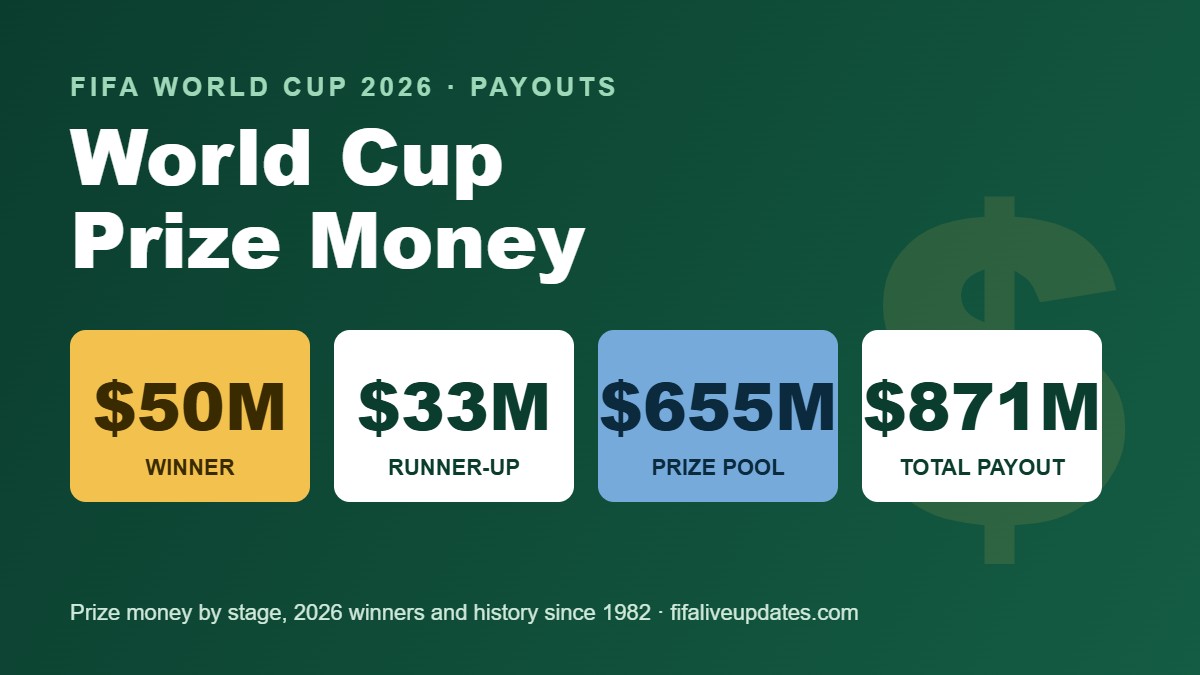
The 2026 FIFA World Cup paid out the biggest prize money in the tournament’s history. The winners, Spain, received $50 million from a performance-based prize pool of $655 million, and FIFA’s total financial distribution to the 48 teams rose to a record $871 million after an increase approved in April 2026. Even the 16 teams that went out in the group stage left with at least $10 million in prize money.
This guide explains World Cup prize money in full: the 2026 payouts by stage, what Spain, Argentina and the other leading teams earned, how the money was increased before the tournament, how prize money has grown since 1982 and how it compares with the Women’s World Cup and the Club World Cup.
World Cup 2026 prize money at a glance
| Item | Amount |
|---|---|
| Total financial distribution to the 48 teams | $871 million (record) |
| Performance-based prize pool | $655 million |
| Winner (Spain) | $50 million |
| Runner-up (Argentina) | $33 million |
| Guaranteed qualification money per team | $10 million (raised from $9 million) |
| Preparation money per team | $2.5 million (raised from $1.5 million) |
| Number of teams | 48 (up from 32 in 2022) |
2026 World Cup prize money by stage
FIFA pays each team one fixed amount based on how far it goes. The amounts are not added together round by round: the winner receives $50 million in total, not $50 million plus the money for each earlier stage. This was the structure approved by the FIFA Council in December 2025:
| Final position | Prize per team | Teams | Total |
|---|---|---|---|
| Winner | $50 million | 1 | $50 million |
| Runner-up | $33 million | 1 | $33 million |
| Third place | $29 million | 1 | $29 million |
| Fourth place | $27 million | 1 | $27 million |
| Quarter-finalists (5th–8th) | $19 million | 4 | $76 million |
| Round of 16 (9th–16th) | $15 million | 8 | $120 million |
| Round of 32 (17th–32nd) | $11 million | 16 | $176 million |
| Group stage (33rd–48th) | $9 million | 16 | $144 million |
| Total | – | 48 | $655 million |
On top of this, every team originally received $1.5 million to cover preparation costs, which brought FIFA’s total package to $727 million when it was first announced.
The April 2026 increase: $871 million
Several national associations raised concerns about the high cost of taking part in a tournament spread across three countries, with long travel distances, expensive accommodation and large delegations. On 28 April 2026, at its meeting in Vancouver, the FIFA Council agreed to increase the total financial distribution by 15% to $871 million.
The main changes were:
- Qualification money, the guaranteed minimum for every team, rose from $9 million to $10 million.
- Preparation money rose from $1.5 million to $2.5 million per team.
- Additional contributions of more than $16 million were added to subsidise team delegation costs and larger ticket allocations for teams.
As a result, every team at the 2026 World Cup was guaranteed at least $12.5 million from FIFA ($10 million plus $2.5 million in preparation money), even if it lost all three group matches. The prize for winning the tournament was reported to remain $50 million, the largest winner’s prize in World Cup history.
How much did Spain earn for winning the World Cup?
Spain beat Argentina 1–0 after extra time in the final at New York New Jersey Stadium on 19 July 2026, with Ferran Torres scoring the winner. That victory earned the Spanish federation the $50 million winner’s prize, plus preparation money. Some outlets reported Spain’s total as about $51 million or more once the extra payments were included.
That is $17 million more than Argentina received as runners-up. In other words, one extra-time goal in the final was worth $17 million to the Spanish federation, before any bonuses for players or commercial gains from becoming world champions. Read the full match story in our World Cup 2026 winner article.
What the leading teams earned in 2026
| Team | Finish | Prize money |
|---|---|---|
| Spain | Champions | $50 million |
| Argentina | Runners-up | $33 million |
| England | Third place | $29 million |
| France | Fourth place | $27 million |
| Quarter-finalists (including Switzerland, Norway and Morocco) | 5th–8th | $19 million each |
| Round of 16 teams (including Egypt and the USA) | 9th–16th | $15 million each |
| Round of 32 teams (including Cape Verde) | 17th–32nd | $11 million each |
England finished third after beating France 6–4 in the third-place match in Miami, which meant a difference of $2 million between the two teams. The figures above are the stage payments; preparation money and other FIFA contributions were paid on top.
World Cup prize money history: 1982 to 2026
Prize money for the World Cup winners has grown more than 35 times since the 1982 tournament in Spain. The table below shows what each champion received.
| World Cup | Host | Winner | Winner’s prize |
|---|---|---|---|
| 1982 | Spain | Italy | $1.4 million |
| 1986 | Mexico | Argentina | $2.2 million |
| 1990 | Italy | West Germany | $3.5 million |
| 1994 | USA | Brazil | $4.5 million |
| 1998 | France | France | $6.4 million |
| 2002 | South Korea and Japan | Brazil | $8.5 million |
| 2006 | Germany | Italy | $12.2 million |
| 2010 | South Africa | Spain | $30.1 million |
| 2014 | Brazil | Germany | $35.1 million |
| 2018 | Russia | France | $38.1 million |
| 2022 | Qatar | Argentina | $42.2 million |
| 2026 | USA, Canada, Mexico | Spain | $50 million |
The biggest single jump came between 2006 and 2010, when the winner’s prize more than doubled from $12.2 million to $30.1 million. Spain were the champions in 2010 too, so the Spanish federation has now collected the winner’s prize at two very different stages of FIFA’s growth: about $30 million in South Africa and $50 million in North America. For every champion and final, see our FIFA World Cup winners list.
Even allowing for inflation, the growth is huge. The $1.4 million Italy received in 1982 is worth roughly $4.7 million in today’s money, less than a tenth of what Spain received in 2026.
2026 vs 2022 vs 2018: prize money compared
| Stage | 2018 Russia | 2022 Qatar | 2026 North America |
|---|---|---|---|
| Winner | $38 million | $42 million | $50 million |
| Runner-up | $28 million | $30 million | $33 million |
| Third place | $24 million | $27 million | $29 million |
| Fourth place | $22 million | $25 million | $27 million |
| Quarter-finals | $16 million | $17 million | $19 million |
| Round of 16 | $12 million | $13 million | $15 million |
| Round of 32 | – | – | $11 million |
| Group stage | $8 million | $9 million | $9–10 million |
| Teams | 32 | 32 | 48 |
| Prize pool | $400 million | $440 million | $655 million |
The 2026 prize pool was roughly 50% larger than in Qatar. Much of that increase was needed simply because there were 16 more teams to pay. The new round of 32 also created an extra prize level of $11 million for teams that got out of their group but lost their first knockout match.
Where does World Cup prize money go?
FIFA pays the prize money to national football associations, not directly to players. Each federation then decides how to use it. In practice, the money is usually split between:
- Player bonuses: most federations agree a bonus structure with their squad before the tournament, often linked to how far the team goes.
- Staff and coaching bonuses: coaches and backroom staff usually receive a share.
- Grassroots and youth football: many federations reinvest part of the money in development programmes, women’s football and facilities.
- Running costs: travel, training camps, accommodation and administration for the national team.
The exact split varies widely. For smaller football nations, a World Cup payment of $10 million or more can be a large share of the federation’s budget for several years. That is one reason qualification matters so much; you can read how teams earn their places in our guide to how World Cup qualification works.
Clubs also benefit indirectly. FIFA runs a separate payment programme for clubs that release players to the World Cup, and an insurance scheme that covers clubs if a player is injured on international duty. These payments are separate from the team prize money shown above.
Women’s World Cup prize money comparison
Prize money at the Women’s World Cup is much smaller, although it has risen quickly. At the 2023 Women’s World Cup in Australia and New Zealand, FIFA’s total prize fund was $110 million, and for the first time FIFA set minimum amounts to be paid directly to each player. Spain won that tournament and received the largest share.
The gap with the men’s game is still very large: the $110 million total for the 2023 Women’s World Cup was only about one-sixth of the $655 million men’s prize pool in 2026. FIFA has said it aims to close the gap in future tournaments. The next Women’s World Cup takes place in Brazil in 2027; see our 2027 Women’s World Cup guide.
World Cup vs Club World Cup prize money
The expanded 32-team FIFA Club World Cup in 2025 had a total prize fund of $1 billion, with up to $125 million available to the winners. Chelsea won that tournament in the United States. On paper, the Club World Cup paid more than the World Cup, because clubs have much higher wage bills and operating costs than national associations. Read our Club World Cup 2025 recap for the full story.
How much is each knockout win worth?
Because FIFA pays a fixed amount for each finishing position, it is easy to work out what each win was worth in 2026. The table below shows the extra prize money a team earned by going one stage further, using the stage amounts from the main prize table.
| Step | From | To | Extra prize money |
|---|---|---|---|
| Getting out of the group | $9 million | $11 million | +$2 million |
| Winning a round of 32 match | $11 million | $15 million | +$4 million |
| Winning a round of 16 match | $15 million | $19 million | +$4 million |
| Winning a quarter-final | $19 million | $27 million or more | +$8 million at least |
| Winning the third-place match | $27 million | $29 million | +$2 million |
| Winning the final | $33 million | $50 million | +$17 million |
The final is by far the most valuable match. Winning it was worth $17 million on its own, more than double the value of any other single win. By contrast, the third-place match was worth only $2 million, which is one reason teams often rotate their squads for that game.
The quarter-final is the other big step. Losing in the last eight earned $19 million, but reaching the semi-finals guaranteed at least $27 million, because even the team that finishes fourth earns more than every quarter-finalist.
How the 48-team format changed the money
The move from 32 to 48 teams changed the prize structure in three important ways.
- More teams paid: 16 extra nations each received at least the minimum payment, which alone added well over $100 million to the bill.
- A new prize level: the round of 32 created a new $11 million tier between the group stage and the round of 16.
- One more match for the finalists: the champions and runners-up played eight matches instead of seven, which raised costs for the deepest-running teams.
For first-time qualifiers and smaller nations, the expanded format was a financial breakthrough. Cape Verde, for example, reached the round of 32 and earned $11 million in stage money, before losing a close match to Argentina.
Key dates for 2026 World Cup prize money
| Date | Event |
|---|---|
| December 2025 (announced 17 December) | FIFA Council approves a $727 million package, including a $655 million prize pool and $50 million for the winner |
| 28 April 2026 | FIFA Council in Vancouver raises the total by 15% to $871 million |
| 11 June 2026 | The 2026 World Cup kicks off |
| 19 July 2026 | Spain beat Argentina 1–0 after extra time in the final and win the $50 million prize |
Prize money is only part of the value of winning
The $50 million prize is the headline figure, but it is only one part of what a World Cup win is worth. A successful tournament can also bring:
- Higher sponsorship income: federations of world champions can usually negotiate bigger kit and sponsorship deals.
- More valuable friendlies: champions can charge higher fees to play international friendlies and tours.
- Player value: players who shine at a World Cup often see their transfer value and wages rise at club level.
- Tourism and national mood: governments and economists often point to wider benefits, although these are hard to measure.
For the federations that only reach the group stage, the guaranteed payment is still extremely important. For many of them, it covers years of youth development, coaching courses and women’s football programmes.
Why World Cup prize money keeps rising
The growth in prize money follows the growth in FIFA’s income. Almost all of FIFA’s revenue comes from the men’s World Cup, through broadcasting rights, sponsorship, ticketing and hospitality. The 2026 tournament, with 48 teams, 104 matches and huge stadiums across the United States, Canada and Mexico, was the biggest commercial event in FIFA’s history.
FIFA said the April 2026 increase was possible because of the commercial success of the tournament. At the same time, national associations faced higher costs than ever, with long flights between host cities and expensive accommodation in North American cities. Higher preparation money and the extra delegation subsidies were designed to make sure smaller nations did not lose money by taking part.
Looking ahead, the 2030 World Cup in Spain, Portugal and Morocco, with centenary matches in South America, will also have 48 teams, so another increase is likely. See our 2030 World Cup guide for dates and format.
FAQs about World Cup prize money
How much prize money does the World Cup winner get?
The winner of the 2026 World Cup received $50 million, the largest winner’s prize in the tournament’s history. Spain won it by beating Argentina 1–0 after extra time in the final.
What is the total prize money for the 2026 World Cup?
The performance-based prize pool was $655 million. Including preparation money, qualification payments and other contributions, FIFA’s total distribution to the 48 teams was $871 million after the April 2026 increase.
How much did the runner-up get at the 2026 World Cup?
Argentina received $33 million as runners-up, $17 million less than Spain.
How much does a team get for playing in the World Cup?
After the April 2026 increase, every team was guaranteed $10 million in qualification money plus $2.5 million in preparation money, a minimum of $12.5 million, even if it was knocked out in the group stage.
Do players receive World Cup prize money directly?
No. At the men’s World Cup, FIFA pays prize money to national football associations. Each federation then agrees its own bonus payments with its players.
How much did Argentina get for winning the 2022 World Cup?
Argentina received about $42 million for winning the 2022 World Cup in Qatar, from a total prize pool of $440 million.
Has World Cup prize money increased over time?
Yes, a lot. The winner’s prize has grown from $1.4 million in 1982 to $50 million in 2026, and the total pool from $400 million in 2018 to $655 million in 2026.
For a full overview of the tournament, see our FIFA World Cup 2026 guide and the details of the 2026 World Cup final.
Sources
- FIFA: Council increases record financial distribution for World Cup 2026
- Al Jazeera: World Cup 2026 winners’ prize money rises to $50m
- Sports Illustrated: 2026 World Cup prize money breakdown
- World Soccer Talk: Record $871m financial distribution
- Striker Report: What every team earned at World Cup 2026