
Updated: October 2026. FIFA Live Updates is an independent fan website and is not affiliated with FIFA.
The 2026 FIFA World Cup final was played on Sunday, 19 July 2026 at New York New Jersey Stadium (MetLife Stadium) in East Rutherford, New Jersey. Spain beat Argentina 1–0 after extra time to win the World Cup for the second time. This page covers the date and venue, the tournament schedule that led up to the final, each finalist’s route, and the key facts from the match itself.
Final at a glance
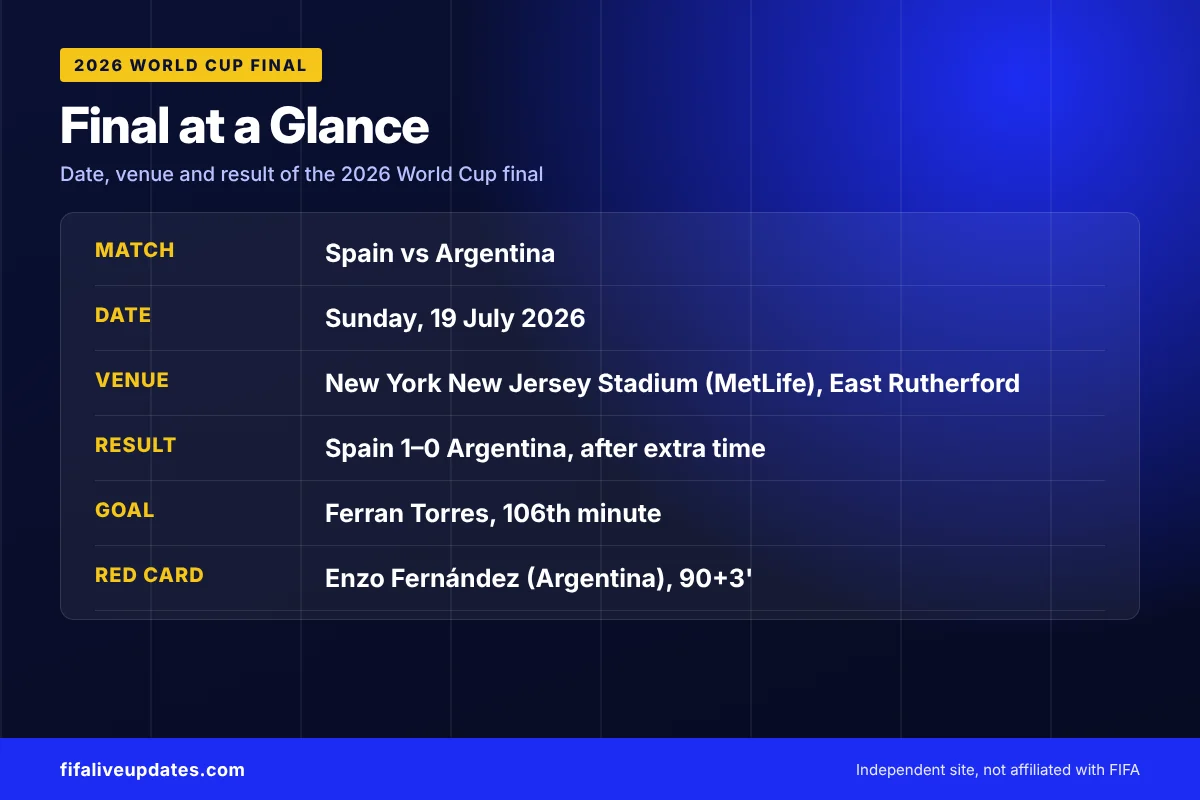
| Date | Sunday, 19 July 2026 |
| Venue | New York New Jersey Stadium (MetLife Stadium), East Rutherford, New Jersey, USA |
| Match | Spain vs Argentina (match 104) |
| Result | Spain 1–0 Argentina (after extra time; 0–0 after 90 minutes) |
| Goal | Ferran Torres, 106th minute |
| Referee | Slavko Vinčič (Slovenia) |
The 2026 World Cup schedule
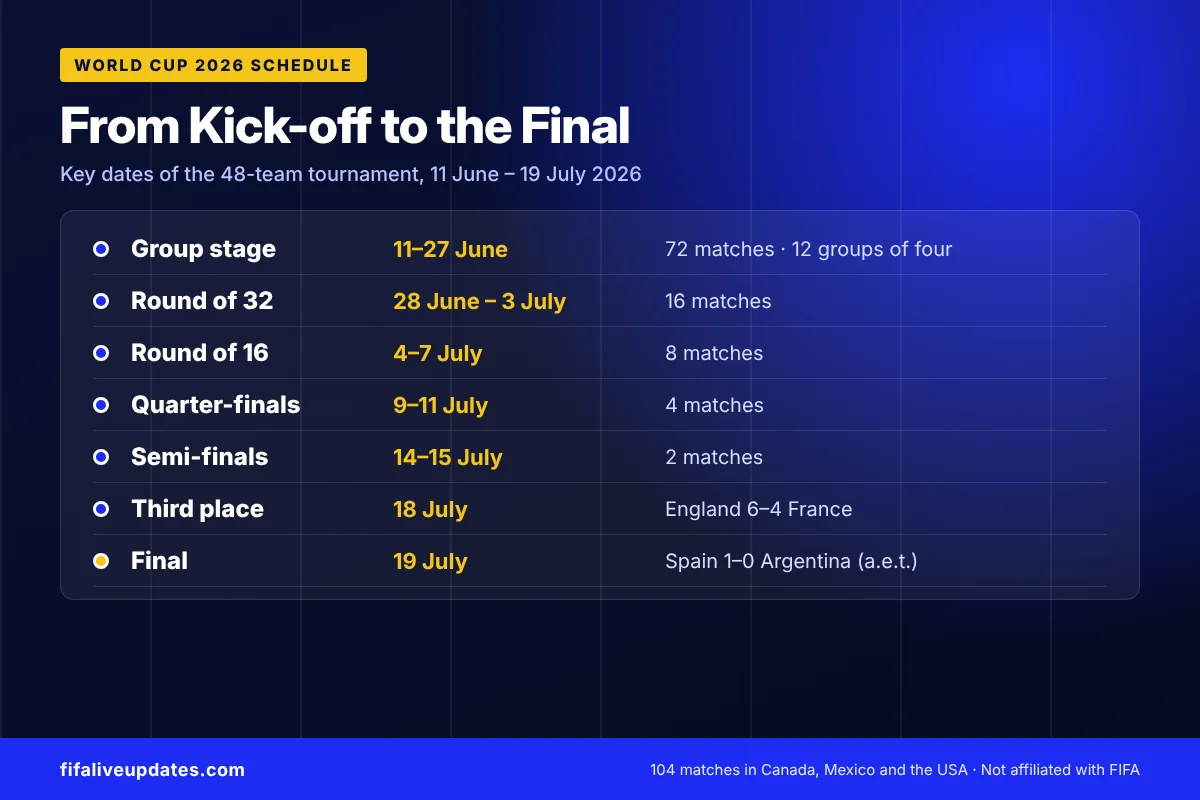
The 48-team format added a Round of 32, so the tournament lasted 39 days and the finalists each played eight matches instead of seven.
| Stage | Dates (2026) | Notes |
|---|---|---|
| Opening match | 11 June | Mexico 2–0 South Africa, Mexico City Stadium (Estadio Azteca) |
| Group stage | 11–27 June | 72 matches, 12 groups of four |
| Round of 32 | 28 June – 3 July | 16 matches |
| Round of 16 | 4–7 July | 8 matches |
| Quarter-finals | 9–11 July | Boston, Los Angeles, Miami and Kansas City |
| Semi-finals | 14–15 July | Dallas Stadium (AT&T Stadium) and Atlanta Stadium (Mercedes-Benz Stadium) |
| Third-place match | 18 July | Miami Stadium (Hard Rock Stadium): England 6–4 France |
| Final | 19 July | New York New Jersey Stadium: Spain 1–0 Argentina (a.e.t.) |
Spain’s route to the final
- Group H: winners with 7 points, scoring five goals and conceding none.
- Round of 32: Spain 3–0 Austria (Los Angeles)
- Round of 16: Portugal 0–1 Spain (Dallas)
- Quarter-final: Spain 2–1 Belgium (Los Angeles)
- Semi-final: France 0–2 Spain (Dallas)
Argentina’s route to the final
- Group J: winners with maximum 9 points, scoring eight goals and conceding one.
- Round of 32: Argentina 3–2 Cape Verde, after extra time (Miami)
- Round of 16: Argentina 3–2 Egypt (Atlanta)
- Quarter-final: Argentina 3–1 Switzerland, after extra time (Kansas City)
- Semi-final: England 1–2 Argentina (Atlanta). Anthony Gordon scored for England; Enzo Fernández and Lautaro Martínez replied late.
Group stage results for both finalists
Neither finalist lost a match on the way to New Jersey, but they arrived by very different routes. Spain were built on defence: after an opening draw they did not concede a goal in the group. Argentina scored freely in Group J but needed extra time twice in the knockout rounds.
| Team | Opponent | Result |
|---|---|---|
| Spain | Cape Verde | 0–0 |
| Spain | Saudi Arabia | 4–0 |
| Spain | Uruguay | 1–0 |
| Argentina | Algeria | 3–0 |
| Argentina | Austria | 2–0 |
| Argentina | Jordan | 3–1 |
Spain’s goalless opener against Cape Verde made them the first eventual champions since Argentina in 2022 not to win their first match. Argentina, by contrast, had the more dramatic knockout path, with extra-time wins over Cape Verde and Switzerland and a late comeback against England in the semi-final.
How the final was decided
The match was goalless after 90 minutes. Argentina were reduced to ten men in stoppage time at the end of normal time, when Enzo Fernández received a second yellow card. In the first minute of the second period of extra time, Pedro Porro crossed to the far post, Nico Williams headed the ball back across goal and substitute Ferran Torres finished to score the only goal. Spain held on to add the 2026 title to their 2010 triumph.
Spain conceded only one goal in their eight matches, and goalkeeper Unai Simón won the Golden Glove. Coach Luis de la Fuente became the oldest coach to win the World Cup. For the full awards list and top scorers, see our World Cup 2026 winner and awards page.
Match report: how the final unfolded
The final was a contest of control against resistance. Spain kept the ball for long spells and created most of the chances; Argentina defended deep, relied on goalkeeper Emiliano Martínez and looked to break through Lionel Messi. Two disallowed goals, a red card and a goalkeeping record made it one of the more eventful goalless 90 minutes in a final.
First half
Lamine Yamal produced the first effort after five minutes, a shot that deflected off Lisandro Martínez and was saved by his namesake in goal. It was the only attempt of the opening 25 minutes. At the other end Unai Simón came off his line to block Julián Álvarez, the closest Argentina came to a clear chance before the break.
Mikel Oyarzabal had a shot saved just before the interval and Marc Cucurella dragged an effort wide. Lisandro Martínez was booked for a late challenge and later went off injured. Argentina did not register a single shot in the first half.
Second half
Both coaches turned to their benches. Luis de la Fuente sent on Pedri and Ferran Torres around the hour, then Nico Williams and Mikel Merino; Lionel Scaloni brought on Leandro Paredes, Nahuel Molina, Giuliano Simeone and others. Torres soon forced a save with a header, and Pedri and Pau Cubarsí both tested Martínez.
Argentina’s discipline began to fray. Enzo Fernández was booked, then in stoppage time he was shown a second yellow card for a tackle on Cubarsí and sent off, a decision confirmed after a VAR check. Martínez still had time to keep out a Yamal free kick, and the match went to extra time at 0–0. For how video review works in decisions like these, see our guide to the offside rule and VAR.
Extra time
Against ten men, Spain kept pushing. Williams had a header saved and then had the ball in the net, only for the goal to be ruled out for a foul in the box. The breakthrough came straight after the restart for the second period of extra time: Pedro Porro crossed, Williams headed back across goal and Torres finished from close range.
Torres later had a second goal ruled out for offside. Argentina’s first shot of the entire match did not come until the 117th minute, when a Messi volley struck Merino in the face, and Simeone’s late effort flew over. Spain saw the game out to become champions.
Final statistics
The numbers reflect how one-sided the match was in terms of chances, even if the scoreline was tight.
| Statistic | Spain | Argentina |
|---|---|---|
| Goals | 1 | 0 |
| Total shots | 20 | 2 |
| Shots on target | 12 | 0 |
| Possession | 60% | 32% (8% in contest) |
| Corners | 9 | 4 |
| Fouls won | 21 | 25 |
| Yellow cards | 0 | 6 |
| Red cards | 0 | 1 |
Source: FIFA official match statistics.
Unai Simón kept his seventh clean sheet of the tournament, a record for a single World Cup.
Records and talking points
- No shots in 90 minutes: Argentina did not manage a single attempt on goal until extra time.
- Super-sub winner: Torres came off the bench to score the 106th-minute winner.
- Meanest champions: Spain conceded one goal in eight matches, the fewest by any World Cup winner.
- Unbeaten run: the win extended Spain’s unbeaten run in regular time to 38 matches.
- Two teenagers in a final: Spain were the first side to field two teenagers in a World Cup final, Lamine Yamal and Pau Cubarsí.
- Men’s and women’s titles: with the 2023 Women’s World Cup already won, Spain became the first nation to hold both World Cup titles at the same time.
- Messi’s third final: Lionel Messi joined Cafu as only the second player to appear in three World Cup finals.
- Extra time is the norm: five of the last six World Cup finals have gone to extra time.
- Red cards: Fernández was only the sixth player sent off in a World Cup final; Argentina have now had three of the six.
- Half-time show: it was the first World Cup final to feature a half-time show.
After the final: trophy and disciplinary action
Spain also dominated the individual awards, with Rodri winning the Golden Ball. See the full list in our 2026 World Cup winner and awards guide.
The final ended in ugly scenes, with several confrontations between the two squads after the whistle. In August 2026 FIFA’s disciplinary committee suspended Leandro Paredes for ten matches and Nahuel Molina for seven, with assistant coach Roberto Ayala also banned, alongside fines.
Argentina finished as runners-up for the fourth time (1930, 1990, 2014 and 2026), equalling Germany’s record for lost finals.
Why Spain won: three deciding factors
1. Control of the ball
Spain had close to two-thirds of possession and used it to keep Argentina pinned back. Rodri and Cubarsí each completed more than 100 passes, something only a handful of players have managed in a World Cup final. Argentina spent most of the afternoon without the ball, which explains why they went the entire 90 minutes without a shot.
2. A defence that barely conceded
Spain’s back line and goalkeeper Unai Simón allowed one goal in the whole tournament, against Belgium in the quarter-final. In the final Argentina’s attackers, including Messi and Julián Álvarez, rarely got into shooting positions, and Simón was hardly tested.
3. The impact of the bench
De la Fuente’s changes decided the match. Ferran Torres, Nico Williams and Mikel Merino all came on in the second half, and the winning goal came from two of them: Williams set it up and Torres scored. With Argentina reduced to ten men by the end of normal time, the extra legs and width from Spain’s substitutes made the difference.
Argentina deserve credit for their resistance. Emiliano Martínez’s record-breaking performance kept them in the match for 105 minutes, and on another day a single counter-attack could have won it. But over 120 minutes Spain’s volume of chances eventually told.
Why New York New Jersey hosted the final
FIFA confirmed the final venue in February 2024 when it published the match schedule. MetLife Stadium, home of the NFL’s New York Giants and New York Jets, was among the largest venues available, with a tournament capacity of 80,663 according to FIFA. It is an open-air stadium; natural grass was installed for the tournament.
Ticket prices for the final
FIFA used variable (demand-based) pricing for 2026. At the start of sales in September 2025 the most expensive standard ticket for the final was listed at $6,730, and the Associated Press reported in April 2026 that the top price had risen to $10,990. Official match-day parking for the final was reported to have sold out months in advance.
World Cup finals in the United States: 1994 and 2026
This was the second men’s World Cup final staged in the United States. The first was in 1994 at the Rose Bowl in Pasadena, California, where Brazil and Italy drew 0–0 after extra time and Brazil won on penalties. That tournament still holds a special place in American football history because it helped launch Major League Soccer.
The two finals have something in common: in both cases the first 90 minutes passed without a goal. The difference in 2026 was that Spain found a winner in extra time, so no penalty shoot-out was needed. The final also completed a tournament shared by three host nations, with matches in the United States, Mexico and Canada. Our 2026 World Cup guide explains the format, the 16 host cities and how the 48-team draw worked.
Spain’s place in World Cup history
Spain’s first world title came in South Africa in 2010, when they also beat their opponents 1–0 after extra time, with Andrés Iniesta scoring late against the Netherlands. Sixteen years later the pattern repeated itself: a patient, possession-based side, a tight final and a goal in the second half of extra time.
With two titles, Spain move level with countries such as Uruguay and France on the list of multiple winners, behind Brazil (five), Germany and Italy (four each) and Argentina (three). See the full roll of honour in our FIFA World Cup winners list.
Spain also became only the second European nation to win a World Cup held in the Americas, after Germany in Brazil in 2014. For Argentina, the defeat ended their bid to retain the trophy they won in Qatar in 2022 and to claim a fourth title.
Messi and the scoring records
The final was Lionel Messi’s third, after 2014 and 2022, and at 39 he became one of the oldest players to appear in the showpiece. He was kept quiet in New Jersey, while Mbappé’s 10 goals in the tournament took him past Messi as the all-time leading scorer at men’s World Cups. The full picture is in our World Cup all-time top scorers list.
What comes next: the 2030 World Cup
Spain will be among the hosts of the next men’s World Cup. The 2030 tournament will be co-hosted by Spain, Portugal and Morocco, with three centenary matches in Uruguay, Argentina and Paraguay to mark 100 years since the first World Cup. That means the reigning champions will defend their title partly on home soil. Read more in our 2030 World Cup hosts, dates and format guide.
Frequently asked questions
When was the 2026 World Cup final?
Sunday, 19 July 2026.
Where was the 2026 World Cup final played?
At New York New Jersey Stadium, the tournament name for MetLife Stadium in East Rutherford, New Jersey.
Who won the 2026 World Cup final?
Spain, who beat Argentina 1–0 after extra time with a goal from Ferran Torres.
Who scored the winning goal in the 2026 World Cup final?
Substitute Ferran Torres, in the 106th minute, at the start of the second period of extra time. Nico Williams headed Pedro Porro’s cross back across goal for him to finish.
Was anyone sent off in the 2026 World Cup final?
Yes. Argentina midfielder Enzo Fernández received a second yellow card in stoppage time at the end of normal time, so Argentina played all of extra time with ten men.
When and where is the next World Cup?
The 2030 World Cup will be hosted by Spain, Portugal and Morocco, with opening centenary matches in South America.
Related articles
- All 2026 World Cup knockout results
- The 16 World Cup 2026 stadiums
- FIFA PASS and World Cup parking prices